Stake attention in this memory
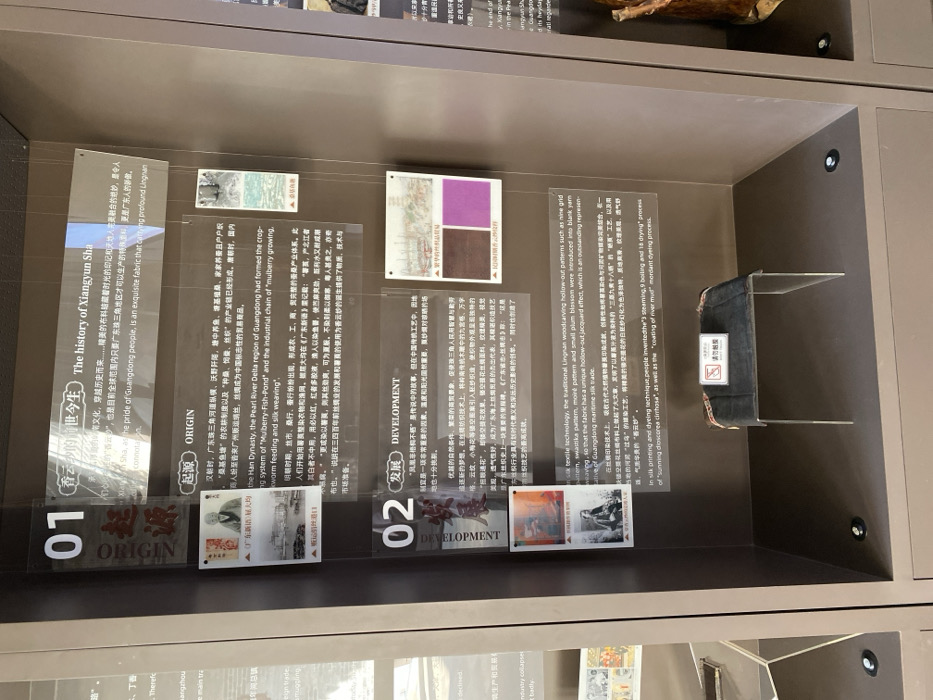
This image displays an educational exhibit detailing "The history of Xiangyun Sha" at a museum in Guang Zhou Shi, China. The display consists of clear acrylic panels featuring both Chinese and English text, alongside various illustrative historical images. The panels are divided into two main sections: "01 ORIGIN" and "02 DEVELOPMENT." The "ORIGIN" section describes the formation of the "Mulberry-Fish-Pond" crop-raising system and the industrial chain of mulberry growing, silkworm feeding, and silk weaving in the Pearl River Delta region since the Han Dynasty. It highlights how silk became a key trade commodity and mentions the use of "dioscorea cirrhosa" for dyeing. The text describes Xiangyun Sha as "an exquisite fabric" and "the pride of Guangdong people, carrying profound Lingnan connotation." The "DEVELOPMENT" section details advances in textile technology, such as the integration of traditional Lingnan woodcarving patterns like "nine grid pattern, swastika pattern, moiré pattern and small plum blossom" into weaving to create a "hollow-out jacquard effect." It also explains innovations in silk printing and dyeing techniques, including a "steaming, 9 boiling and 18 drying process" and the "coating of river mud" mordant dyeing process. To the right, a folded sample of dark fabric, likely Xiangyun Sha, is presented on a clear acrylic stand, accompanied by a "请勿触摸" (Do not touch) sign. The exhibit is well-lit by overhead spotlights, creating a focused and informative presentation on the cultural and historical significance of this unique fabric.
Loading AttnAds…
No transactions found