
Sign in
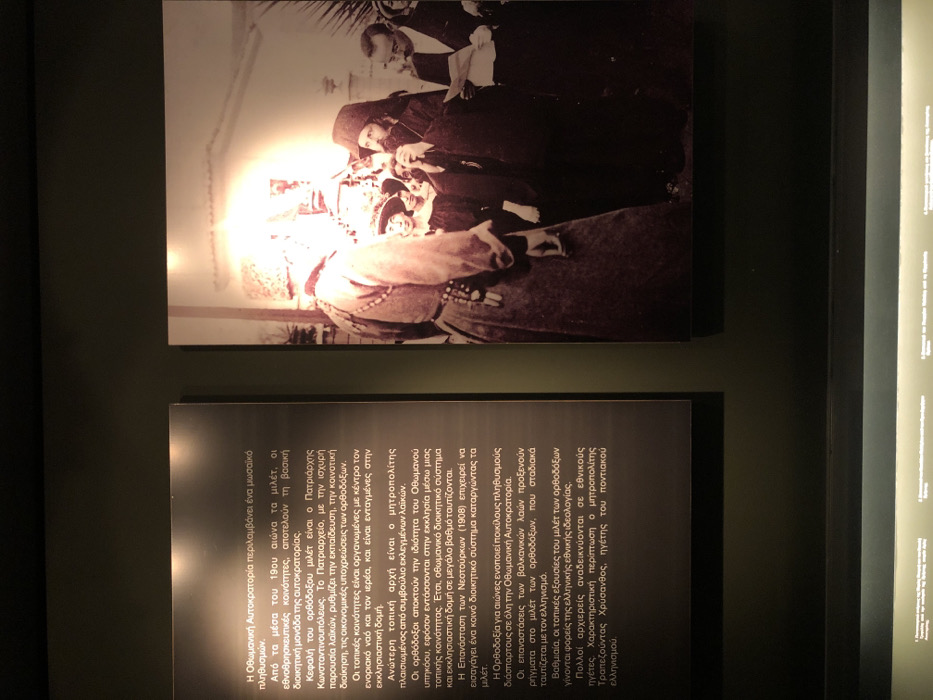
The image displays a black and white historical photograph mounted on a dark wall, alongside a descriptive text plaque. The photograph features several individuals, predominantly men, dressed in traditional or formal attire, likely robes and head coverings, suggesting a religious or official context. They are gathered closely, with some appearing to interact or observe. A bright light source in the center of the image creates a glare, obscuring some details of the figures, particularly in the foreground where one person wears a heavily embellished garment with beads. The setting appears to be an indoor or semi-outdoor space, possibly a formal gathering.

The accompanying Greek text, positioned below the photograph, provides historical context. It discusses the Ottoman Empire's diverse population and the millet system, where ethnoreligious communities like the Orthodox had their own administrative structures. It highlights the Patriarch of Constantinople as the head of the Orthodox millet, overseeing education, community administration, and finances. The text explains that Orthodox communities were organized around local churches and priests, with metropolitan bishops and elected lay councils forming higher regional authorities. It mentions how Orthodox individuals gained Ottoman subject status through their church membership. The text further notes that the Young Turk Revolution of 1908 attempted to introduce a unified administrative system, abolishing the millets. It concludes by describing how the Orthodox Church, which had historically unified diverse populations across the Ottoman Empire, experienced fragmentation with the rise of Balkan national movements, leading to the gradual alignment of the Orthodox millet with Hellenism. It cites Metropolitan Chrysanthos of Trebizond as a significant figure in this context, an example of church leaders becoming national figures for the Pontic Greeks.
FM-nSho83

Jan 10, 2025

Nea Filadelfia, Greece

Stake attention in this memory

The image displays a black and white historical photograph mounted on a dark wall, alongside a descriptive text plaque. The photograph features several individuals, predominantly men, dressed in traditional or formal attire, likely robes and head coverings, suggesting a religious or official context. They are gathered closely, with some appearing to interact or observe. A bright light source in the center of the image creates a glare, obscuring some details of the figures, particularly in the foreground where one person wears a heavily embellished garment with beads. The setting appears to be an indoor or semi-outdoor space, possibly a formal gathering. The accompanying Greek text, positioned below the photograph, provides historical context. It discusses the Ottoman Empire's diverse population and the millet system, where ethnoreligious communities like the Orthodox had their own administrative structures. It highlights the Patriarch of Constantinople as the head of the Orthodox millet, overseeing education, community administration, and finances. The text explains that Orthodox communities were organized around local churches and priests, with metropolitan bishops and elected lay councils forming higher regional authorities. It mentions how Orthodox individuals gained Ottoman subject status through their church membership. The text further notes that the Young Turk Revolution of 1908 attempted to introduce a unified administrative system, abolishing the millets. It concludes by describing how the Orthodox Church, which had historically unified diverse populations across the Ottoman Empire, experienced fragmentation with the rise of Balkan national movements, leading to the gradual alignment of the Orthodox millet with Hellenism. It cites Metropolitan Chrysanthos of Trebizond as a significant figure in this context, an example of church leaders becoming national figures for the Pontic Greeks.

transactions
revenues
stakers
Earliest
Latest
Highest stake

No transactions found

More from this user

More from Nea Filadelfia

FM-nSho83

Jan 10, 2025

Nea Filadelfia, Greece

Licensed under Creative Commons Attribution 4.0 International License. You are free to share and adapt this content with proper attribution.