Sign in
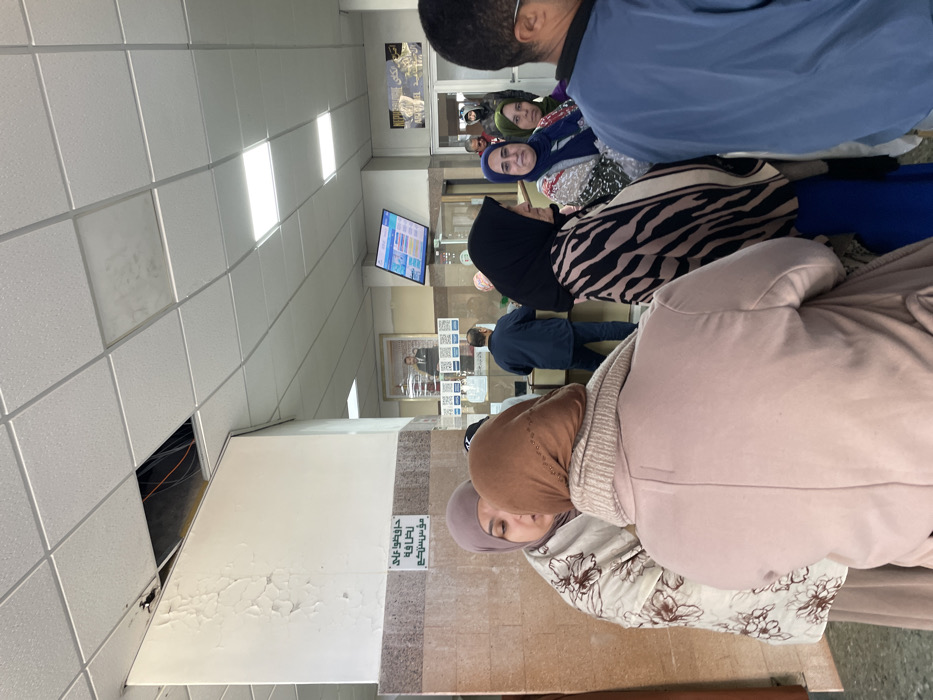
The image captures an indoor scene in Dar-el-Beida, Morocco, showing a group of people, primarily women wearing hijabs, queuing or waiting in what appears to be a public service area or office. The overall setting suggests a functional, possibly institutional, environment.

In the foreground, a woman wearing a light brown hijab and a beige sweater over a floral patterned top is partially visible from behind. To her left, another woman in a black hijab and a black and white striped top is visible, looking towards the right side of the frame. Further back in the queue, several other women, also mostly in hijabs and modest clothing, are visible, along with a man wearing glasses and a blue shirt, seen from behind. One woman in the middle of the queue looks directly at the camera with a slight smile.

The room features a white acoustic tile ceiling with rectangular fluorescent lights, some of which are illuminated. One ceiling tile on the far left is missing, revealing a tangle of wires within the ceiling cavity. The walls have a two-tone design, with a lower section covered in what appears to be beige and brown marble or tile, and an upper section painted white. A section of the painted wall on the left exhibits noticeable peeling paint.

On the back wall, a small digital display screen shows some text or graphics, and below it, a framed portrait (possibly of a dignitary) is mounted, flanked by multiple QR codes. Above the framed portrait, a decorative banner with Arabic script is visible. Another sign on the wall, to the left of the peeled paint area, clearly displays Arabic text: "حاولوا بعدم إلقاء كل أنواع القمامة في سلة المهملات," which translates to "Try not to throw all kinds of trash in the waste bin," indicating a request for proper waste disposal. The overall impression is of a busy public space, likely a government office or clinic, consistent with the identified location.
F
FM-tnTx53

Jan 21, 2025

Dar-el-Beida, Morocco

Stake attention in this memory

The image captures an indoor scene in Dar-el-Beida, Morocco, showing a group of people, primarily women wearing hijabs, queuing or waiting in what appears to be a public service area or office. The overall setting suggests a functional, possibly institutional, environment. In the foreground, a woman wearing a light brown hijab and a beige sweater over a floral patterned top is partially visible from behind. To her left, another woman in a black hijab and a black and white striped top is visible, looking towards the right side of the frame. Further back in the queue, several other women, also mostly in hijabs and modest clothing, are visible, along with a man wearing glasses and a blue shirt, seen from behind. One woman in the middle of the queue looks directly at the camera with a slight smile. The room features a white acoustic tile ceiling with rectangular fluorescent lights, some of which are illuminated. One ceiling tile on the far left is missing, revealing a tangle of wires within the ceiling cavity. The walls have a two-tone design, with a lower section covered in what appears to be beige and brown marble or tile, and an upper section painted white. A section of the painted wall on the left exhibits noticeable peeling paint. On the back wall, a small digital display screen shows some text or graphics, and below it, a framed portrait (possibly of a dignitary) is mounted, flanked by multiple QR codes. Above the framed portrait, a decorative banner with Arabic script is visible. Another sign on the wall, to the left of the peeled paint area, clearly displays Arabic text: "حاولوا بعدم إلقاء كل أنواع القمامة في سلة المهملات," which translates to "Try not to throw all kinds of trash in the waste bin," indicating a request for proper waste disposal. The overall impression is of a busy public space, likely a government office or clinic, consistent with the identified location.

transactions
revenues
stakers
Earliest
Latest
Highest stake

No transactions found

More from this user

More from Dar-el-Beida

FFM-tnTx53

Jan 21, 2025

Dar-el-Beida, Morocco

Licensed under Creative Commons Attribution 4.0 International License. You are free to share and adapt this content with proper attribution.