Sign in
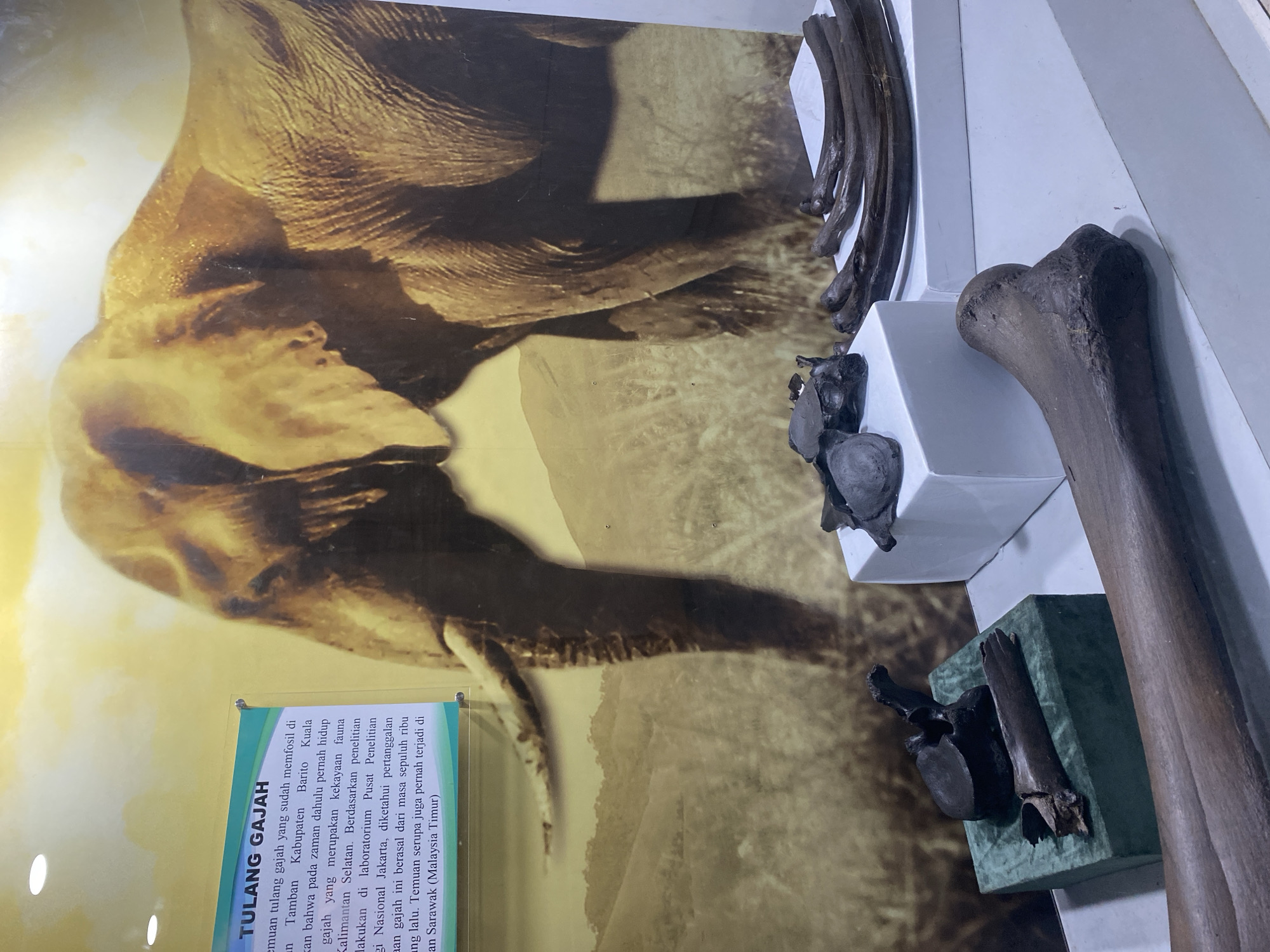
The image depicts an exhibit displaying fossilized elephant bones. A large informational placard, titled "TULANG GAJAH" (Elephant Bone), is visible on the left side of the frame. The text on the placard indicates that these fossilized elephant remains were found in Tamban, Kabupaten Barito Kuala, and were part of a fauna that lived in ancient times in South Kalimantan. Research conducted at the National Research Center in Jakarta suggests the bones date back approximately ten thousand years. Similar findings have also occurred in Sarawak, East Malaysia.

In the foreground, various bone fragments are displayed on pedestals. One prominent object is a large, thick bone, possibly a femur, positioned horizontally. To its left, on a green velvet-covered block, sits a dark, irregular bone fragment, likely a vertebra, and a smaller, broken bone piece. Further back, on white pedestals, are several curved, dark brown bone pieces, possibly ribs or tusks, and some smaller, dark, fragmented objects.

The background of the exhibit features a large photographic mural of an elephant, with its body and legs prominently displayed. The mural is set against a backdrop of hills and savanna-like vegetation, creating an immersive environment. The lighting in the exhibit appears to be artificial, casting illumination on the displayed objects and the mural. The overall scene suggests a museum or educational display focused on paleontology and natural history.
Eyachan

Jul 18, 2026, 5:08 AM

Banjarbaru, Indonesia

Stake attention in this memory

awe
curiosity
nostalgia
wonder
discovery

The image depicts an exhibit displaying fossilized elephant bones. A large informational placard, titled "TULANG GAJAH" (Elephant Bone), is visible on the left side of the frame. The text on the placard indicates that these fossilized elephant remains were found in Tamban, Kabupaten Barito Kuala, and were part of a fauna that lived in ancient times in South Kalimantan. Research conducted at the National Research Center in Jakarta suggests the bones date back approximately ten thousand years. Similar findings have also occurred in Sarawak, East Malaysia. In the foreground, various bone fragments are displayed on pedestals. One prominent object is a large, thick bone, possibly a femur, positioned horizontally. To its left, on a green velvet-covered block, sits a dark, irregular bone fragment, likely a vertebra, and a smaller, broken bone piece. Further back, on white pedestals, are several curved, dark brown bone pieces, possibly ribs or tusks, and some smaller, dark, fragmented objects. The background of the exhibit features a large photographic mural of an elephant, with its body and legs prominently displayed. The mural is set against a backdrop of hills and savanna-like vegetation, creating an immersive environment. The lighting in the exhibit appears to be artificial, casting illumination on the displayed objects and the mural. The overall scene suggests a museum or educational display focused on paleontology and natural history.

Loading AttnAds…

transactions
revenues
stakers
Earliest
Latest
Highest stake

No transactions found

More from this user

More from Banjarbaru

Eyachan

Jul 18, 2026, 5:08 AM

Banjarbaru, Indonesia

Licensed under Creative Commons Attribution 4.0 International License. You are free to share and adapt this content with proper attribution.