Sign in
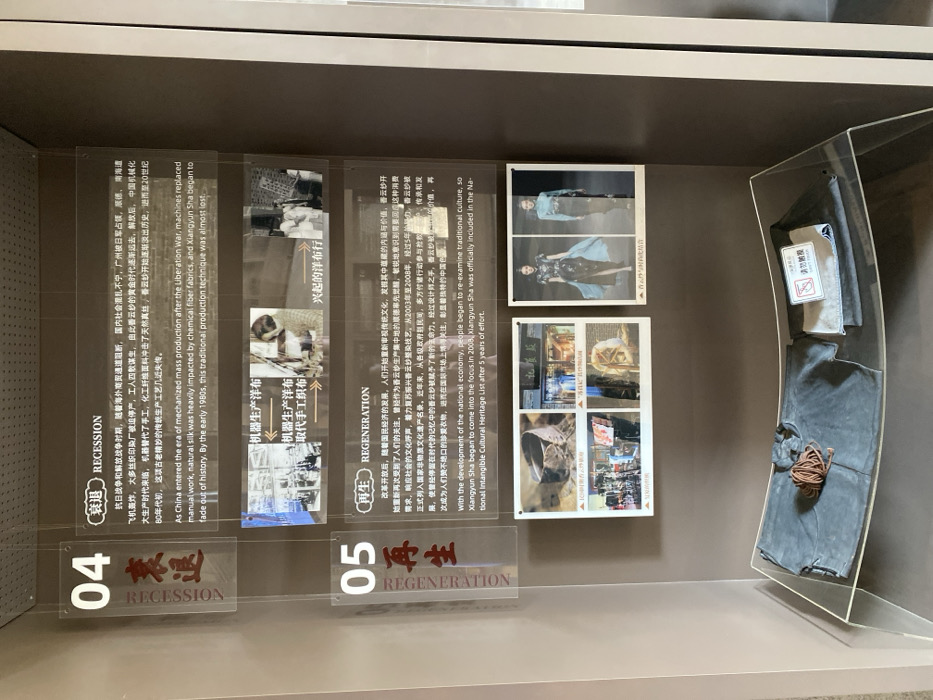
This image captures an indoor museum or exhibition display showcasing the history and revival of Xiangyun Sha (香云纱) fabric. The exhibit consists of two main information panels and a glass display case with artifacts.

Panel 04 is titled "衰退 RECESSION" in both Chinese and English. Its text details the decline of Xiangyun Sha production in China, mentioning how the Anti-Japanese War and Liberation War disrupted trade, and how mechanized mass production, chemical fibers, and factory bombings led to the near loss of this traditional technique by the early 1980s. Small black and white images on this panel illustrate machine-produced fabrics replacing traditional hand-weaving.

Panel 05 is labeled "再生 REGENERATION," also in both languages. This section describes the re-examination of traditional culture after China's economic development, leading to a renewed interest in Xiangyun Sha. It highlights Shunde's efforts in its revival and its official inclusion in the National Intangible Cultural Heritage List in 2008. The panel features several color photographs, including models wearing contemporary garments possibly made from Xiangyun Sha, and images of workshops or street scenes related to its production, such as fabric drying outdoors.

To the right, a clear glass display case holds several folded pieces of dark, possibly dyed, fabric, likely Xiangyun Sha samples. A brown braided cord rests on one of the fabric pieces. Inside the case, a small white sign with Chinese characters "请勿触摸" (Please do not touch) is visible, indicating the historical or cultural value of the displayed items.

The exhibit's presentation is clean and informative, using a chronological narrative to tell the story of Xiangyun Sha, from its near disappearance to its regeneration as a recognized cultural heritage. The presence of both Chinese and English text suggests it caters to a diverse audience.
F
FM-CaIMM2

Dec 19, 2024, 6:52 AM

Guang Zhou Shi, China

Stake attention in this memory

This image captures an indoor museum or exhibition display showcasing the history and revival of Xiangyun Sha (香云纱) fabric. The exhibit consists of two main information panels and a glass display case with artifacts. Panel 04 is titled "衰退 RECESSION" in both Chinese and English. Its text details the decline of Xiangyun Sha production in China, mentioning how the Anti-Japanese War and Liberation War disrupted trade, and how mechanized mass production, chemical fibers, and factory bombings led to the near loss of this traditional technique by the early 1980s. Small black and white images on this panel illustrate machine-produced fabrics replacing traditional hand-weaving. Panel 05 is labeled "再生 REGENERATION," also in both languages. This section describes the re-examination of traditional culture after China's economic development, leading to a renewed interest in Xiangyun Sha. It highlights Shunde's efforts in its revival and its official inclusion in the National Intangible Cultural Heritage List in 2008. The panel features several color photographs, including models wearing contemporary garments possibly made from Xiangyun Sha, and images of workshops or street scenes related to its production, such as fabric drying outdoors. To the right, a clear glass display case holds several folded pieces of dark, possibly dyed, fabric, likely Xiangyun Sha samples. A brown braided cord rests on one of the fabric pieces. Inside the case, a small white sign with Chinese characters "请勿触摸" (Please do not touch) is visible, indicating the historical or cultural value of the displayed items. The exhibit's presentation is clean and informative, using a chronological narrative to tell the story of Xiangyun Sha, from its near disappearance to its regeneration as a recognized cultural heritage. The presence of both Chinese and English text suggests it caters to a diverse audience.

Loading AttnAds…

transactions
revenues
stakers
Earliest
Latest
Highest stake

No transactions found

More from this user

More from Guang Zhou Shi

FFM-CaIMM2

Dec 19, 2024, 6:52 AM

Guang Zhou Shi, China

Licensed under Creative Commons Attribution 4.0 International License. You are free to share and adapt this content with proper attribution.