
Sign in
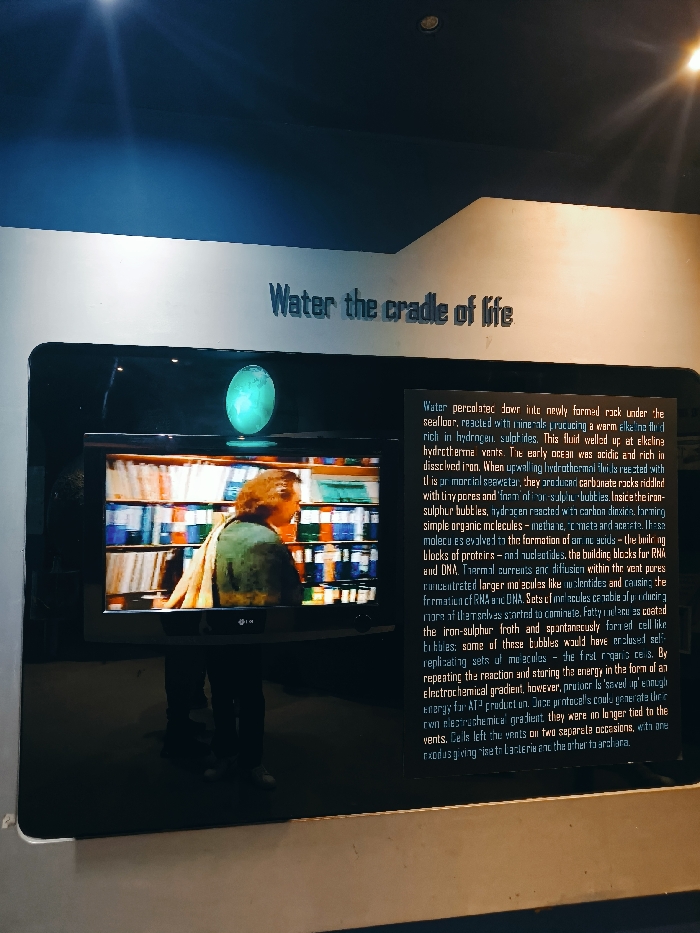
The image shows a wall display inside a museum exhibit in New Delhi, India. The display is located at the National Science Centre, which is at 28.613 degrees latitude and 77.246 degrees longitude. The display is titled "Water the cradle of life" and features a large flat-screen monitor. The monitor displays a video of a man standing in a library, facing towards the left. The video has subtitles, and the caption reads "Water percolated down into newly formed rock under the seafloor, reacted with minerals producing a warm alkaline fluid rich in hydrogen sulphides. This fluid welled up at alkaline hydrothermal vents. The early ocean was acidic and rich in dissolved iron. When upwelling hydrothermal fluid reacted with iron and seawater, they produced carbonate rocks riddled with tiny pores and open. And in these bubbles, these iron-sulphur bubbles, hydrogen reacted with carbon dioxide, forming simple organic molecules - methionine, c and meta acids. These molecules evolved to the formation of amino acids – the building blocks of proteins – and nucleotides, the building blocks for RNA and DNA. Thermal currents and gas diffusion within the vent pores concentrated RNA and DNA. Sets of molecules fatty and causing the formation of larger mocules like membranes enclosed self-replicating sets of molecules – the first organs cells. By repeating some of these bubbles would have in the form of an electrochemical gradient, however, the energy is several times. The energy for ATP production. These protocells could tied to the vents. Cells left the vents on two separate occasions, one producing bacteria, the other on the archaea."
FM-v457R2

Apr 10, 2025, 10:07 AM

New Delhi, India

Stake attention in this memory

Informative
Educational
Curious
Scientific
Wonder

The image shows a wall display inside a museum exhibit in New Delhi, India. The display is located at the National Science Centre, which is at 28.613 degrees latitude and 77.246 degrees longitude. The display is titled "Water the cradle of life" and features a large flat-screen monitor. The monitor displays a video of a man standing in a library, facing towards the left. The video has subtitles, and the caption reads "Water percolated down into newly formed rock under the seafloor, reacted with minerals producing a warm alkaline fluid rich in hydrogen sulphides. This fluid welled up at alkaline hydrothermal vents. The early ocean was acidic and rich in dissolved iron. When upwelling hydrothermal fluid reacted with iron and seawater, they produced carbonate rocks riddled with tiny pores and open. And in these bubbles, these iron-sulphur bubbles, hydrogen reacted with carbon dioxide, forming simple organic molecules - methionine, c and meta acids. These molecules evolved to the formation of amino acids – the building blocks of proteins – and nucleotides, the building blocks for RNA and DNA. Thermal currents and gas diffusion within the vent pores concentrated RNA and DNA. Sets of molecules fatty and causing the formation of larger mocules like membranes enclosed self-replicating sets of molecules – the first organs cells. By repeating some of these bubbles would have in the form of an electrochemical gradient, however, the energy is several times. The energy for ATP production. These protocells could tied to the vents. Cells left the vents on two separate occasions, one producing bacteria, the other on the archaea."

Loading AttnAds…

transactions
revenues
stakers
Earliest
Latest
Highest stake

No transactions found

More from this user

More from New Delhi

FM-v457R2

Apr 10, 2025, 10:07 AM

New Delhi, India

Licensed under Creative Commons Attribution 4.0 International License. You are free to share and adapt this content with proper attribution.