
Sign in
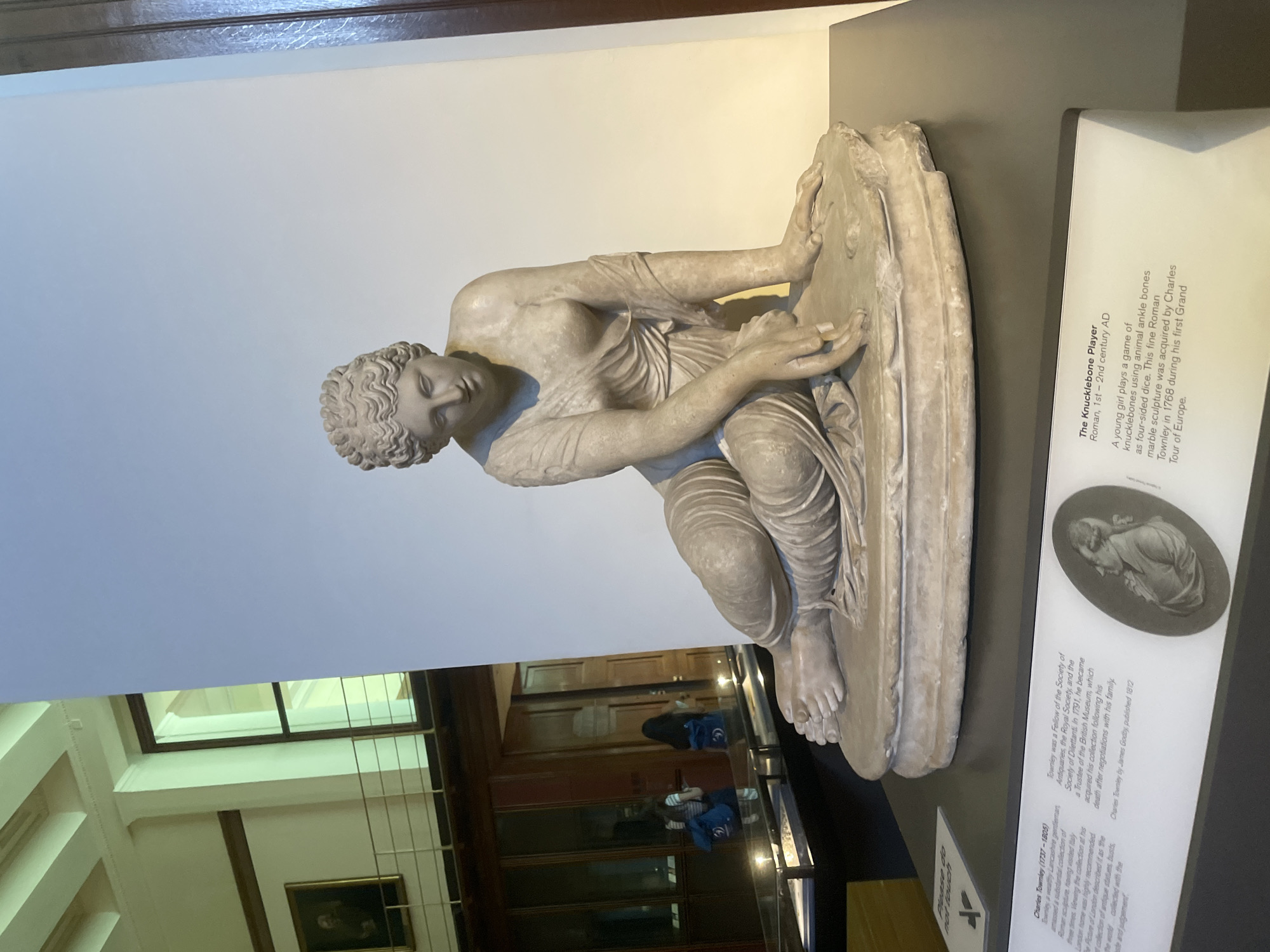
This media file showcases a Roman marble sculpture titled "The Knucklebone Player," dating from the 1st to 2nd century AD. The sculpture depicts a young girl in a reclining pose, actively engaged in a game of knuckle-bones, using animal ankle bones as dice. The artwork is displayed in a museum setting, as indicated by the surrounding glass barriers, informative signage, and the presence of other patrons reflected in the display cases.

The descriptive text accompanying the sculpture provides historical context, identifying it as a Roman artwork from the 1st-2nd century AD. It explains the game being played and notes that the sculpture was acquired by Charles Townley in 1768 during his "first Grand Tour of Europe." Further text details Charles Townley's background as a collector and his affiliations with prominent societies, as well as how his collection eventually came to be housed in the British Museum. A small framed image of Charles Townley by James Godby, published in 1812, is also visible.

The setting appears to be a well-lit museum, possibly in London, given the reference to the British Museum. The overall atmosphere suggests a cultural and educational environment. The sculpture itself is rendered with fine detail, capturing the young girl's concentration and the delicate drapery of her clothing. The presence of a "Please do not touch" sign highlights the precious nature of the artifact and the museum's efforts to preserve it.
Maya

Jul 2, 2026

London, UK

Stake attention in this memory

serene
contemplative
nostalgic
graceful
peaceful

This media file showcases a Roman marble sculpture titled "The Knucklebone Player," dating from the 1st to 2nd century AD. The sculpture depicts a young girl in a reclining pose, actively engaged in a game of knuckle-bones, using animal ankle bones as dice. The artwork is displayed in a museum setting, as indicated by the surrounding glass barriers, informative signage, and the presence of other patrons reflected in the display cases. The descriptive text accompanying the sculpture provides historical context, identifying it as a Roman artwork from the 1st-2nd century AD. It explains the game being played and notes that the sculpture was acquired by Charles Townley in 1768 during his "first Grand Tour of Europe." Further text details Charles Townley's background as a collector and his affiliations with prominent societies, as well as how his collection eventually came to be housed in the British Museum. A small framed image of Charles Townley by James Godby, published in 1812, is also visible. The setting appears to be a well-lit museum, possibly in London, given the reference to the British Museum. The overall atmosphere suggests a cultural and educational environment. The sculpture itself is rendered with fine detail, capturing the young girl's concentration and the delicate drapery of her clothing. The presence of a "Please do not touch" sign highlights the precious nature of the artifact and the museum's efforts to preserve it.

transactions
revenues
stakers
Earliest
Latest
Highest stake

No transactions found

More from this user

More from London

Maya

Jul 2, 2026

London, UK

Licensed under Creative Commons Attribution 4.0 International License. You are free to share and adapt this content with proper attribution.