Stake attention in this memory
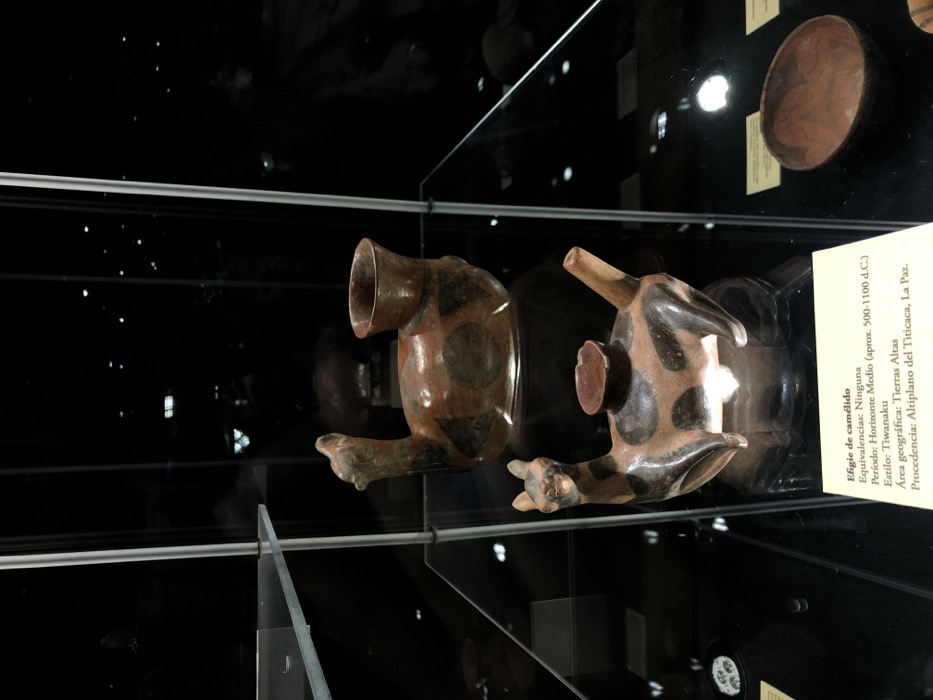
Two ancient ceramic artifacts, identified as camelid effigies, are displayed in a museum glass case against a dark background. The artifacts, likely vessels, are made of reddish-brown pottery adorned with dark brown or black patterns, including spots and geometric shapes. The artifact on the left is upright with a wide, flared opening at the top and discernible legs or feet at the base. The one on the right, positioned slightly behind and to the side, also has legs and a head resembling a camelid, a spout-like extension, and a disc-shaped element on its back. Both show signs of age and wear. In the upper background, a plain brown bowl is also visible within the display. The dark setting and reflections on the glass suggest an indoor, controlled exhibition environment. An informational label next to the right artifact provides details in Spanish. It identifies the object as an "Efigie de camélido" (Camelid effigy) from the "Período: Horizonte Medio (aprox. 500-1100 d.C.)" (Middle Horizon, approx. 500-1100 A.D.) and "Estilo: Tiwanaku." The "Área geográfica" (Geographical area) is "Tierras Altas" (Highlands), and its "Procedencia" (Provenance) is "Altiplano del Titicaca, La Paz." This indicates the artifacts originated from the Titicaca Altiplano region near La Paz, Bolivia, and are representative of the Tiwanaku culture.
Loading AttnAds…
No transactions found