
Sign in
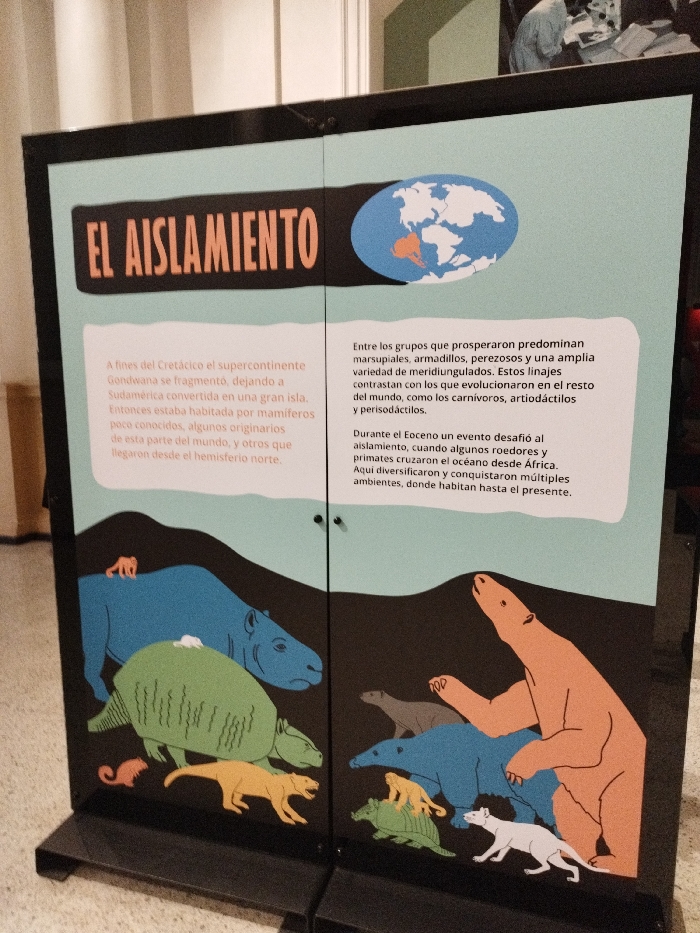
This media file captures an informational display, likely in a museum or exhibition hall in Santiago, Chile. The primary subject is a two-panel exhibit presenting geological and evolutionary information under the Spanish title "EL AISLAMIENTO" (THE ISOLATION).

The display features a light blue background on the upper half and a dark brown/black background on the lower half, where various stylized illustrations of prehistoric animals are depicted. On the upper right panel, there's a world map highlighting South America in orange, emphasizing its isolation.

The text on the left panel, in orange, explains that "At the end of the Cretaceous, the supercontinent Gondwana fragmented, leaving South America converted into a large island. It was then inhabited by little-known mammals, some originating from this part of the world, and others that arrived from the northern hemisphere." Below this text, on the dark background, are illustrations of a large blue animal resembling a hippopotamus, a green armadillo-like creature, and smaller orange and white animals, possibly early mammals unique to the isolated continent.

The text on the right panel, in black, continues: "Among the groups that prospered were marsupials, armadillos, sloths, and a wide variety of meridiungulates. These lineages contrast with those that evolved in the rest of the world, such as carnivores, artiodactyls, and perissodactyls." It further states: "During the Eocene, an event challenged the isolation, when some rodents and primates crossed the ocean from Africa. Here they diversified and conquered multiple environments, where they live to the present." Below this text are more illustrations, including a large tan bear-like creature, blue and gray animals, and smaller green, orange, and white creatures, suggesting a broader range of fauna after the Eocene migration.

In the background, a blurry image of a person at a desk is faintly visible, indicating an indoor setting. The overall presentation is educational, using clear text and illustrative graphics to explain a scientific concept.
Mrv

Jan 7, 2025

Santiago, Chile

Stake attention in this memory

This media file captures an informational display, likely in a museum or exhibition hall in Santiago, Chile. The primary subject is a two-panel exhibit presenting geological and evolutionary information under the Spanish title "EL AISLAMIENTO" (THE ISOLATION). The display features a light blue background on the upper half and a dark brown/black background on the lower half, where various stylized illustrations of prehistoric animals are depicted. On the upper right panel, there's a world map highlighting South America in orange, emphasizing its isolation. The text on the left panel, in orange, explains that "At the end of the Cretaceous, the supercontinent Gondwana fragmented, leaving South America converted into a large island. It was then inhabited by little-known mammals, some originating from this part of the world, and others that arrived from the northern hemisphere." Below this text, on the dark background, are illustrations of a large blue animal resembling a hippopotamus, a green armadillo-like creature, and smaller orange and white animals, possibly early mammals unique to the isolated continent. The text on the right panel, in black, continues: "Among the groups that prospered were marsupials, armadillos, sloths, and a wide variety of meridiungulates. These lineages contrast with those that evolved in the rest of the world, such as carnivores, artiodactyls, and perissodactyls." It further states: "During the Eocene, an event challenged the isolation, when some rodents and primates crossed the ocean from Africa. Here they diversified and conquered multiple environments, where they live to the present." Below this text are more illustrations, including a large tan bear-like creature, blue and gray animals, and smaller green, orange, and white creatures, suggesting a broader range of fauna after the Eocene migration. In the background, a blurry image of a person at a desk is faintly visible, indicating an indoor setting. The overall presentation is educational, using clear text and illustrative graphics to explain a scientific concept.

transactions
revenues
stakers
Earliest
Latest
Highest stake

No transactions found

More from this user

More from Santiago

Mrv

Jan 7, 2025

Santiago, Chile

Licensed under Creative Commons Attribution 4.0 International License. You are free to share and adapt this content with proper attribution.