
Sign in
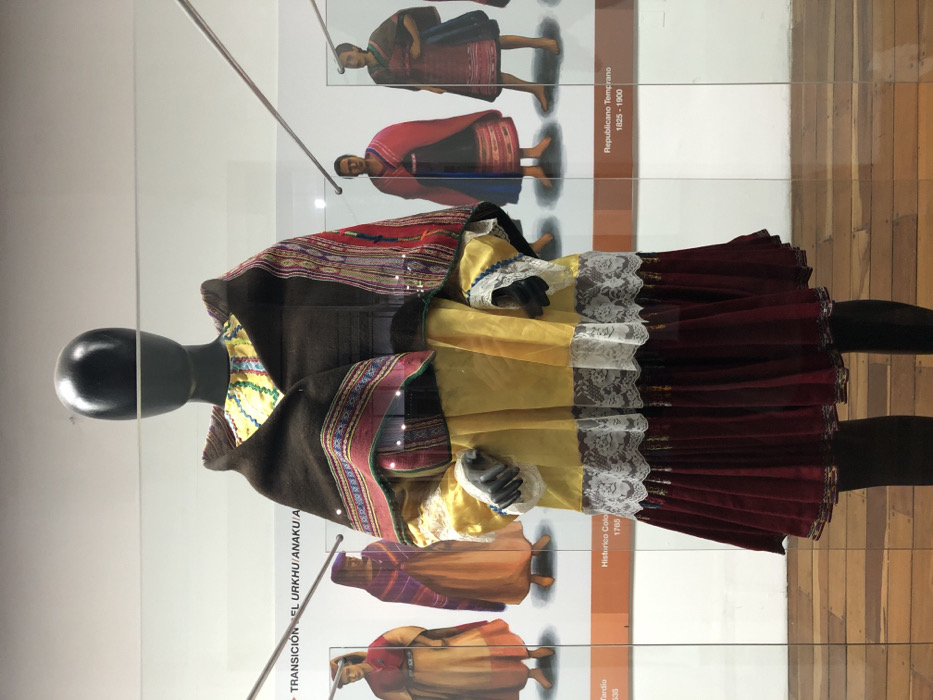
This image, when viewed upright, presents a museum display featuring traditional clothing on a black mannequin, set against a background of illustrative historical costume panels.

The main subject is a black mannequin adorned in a vibrant, multi-layered traditional ensemble. The outfit comprises a dark brown or black top, possibly a shawl or poncho, embellished with intricate, colorful woven borders featuring geometric patterns in red, yellow, blue, and white. Beneath this, a bright yellow long-sleeved dress or blouse is visible, characterized by white lace trim on its cuffs and a tiered lower section. A segment of colorful embroidered fabric can also be seen near the mannequin's neckline, suggesting an undershirt. The lower part of the attire is a dark red or maroon pleated skirt, also featuring white lace detailing where it meets the yellow garment.

In the background, through a transparent display barrier, a series of illustrated figures depict historical costume changes. These figures are accompanied by informational panels. Visible text includes "TRANSICIÓN EL URKHU / ANAKU / A," indicating a focus on specific garment transitions. Other labels provide chronological context: "Histórico Colonial Tardío 1765" and "Republicano Temprano 1825 - 1900." A partially obscured label suggests "Histórico Colonial Temprano 1538." These illustrations show the evolution of clothing styles, from draped garments to more layered and structured designs, likely reflecting the cultural heritage of the region.

The setting is an indoor exhibition space, possibly a museum in La Paz, Bolivia, designed to showcase the historical development of local attire. The floor is made of wood, and the bright lighting causes reflections on the glass display. The overall scene captures an educational presentation of historical fashion.
MNela

Jan 9, 2025, 8:05 PM

La Paz, Bolivia

Stake attention in this memory

This image, when viewed upright, presents a museum display featuring traditional clothing on a black mannequin, set against a background of illustrative historical costume panels. The main subject is a black mannequin adorned in a vibrant, multi-layered traditional ensemble. The outfit comprises a dark brown or black top, possibly a shawl or poncho, embellished with intricate, colorful woven borders featuring geometric patterns in red, yellow, blue, and white. Beneath this, a bright yellow long-sleeved dress or blouse is visible, characterized by white lace trim on its cuffs and a tiered lower section. A segment of colorful embroidered fabric can also be seen near the mannequin's neckline, suggesting an undershirt. The lower part of the attire is a dark red or maroon pleated skirt, also featuring white lace detailing where it meets the yellow garment. In the background, through a transparent display barrier, a series of illustrated figures depict historical costume changes. These figures are accompanied by informational panels. Visible text includes "TRANSICIÓN EL URKHU / ANAKU / A," indicating a focus on specific garment transitions. Other labels provide chronological context: "Histórico Colonial Tardío 1765" and "Republicano Temprano 1825 - 1900." A partially obscured label suggests "Histórico Colonial Temprano 1538." These illustrations show the evolution of clothing styles, from draped garments to more layered and structured designs, likely reflecting the cultural heritage of the region. The setting is an indoor exhibition space, possibly a museum in La Paz, Bolivia, designed to showcase the historical development of local attire. The floor is made of wood, and the bright lighting causes reflections on the glass display. The overall scene captures an educational presentation of historical fashion.

Loading AttnAds…

transactions
revenues
stakers
Earliest
Latest
Highest stake

No transactions found

More from this user

More from La Paz

MNela

Jan 9, 2025, 8:05 PM

La Paz, Bolivia

Licensed under Creative Commons Attribution 4.0 International License. You are free to share and adapt this content with proper attribution.