
Stake attention in this memory
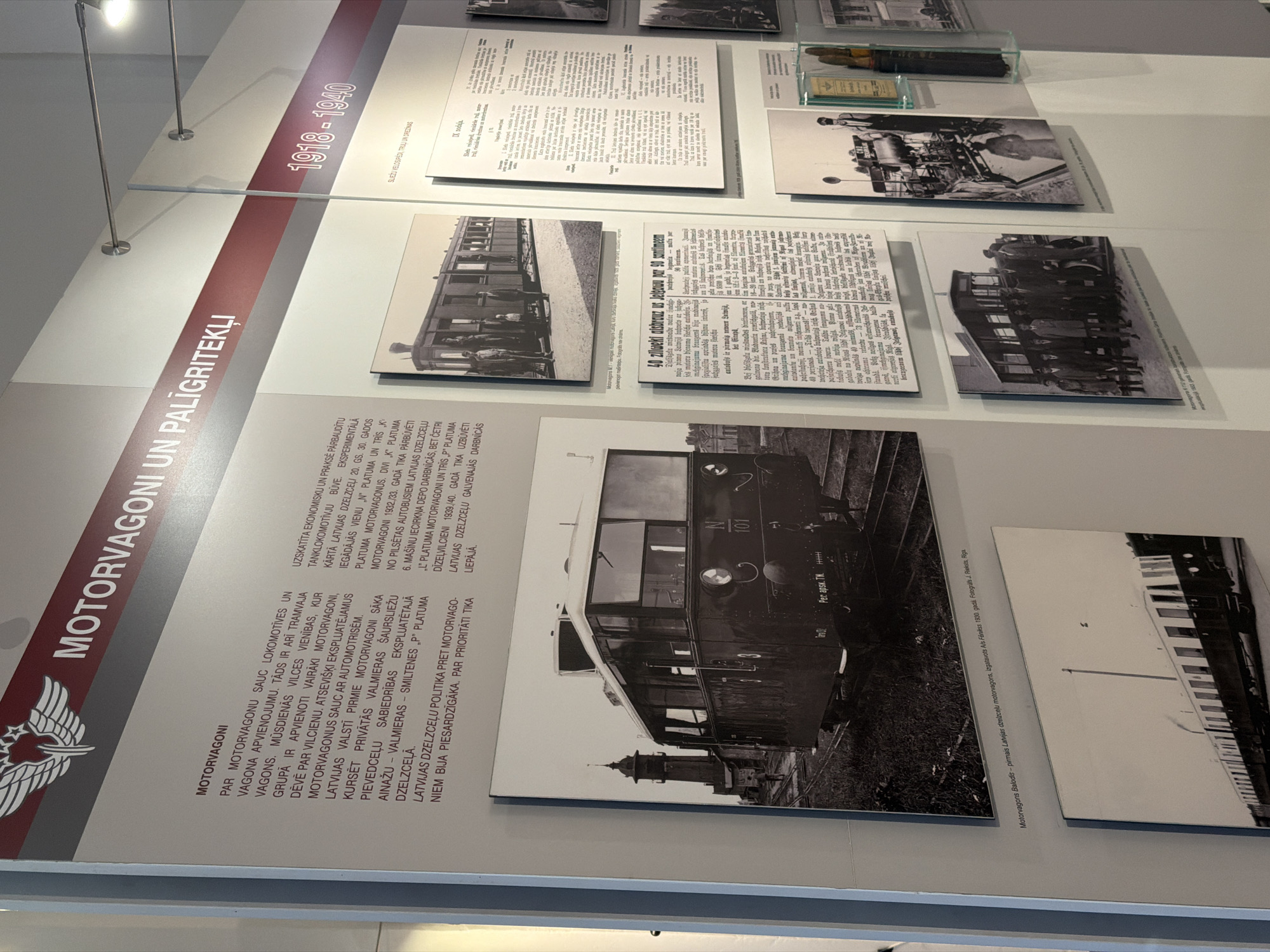
This image shows a wall exhibit in a museum, likely dedicated to the history of Latvian railways. The main title of the exhibit is "MOTORVAGONI UN PALĪGRITEKLI" (Motorwagons and Auxiliary Rail Vehicles), covering the period "1918-1940". The exhibit features several black and white historical photographs of various motorwagons and people associated with them. One prominent photo shows a motorwagon labeled "N 101" with a church tower in the background, and another caption identifies it as "Motorvagons Balodis - pirmais Latvijas dzelzceļu motorvagons, izgatavots Als Féinks 1930. gada" (Motorwagon Balodis - the first Latvian railway motorwagon, manufactured by Alš Fēinks in 1930). Another photograph depicts a group of people standing next to a train car. Accompanying the images are extensive text panels in Latvian, detailing the history, development, and use of motorwagons on Latvian railways. The text explains that motorwagons were self-propelled railcars, sometimes grouped into "vilcieni" (trains) or used as "automotrisēm" (autorails). It mentions their introduction on private narrow-gauge lines like Valmiera and Ainaži-Valmiera-Smiltene, and refers to experimental purchases and rebuilds from city buses. One section is titled "SLIEŽU VELOSIPEDI, TRULJ UN DREZINAS" (Rail bicycles, trolleys and draisines), suggesting that these auxiliary vehicles are also part of the display. A snippet of what appears to be a historical newspaper clipping is captioned "40 zilweki alsbrauz us Jelgawu par 90 santimeem" (40 people traveling to Jelgava for 90 santims). The setting is an indoor, well-lit museum space with light-colored walls. The exhibit is presented chronologically, focusing on railway innovation in Latvia during the interwar period.
No transactions found