Sign in
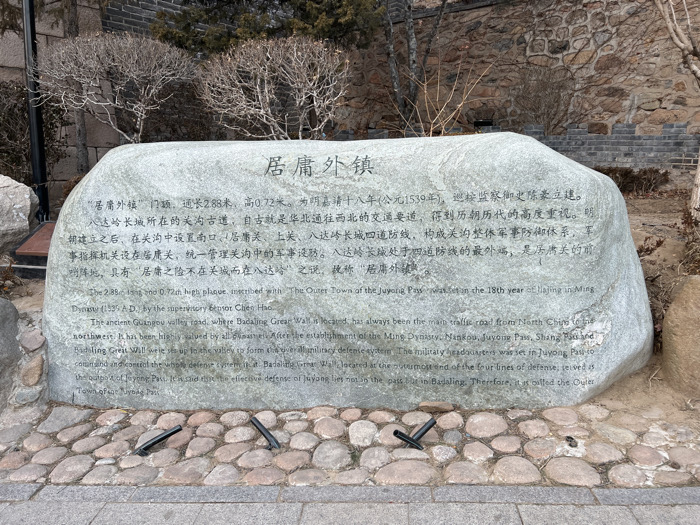
A large, irregularly shaped gray stone tablet stands as the central subject of the image, bearing inscriptions in both Chinese and English. The tablet details "居庸外镇" (Juyong Waizhen), or "The Outer Town of Juyong Pass."

According to the text, the plaque measures 2.88 meters long and 0.72 meters high and was erected in 1539 AD during the Ming Dynasty by supervisory Censor Chen Hao. The inscription highlights the strategic importance of the ancient Guangou valley road, where the Badaling Great Wall is located, as a vital traffic route from North China to the northwest. It explains that the Ming Dynasty established a four-line defense system in the valley, including Nankou, Juyong Pass, Shangguan, and Badaling Great Wall. Badaling, as the outermost defense line and outpost of Juyong Pass, was considered crucial, leading to the saying: "the effective defense of Juyong lies not in the pass but in Badaling."

The ground in front of the tablet is paved with a pattern of rounded cobblestones and concrete pavers, with two dark, T-shaped objects resting on the cobblestones. In the background, a rustic stone wall is visible, along with several bare-branched trees, suggesting a winter or early spring setting. The scene is well-lit under clear daylight, indicating a daytime shot. The image captures a historical marker at a significant site near the Great Wall in Beijing, China, commemorating its strategic military importance.
F
FM-kxd2z1

Jan 22, 2025, 9:02 AM

Beijing, China

Stake attention in this memory

A large, irregularly shaped gray stone tablet stands as the central subject of the image, bearing inscriptions in both Chinese and English. The tablet details "居庸外镇" (Juyong Waizhen), or "The Outer Town of Juyong Pass." According to the text, the plaque measures 2.88 meters long and 0.72 meters high and was erected in 1539 AD during the Ming Dynasty by supervisory Censor Chen Hao. The inscription highlights the strategic importance of the ancient Guangou valley road, where the Badaling Great Wall is located, as a vital traffic route from North China to the northwest. It explains that the Ming Dynasty established a four-line defense system in the valley, including Nankou, Juyong Pass, Shangguan, and Badaling Great Wall. Badaling, as the outermost defense line and outpost of Juyong Pass, was considered crucial, leading to the saying: "the effective defense of Juyong lies not in the pass but in Badaling." The ground in front of the tablet is paved with a pattern of rounded cobblestones and concrete pavers, with two dark, T-shaped objects resting on the cobblestones. In the background, a rustic stone wall is visible, along with several bare-branched trees, suggesting a winter or early spring setting. The scene is well-lit under clear daylight, indicating a daytime shot. The image captures a historical marker at a significant site near the Great Wall in Beijing, China, commemorating its strategic military importance.

Loading AttnAds…

transactions
revenues
stakers
Earliest
Latest
Highest stake

No transactions found

More from this user

More from Beijing

FFM-kxd2z1

Jan 22, 2025, 9:02 AM

Beijing, China

Licensed under Creative Commons Attribution 4.0 International License. You are free to share and adapt this content with proper attribution.