Sign in
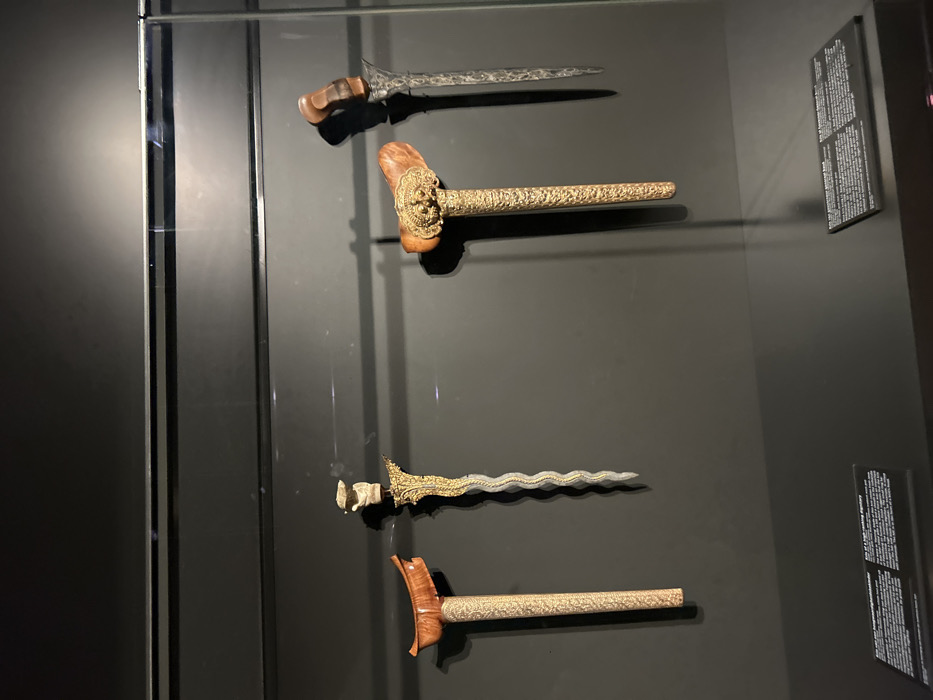
Four ornate, bladed artifacts, likely traditional Southeast Asian daggers known as Krises, are displayed horizontally in a glass museum case against a dark grey or black background. The artifacts appear to be suspended, casting soft shadows behind them.

From top to bottom:
The first item is a kris with a straight, patterned blade and an intricately carved, light brown wooden hilt.
Below it is a kris scabbard, featuring a heavily decorated, gold-colored metal casing with fine patterns, attached to a curved, light brown wooden hilt. The scabbard appears to be closed, protecting a blade within.
The third item is another kris, distinguished by its wavy, serpentine blade, showcasing intricate metalwork patterns (pamor). Its hilt is light-colored and ornately carved, possibly from bone or ivory.
The bottom item is a kris scabbard, similar to the second, with a long, gold-colored, patterned casing and a distinctively carved, polished wooden hilt.

The display is illuminated by focused lighting, highlighting the details of each piece. Reflections on the glass of the display case indicate an indoor setting. To the right of the artifacts, two rectangular information panels with small white text on a dark background provide contextual details for the exhibit, though the text itself is unreadable in the image. The scene suggests a cultural or historical exhibition, presenting these weapons as significant art or heritage pieces.
F
FM-uqmbw2

Dec 30, 2024

Amsterdam, Netherlands

Stake attention in this memory

Four ornate, bladed artifacts, likely traditional Southeast Asian daggers known as Krises, are displayed horizontally in a glass museum case against a dark grey or black background. The artifacts appear to be suspended, casting soft shadows behind them. From top to bottom: The first item is a kris with a straight, patterned blade and an intricately carved, light brown wooden hilt. Below it is a kris scabbard, featuring a heavily decorated, gold-colored metal casing with fine patterns, attached to a curved, light brown wooden hilt. The scabbard appears to be closed, protecting a blade within. The third item is another kris, distinguished by its wavy, serpentine blade, showcasing intricate metalwork patterns (pamor). Its hilt is light-colored and ornately carved, possibly from bone or ivory. The bottom item is a kris scabbard, similar to the second, with a long, gold-colored, patterned casing and a distinctively carved, polished wooden hilt. The display is illuminated by focused lighting, highlighting the details of each piece. Reflections on the glass of the display case indicate an indoor setting. To the right of the artifacts, two rectangular information panels with small white text on a dark background provide contextual details for the exhibit, though the text itself is unreadable in the image. The scene suggests a cultural or historical exhibition, presenting these weapons as significant art or heritage pieces.

transactions
revenues
stakers
Earliest
Latest
Highest stake

No transactions found

More from this user

More from Amsterdam

FFM-uqmbw2

Dec 30, 2024

Amsterdam, Netherlands

Licensed under Creative Commons Attribution 4.0 International License. You are free to share and adapt this content with proper attribution.