Sign in
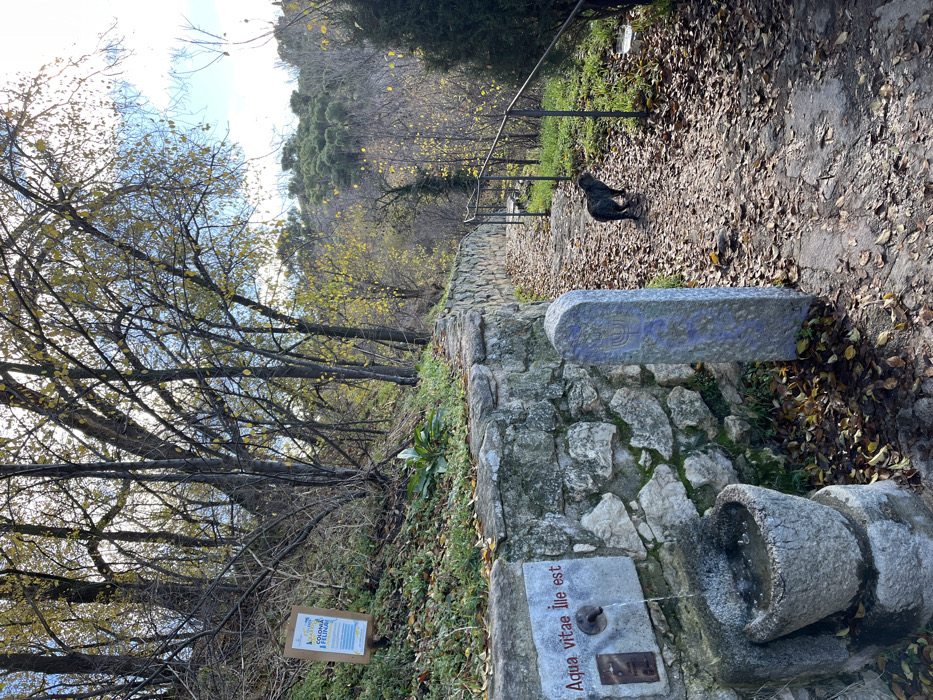
The image captures an autumnal outdoor scene, likely a pathway or trail, featuring a blend of natural elements and stone architecture. The setting suggests a park or scenic route in Segovia, Spain, given the context.

In the foreground, a rustic stone wall lines the path. Integrated into this wall is a stone water fountain from which a stream of water continuously flows into a shallow, rough-hewn stone basin. Above the spigot, an inscription in Latin reads "Aqua vitae illic est," meaning "Here is the water of life." Below the spigot, a smaller, dark plaque has text that is partially obscured but visible words include "COLONIA FELINA" which refers to a cat colony. On top of the stone wall, to the right of the fountain, rests a grey stone block or bench. This stone features a distinct carved symbol, possibly a stylized seven-branched candelabrum (a Menorah) or a similar local emblem, highlighted in blue or purple. Further to the left, a small light-colored sign is visible, displaying text in Spanish that clearly includes "COLONIA FELINA," suggesting the presence or care for a cat colony in the area, and has some graphics.

A black dog, possibly medium-sized, is positioned on the leaf-strewn pathway in the mid-ground, facing away from the camera and appearing to sniff the ground. The path itself is covered with numerous fallen yellow and brown leaves, indicating the autumn season. A metal handrail runs along the side of the path, ascending further into the background.

The background is dominated by trees with sparse branches and many yellow leaves, typical of autumn foliage. The sky, visible through the branches, appears bright and clear, suggesting daytime, likely late morning or early afternoon. The overall atmosphere is tranquil and natural, with hints of historical or local significance through the stone structures and inscriptions.
Manubuda

Dec 4, 2024

Segovia, Spain

Stake attention in this memory

The image captures an autumnal outdoor scene, likely a pathway or trail, featuring a blend of natural elements and stone architecture. The setting suggests a park or scenic route in Segovia, Spain, given the context. In the foreground, a rustic stone wall lines the path. Integrated into this wall is a stone water fountain from which a stream of water continuously flows into a shallow, rough-hewn stone basin. Above the spigot, an inscription in Latin reads "Aqua vitae illic est," meaning "Here is the water of life." Below the spigot, a smaller, dark plaque has text that is partially obscured but visible words include "COLONIA FELINA" which refers to a cat colony. On top of the stone wall, to the right of the fountain, rests a grey stone block or bench. This stone features a distinct carved symbol, possibly a stylized seven-branched candelabrum (a Menorah) or a similar local emblem, highlighted in blue or purple. Further to the left, a small light-colored sign is visible, displaying text in Spanish that clearly includes "COLONIA FELINA," suggesting the presence or care for a cat colony in the area, and has some graphics. A black dog, possibly medium-sized, is positioned on the leaf-strewn pathway in the mid-ground, facing away from the camera and appearing to sniff the ground. The path itself is covered with numerous fallen yellow and brown leaves, indicating the autumn season. A metal handrail runs along the side of the path, ascending further into the background. The background is dominated by trees with sparse branches and many yellow leaves, typical of autumn foliage. The sky, visible through the branches, appears bright and clear, suggesting daytime, likely late morning or early afternoon. The overall atmosphere is tranquil and natural, with hints of historical or local significance through the stone structures and inscriptions.

transactions
revenues
stakers
Earliest
Latest
Highest stake

No transactions found

More from this user

More from Segovia

Manubuda

Dec 4, 2024

Segovia, Spain

Licensed under Creative Commons Attribution 4.0 International License. You are free to share and adapt this content with proper attribution.