
Sign in
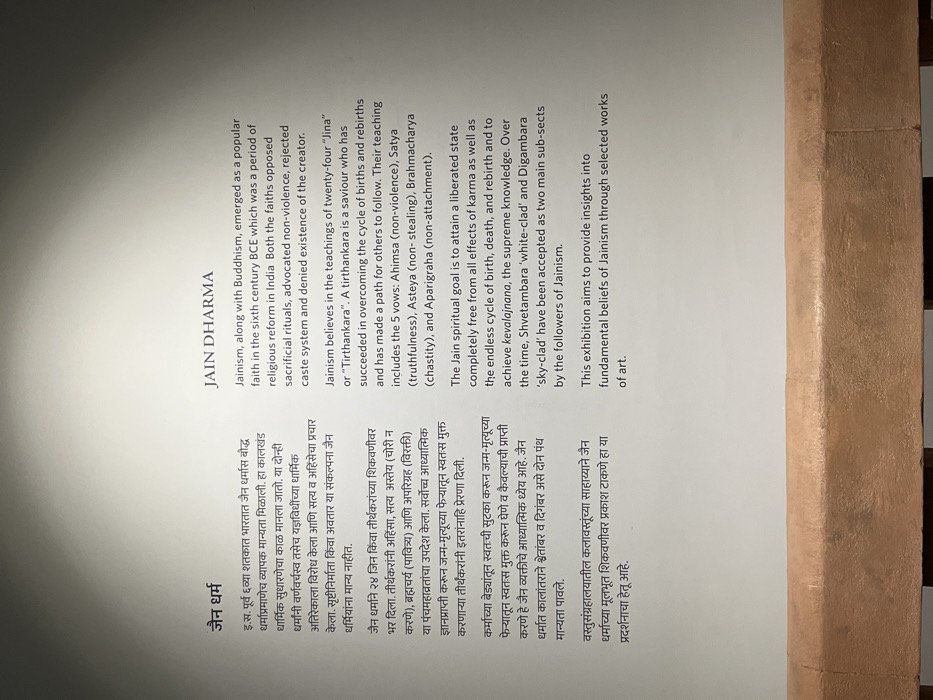
The image displays an informational panel, likely from a museum or exhibition, detailing aspects of Jainism in both English and Marathi. The panel is predominantly light-colored with dark text printed on it. On the right side of the frame, a segment of a brown or wooden pillar or frame is visible, suggesting an indoor architectural setting.

The English section is titled "JAIN DHARMA". It describes Jainism's origins in the 6th century BCE, its opposition to sacrificial rituals and the caste system, and its denial of a creator. It explains the belief in 24 "Jina" or "Tirthankara" who overcame cycles of birth and rebirth, and outlines the five vows: Ahimsa (non-violence), Satya (truthfulness), Asteya (non-stealing), Brahmacharya (chastity), and Aparigraha (non-attachment). The text further states that the Jain spiritual goal is to achieve a liberated state, free from karma and endless rebirth, and to attain kevalajnana (supreme knowledge). It mentions the two main sub-sects, Shvetambara ('white-clad') and Digambara ('sky-clad'), and concludes by stating the exhibition's aim to provide insights into Jainism through selected works of art.

The Marathi section, titled "जैन धर्म" (Jain Dharma), covers similar information, discussing its emergence alongside Buddhism in the 6th century BCE, its rejection of caste and rituals, the teachings of the 24 Tirthankaras and the five great vows, the spiritual goal of liberation from karma and rebirth, and the two sects (Shvetambar and Digambar). It also notes the exhibition's purpose to shed light on Jainism through art. The image captures the display from a slightly angled perspective, and the lighting is even.
FM-OhtiC3

Dec 10, 2024

Mumbai, India

Stake attention in this memory

The image displays an informational panel, likely from a museum or exhibition, detailing aspects of Jainism in both English and Marathi. The panel is predominantly light-colored with dark text printed on it. On the right side of the frame, a segment of a brown or wooden pillar or frame is visible, suggesting an indoor architectural setting. The English section is titled "JAIN DHARMA". It describes Jainism's origins in the 6th century BCE, its opposition to sacrificial rituals and the caste system, and its denial of a creator. It explains the belief in 24 "Jina" or "Tirthankara" who overcame cycles of birth and rebirth, and outlines the five vows: Ahimsa (non-violence), Satya (truthfulness), Asteya (non-stealing), Brahmacharya (chastity), and Aparigraha (non-attachment). The text further states that the Jain spiritual goal is to achieve a liberated state, free from karma and endless rebirth, and to attain kevalajnana (supreme knowledge). It mentions the two main sub-sects, Shvetambara ('white-clad') and Digambara ('sky-clad'), and concludes by stating the exhibition's aim to provide insights into Jainism through selected works of art. The Marathi section, titled "जैन धर्म" (Jain Dharma), covers similar information, discussing its emergence alongside Buddhism in the 6th century BCE, its rejection of caste and rituals, the teachings of the 24 Tirthankaras and the five great vows, the spiritual goal of liberation from karma and rebirth, and the two sects (Shvetambar and Digambar). It also notes the exhibition's purpose to shed light on Jainism through art. The image captures the display from a slightly angled perspective, and the lighting is even.

transactions
revenues
stakers
Earliest
Latest
Highest stake

No transactions found

More from this user

More from Mumbai

FM-OhtiC3

Dec 10, 2024

Mumbai, India

Licensed under Creative Commons Attribution 4.0 International License. You are free to share and adapt this content with proper attribution.