
Sign in
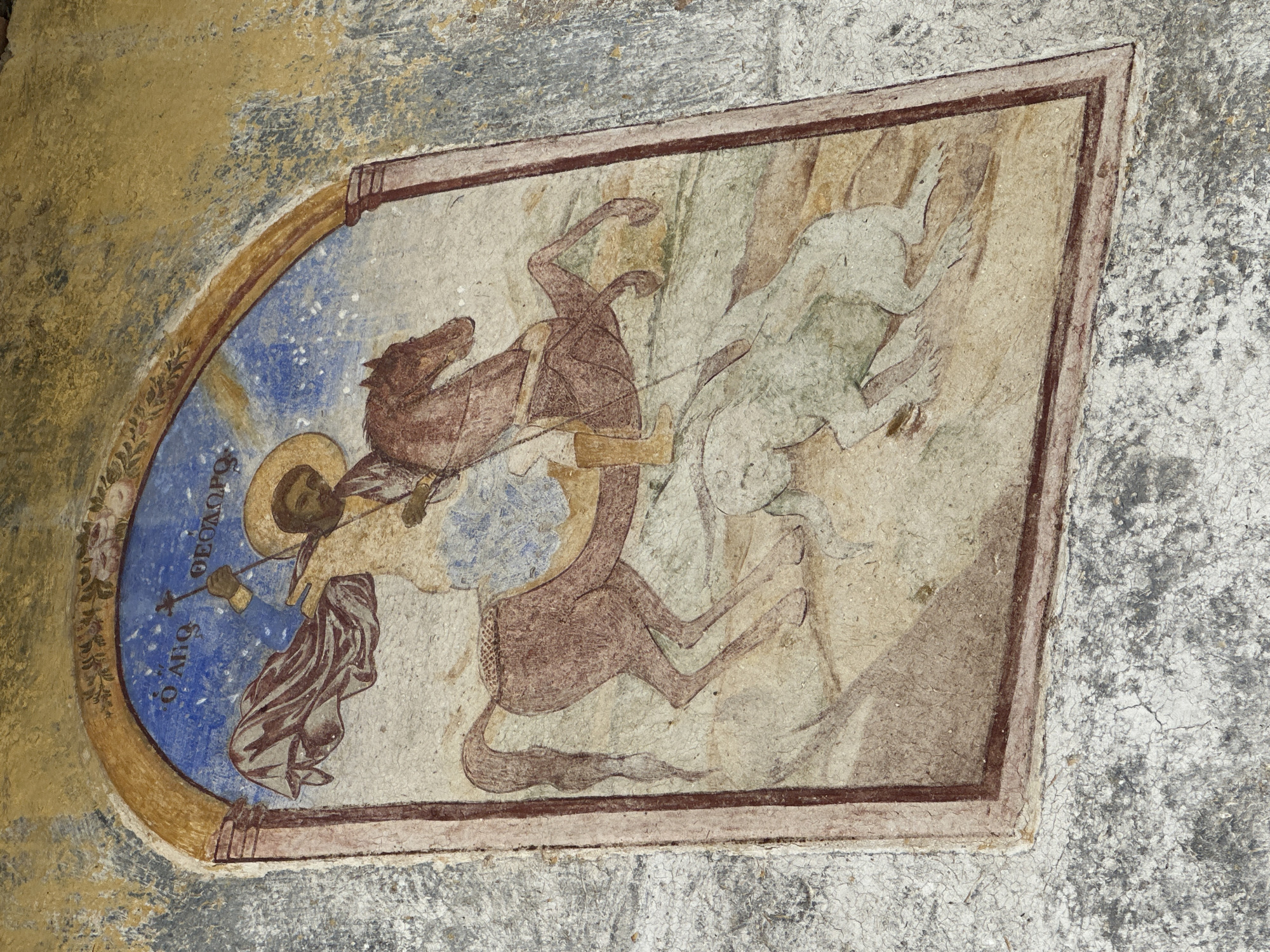
This media file displays a weathered fresco or mural, likely from an Orthodox church or monastery in Asenovgrad, Bulgaria, depicting a dramatic equestrian scene. The central figure is a haloed male saint, identified by the Greek inscription "Ο ΑΓΙΟΣ ΘΕΟΔΩΡΟ" (Saint Theodore) near his head. He is shown on a reddish-brown horse, dynamically positioned with its front legs raised. The saint, dressed in flowing robes, holds a long staff or spear topped with a cross, aimed towards the right side of the composition.

To the right, a lighter-colored, possibly white or greyish-white, horse rears up violently. Tied to or being dragged by this lighter horse are two smaller, humanoid figures, one clearly visible with raised, seemingly bound arms, suggesting defeat or captivity. These figures likely symbolize evil or paganism being overcome by the saint.

The overall composition is framed by a decorative border, rounded at the top left and straight at the bottom right. The background behind Saint Theodore is a vibrant blue, suggesting the sky, while the rest of the scene has a more muted, earthy palette of browns, greens, and beige, with areas of grey. The fresco exhibits significant age and wear, with visible cracks, flaking paint, and a textured surface, indicating its antiquity and exposure to the elements over time. The style is characteristic of Byzantine or post-Byzantine iconography.
Hristina Angelova

Jun 5, 2026, 11:20 AM

Asenovgrad, Bulgaria

Stake attention in this memory

heroic
spiritual
ancient
resilient
triumphant

This media file displays a weathered fresco or mural, likely from an Orthodox church or monastery in Asenovgrad, Bulgaria, depicting a dramatic equestrian scene. The central figure is a haloed male saint, identified by the Greek inscription "Ο ΑΓΙΟΣ ΘΕΟΔΩΡΟ" (Saint Theodore) near his head. He is shown on a reddish-brown horse, dynamically positioned with its front legs raised. The saint, dressed in flowing robes, holds a long staff or spear topped with a cross, aimed towards the right side of the composition. To the right, a lighter-colored, possibly white or greyish-white, horse rears up violently. Tied to or being dragged by this lighter horse are two smaller, humanoid figures, one clearly visible with raised, seemingly bound arms, suggesting defeat or captivity. These figures likely symbolize evil or paganism being overcome by the saint. The overall composition is framed by a decorative border, rounded at the top left and straight at the bottom right. The background behind Saint Theodore is a vibrant blue, suggesting the sky, while the rest of the scene has a more muted, earthy palette of browns, greens, and beige, with areas of grey. The fresco exhibits significant age and wear, with visible cracks, flaking paint, and a textured surface, indicating its antiquity and exposure to the elements over time. The style is characteristic of Byzantine or post-Byzantine iconography.

Loading AttnAds…

transactions
revenues
stakers
Earliest
Latest
Highest stake

No transactions found

More from this user

More from Asenovgrad

Hristina Angelova

Jun 5, 2026, 11:20 AM

Asenovgrad, Bulgaria

Licensed under Creative Commons Attribution 4.0 International License. You are free to share and adapt this content with proper attribution.