Sign in
The image displays three informational plaques mounted on a plain white wall, likely at a historical or cultural site. There are no people visible.

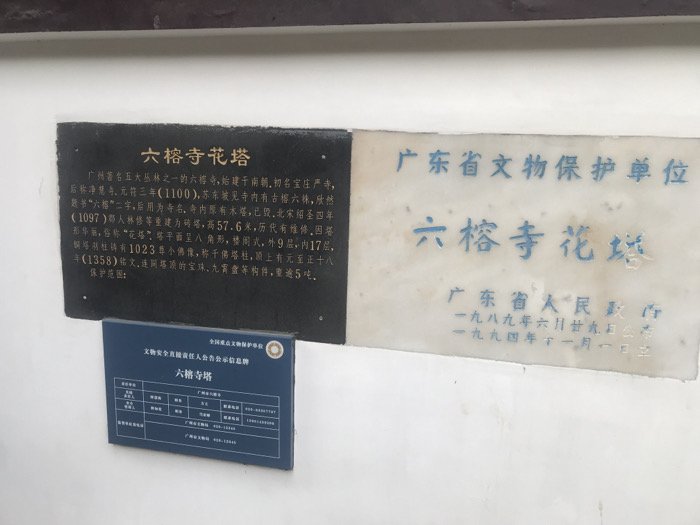
The largest plaque, located on the top left and black, provides a detailed historical description of the "六榕寺花塔" (Liurong Temple Flower Pagoda). It states that the pagoda is part of one of Guangzhou's five major Buddhist temples, originally named Baozhuangyan Temple. It was renamed Liurong (Six Banyan) after Su Dongpo admired six ancient banyan trees and inscribed the name in 1100. The plaque details the pagoda's reconstruction in 1097 as a 57.6-meter-high brick pagoda, its ornate appearance earning it the nickname "Flower Pagoda." It has an octagonal base, 9 exterior stories, 17 interior stories, and its bronze pillar chain contains 1023 small Buddha statues. The inscription at its top dates to 1358, and the pagoda's components, including its top jewel, weigh over 5 tons.

To the right, a white marble plaque, inscribed in blue, designates the "六榕寺花塔" (Liurong Temple Flower Pagoda) as a "广东省文物保护单位" (Guangdong Provincial Cultural Relics Protection Unit). It indicates that this designation was announced by the "广东省人民政府" (Guangdong Provincial People's Government) on June 29, 1989, and established on January 1, 1994.

A smaller blue plaque at the bottom left is a "文物安全直接责任人公告公示信息牌" (Cultural Relics Safety Direct Responsible Person Announcement Information Board) for the "六榕寺塔" (Liurong Temple Pagoda). This plaque provides information such as responsible units and contact numbers, including details related to Guangzhou City. The lighting suggests it is daytime.
F
FM-qn0Jb2

Dec 11, 2024, 6:58 AM

Guang Zhou Shi, China

Stake attention in this memory

The image displays three informational plaques mounted on a plain white wall, likely at a historical or cultural site. There are no people visible. The largest plaque, located on the top left and black, provides a detailed historical description of the "六榕寺花塔" (Liurong Temple Flower Pagoda). It states that the pagoda is part of one of Guangzhou's five major Buddhist temples, originally named Baozhuangyan Temple. It was renamed Liurong (Six Banyan) after Su Dongpo admired six ancient banyan trees and inscribed the name in 1100. The plaque details the pagoda's reconstruction in 1097 as a 57.6-meter-high brick pagoda, its ornate appearance earning it the nickname "Flower Pagoda." It has an octagonal base, 9 exterior stories, 17 interior stories, and its bronze pillar chain contains 1023 small Buddha statues. The inscription at its top dates to 1358, and the pagoda's components, including its top jewel, weigh over 5 tons. To the right, a white marble plaque, inscribed in blue, designates the "六榕寺花塔" (Liurong Temple Flower Pagoda) as a "广东省文物保护单位" (Guangdong Provincial Cultural Relics Protection Unit). It indicates that this designation was announced by the "广东省人民政府" (Guangdong Provincial People's Government) on June 29, 1989, and established on January 1, 1994. A smaller blue plaque at the bottom left is a "文物安全直接责任人公告公示信息牌" (Cultural Relics Safety Direct Responsible Person Announcement Information Board) for the "六榕寺塔" (Liurong Temple Pagoda). This plaque provides information such as responsible units and contact numbers, including details related to Guangzhou City. The lighting suggests it is daytime.

Loading AttnAds…

transactions
revenues
stakers
Earliest
Latest
Highest stake

No transactions found

More from this user

More from Guang Zhou Shi

FFM-qn0Jb2

Dec 11, 2024, 6:58 AM

Guang Zhou Shi, China

Licensed under Creative Commons Attribution 4.0 International License. You are free to share and adapt this content with proper attribution.