
Sign in
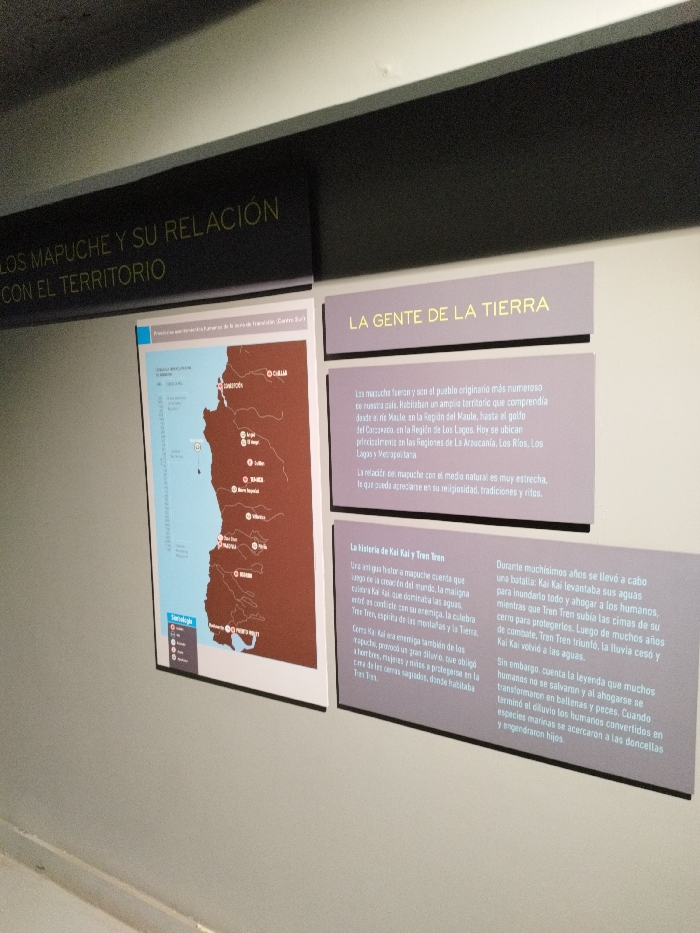
This image captures an indoor museum or exhibit display focused on the Mapuche people and their connection to the territory in Chile. The setting features light grey walls and several informational panels in dark grey/black and light purple/grey.

The main title panel, prominently displayed, reads "LOS MAPUCHE Y SU RELACIÓN CON EL TERRITORIO" (The Mapuche and their Relationship with the Territory). Below this, a large map illustrates the "Distribución espacial humana de la zona de transición: Centro-Sur" (Human spatial distribution of the transition zone: Central-South) in Chile, with markers for various locations like Osorno, Valdivia, and Temuco.

To the right, a series of text panels provide further information. The first subtitle is "LA GENTE DE LA TIERRA" (The People of the Earth), describing the Mapuche as the most numerous indigenous group in Chile, historically occupying a vast territory from Maule to Los Lagos, and currently residing mainly in La Araucanía, Los Ríos, Los Lagos, and Metropolitan regions. It also highlights their deep connection to nature.

The lower right panel is titled "La historia de Kai Kai y Tren Tren" (The story of Kai Kai and Tren Tren). This section narrates a Mapuche creation myth involving a battle between Kai Kai, a serpent of the waters, and Tren Tren, a serpent of the mountains. Kai Kai caused a great flood, leading people to seek refuge on Tren Tren's sacred hills. Tren Tren ultimately triumphed, ending the flood. The text also mentions a legend where some humans who drowned transformed into whales and fish, later interacting with maidens.

The exhibit provides an informative overview of Mapuche culture, geography, and mythology.
Mrv

Jan 7, 2025

Santiago, Chile

Stake attention in this memory

This image captures an indoor museum or exhibit display focused on the Mapuche people and their connection to the territory in Chile. The setting features light grey walls and several informational panels in dark grey/black and light purple/grey. The main title panel, prominently displayed, reads "LOS MAPUCHE Y SU RELACIÓN CON EL TERRITORIO" (The Mapuche and their Relationship with the Territory). Below this, a large map illustrates the "Distribución espacial humana de la zona de transición: Centro-Sur" (Human spatial distribution of the transition zone: Central-South) in Chile, with markers for various locations like Osorno, Valdivia, and Temuco. To the right, a series of text panels provide further information. The first subtitle is "LA GENTE DE LA TIERRA" (The People of the Earth), describing the Mapuche as the most numerous indigenous group in Chile, historically occupying a vast territory from Maule to Los Lagos, and currently residing mainly in La Araucanía, Los Ríos, Los Lagos, and Metropolitan regions. It also highlights their deep connection to nature. The lower right panel is titled "La historia de Kai Kai y Tren Tren" (The story of Kai Kai and Tren Tren). This section narrates a Mapuche creation myth involving a battle between Kai Kai, a serpent of the waters, and Tren Tren, a serpent of the mountains. Kai Kai caused a great flood, leading people to seek refuge on Tren Tren's sacred hills. Tren Tren ultimately triumphed, ending the flood. The text also mentions a legend where some humans who drowned transformed into whales and fish, later interacting with maidens. The exhibit provides an informative overview of Mapuche culture, geography, and mythology.

transactions
revenues
stakers
Earliest
Latest
Highest stake

No transactions found

More from this user

More from Santiago

Mrv

Jan 7, 2025

Santiago, Chile

Licensed under Creative Commons Attribution 4.0 International License. You are free to share and adapt this content with proper attribution.