Sign in
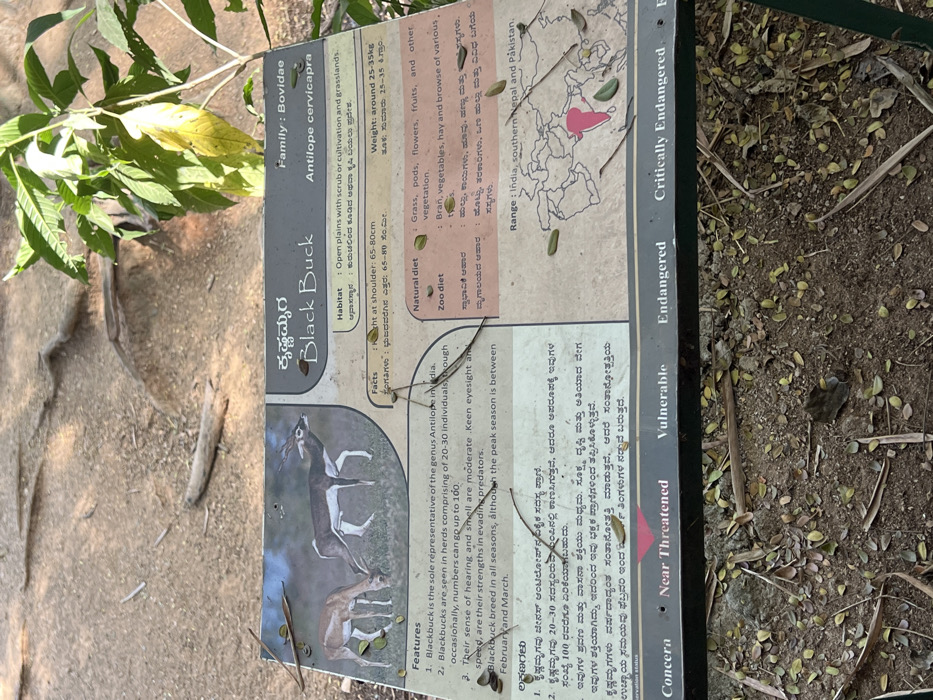
An outdoor, daytime image features an informational sign about the Black Buck (Antilope cervicapra) set against a natural, dusty ground with scattered dry leaves and debris. Green foliage partially obscures the top left corner of the sign, suggesting it is located amidst vegetation. The sign is oriented vertically but the image is rotated, presenting the sign horizontally.

The sign, written in both English and Kannada, provides details about the Black Buck. Key information includes its family (Bovidae), habitat (open plains, scrub, grasslands), physical characteristics (height at shoulder: 65-80cm; weight: 25-35kg), and diet (natural: grass, pods, flowers, fruits; zoo: bran, vegetables, hay). Illustrations of two Black Bucks, one dark and one lighter, are visible on the left side of the sign.

The text highlights features such as the Black Buck being the sole representative of its genus in India, living in herds of 20-30 individuals (sometimes up to 100), and possessing keen eyesight and speed for evading predators. It also notes that they breed year-round, with a peak season from February to March.

A map on the sign indicates the Black Buck's range across India, southern Nepal, and Pakistan. At the bottom, a conservation status bar labels the species as "Near Threatened," with categories for "Concern," "Vulnerable," "Endangered," and "Critically Endangered" also displayed. The dual language (English and Kannada) suggests the location is in Karnataka, India, consistent with the provided context of Mysuru.
FM-7y8Ft1

Jan 12, 2025

Mysuru, India

Stake attention in this memory

An outdoor, daytime image features an informational sign about the Black Buck (Antilope cervicapra) set against a natural, dusty ground with scattered dry leaves and debris. Green foliage partially obscures the top left corner of the sign, suggesting it is located amidst vegetation. The sign is oriented vertically but the image is rotated, presenting the sign horizontally. The sign, written in both English and Kannada, provides details about the Black Buck. Key information includes its family (Bovidae), habitat (open plains, scrub, grasslands), physical characteristics (height at shoulder: 65-80cm; weight: 25-35kg), and diet (natural: grass, pods, flowers, fruits; zoo: bran, vegetables, hay). Illustrations of two Black Bucks, one dark and one lighter, are visible on the left side of the sign. The text highlights features such as the Black Buck being the sole representative of its genus in India, living in herds of 20-30 individuals (sometimes up to 100), and possessing keen eyesight and speed for evading predators. It also notes that they breed year-round, with a peak season from February to March. A map on the sign indicates the Black Buck's range across India, southern Nepal, and Pakistan. At the bottom, a conservation status bar labels the species as "Near Threatened," with categories for "Concern," "Vulnerable," "Endangered," and "Critically Endangered" also displayed. The dual language (English and Kannada) suggests the location is in Karnataka, India, consistent with the provided context of Mysuru.

transactions
revenues
stakers
Earliest
Latest
Highest stake

No transactions found

More from this user

More from Mysuru

FM-7y8Ft1

Jan 12, 2025

Mysuru, India

Licensed under Creative Commons Attribution 4.0 International License. You are free to share and adapt this content with proper attribution.