Sign in
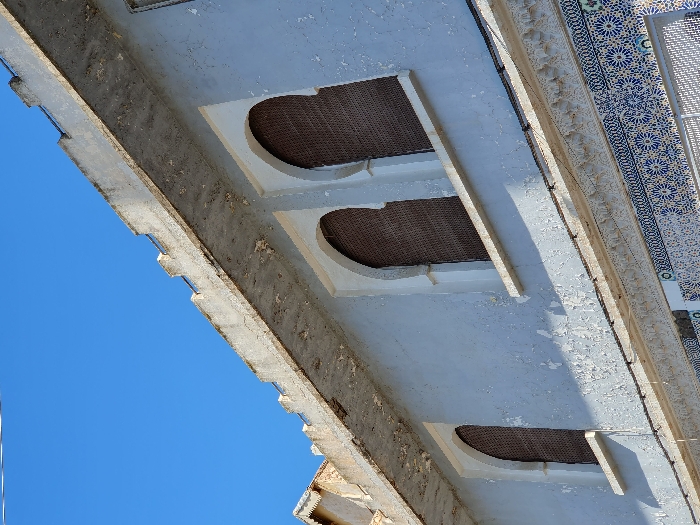
The image displays an architectural detail, captured from a low angle looking upwards, with the scene rotated significantly clockwise. When viewed with a corrected orientation (leveling the horizon), it shows the underside of an overhang or building structure against a clear blue sky on the left.

The primary elements are a weathered concrete or stone beam on the left, a painted ceiling/underside, several arched openings, and ornate decorative tiling on the right.

On the far left, a robust, light grey concrete or stone beam runs diagonally across the frame (horizontally if corrected). Its underside features a series of notched or stepped projections, giving it a somewhat crenellated appearance. This beam shows signs of weathering and discoloration.

To the right of this beam, and forming the main "ceiling" of the overhang, is a light blue-grey surface. This surface exhibits significant peeling paint, revealing a rougher, darker substrate beneath, suggesting age and exposure to the elements.

Within this blue-grey surface, there are at least three rectangular openings with distinct arched tops. These arches are a classic horseshoe or pointed arch shape. Inside each opening, a dark, textured material, possibly a mesh screen, grille, or perforated panel, is visible. These openings are framed by smooth, light-colored (possibly white or light grey) rectangular borders, creating a clean contrast with the peeling paint of the surrounding surface. The openings are arranged linearly.

Further to the right, the structure becomes more decorative. A prominent band of intricate blue and white patterned tiles, likely Zellige or similar Islamic geometric mosaic, runs along the top edge of this section. Below the tiled band, there is a richly carved frieze made of a light-colored material, possibly plaster or stone. This frieze features delicate floral or geometric motifs in relief, showcasing fine craftsmanship. Several thin, dark wires or cables are noticeable running along the lines of this decorative section.

The top-left portion of the image is dominated by a bright, clear blue sky, indicating an outdoor setting with good weather conditions. Shadows are cast across parts of the blue-grey underside and the architectural elements, suggesting strong sunlight, likely during the day.

The architectural style, with its arched openings, geometric tiling, and carved frieze, strongly suggests a building influenced by Islamic or Moorish design, commonly found in regions like North Africa (e.g., Morocco) or Southern Spain (Andalusia). The overall impression is one of historical or traditional architecture with visible signs of aging.
FM-64rhC2

Oct 22, 2024

Mascara, Algeria

Stake attention in this memory

The image displays an architectural detail, captured from a low angle looking upwards, with the scene rotated significantly clockwise. When viewed with a corrected orientation (leveling the horizon), it shows the underside of an overhang or building structure against a clear blue sky on the left. The primary elements are a weathered concrete or stone beam on the left, a painted ceiling/underside, several arched openings, and ornate decorative tiling on the right. On the far left, a robust, light grey concrete or stone beam runs diagonally across the frame (horizontally if corrected). Its underside features a series of notched or stepped projections, giving it a somewhat crenellated appearance. This beam shows signs of weathering and discoloration. To the right of this beam, and forming the main "ceiling" of the overhang, is a light blue-grey surface. This surface exhibits significant peeling paint, revealing a rougher, darker substrate beneath, suggesting age and exposure to the elements. Within this blue-grey surface, there are at least three rectangular openings with distinct arched tops. These arches are a classic horseshoe or pointed arch shape. Inside each opening, a dark, textured material, possibly a mesh screen, grille, or perforated panel, is visible. These openings are framed by smooth, light-colored (possibly white or light grey) rectangular borders, creating a clean contrast with the peeling paint of the surrounding surface. The openings are arranged linearly. Further to the right, the structure becomes more decorative. A prominent band of intricate blue and white patterned tiles, likely Zellige or similar Islamic geometric mosaic, runs along the top edge of this section. Below the tiled band, there is a richly carved frieze made of a light-colored material, possibly plaster or stone. This frieze features delicate floral or geometric motifs in relief, showcasing fine craftsmanship. Several thin, dark wires or cables are noticeable running along the lines of this decorative section. The top-left portion of the image is dominated by a bright, clear blue sky, indicating an outdoor setting with good weather conditions. Shadows are cast across parts of the blue-grey underside and the architectural elements, suggesting strong sunlight, likely during the day. The architectural style, with its arched openings, geometric tiling, and carved frieze, strongly suggests a building influenced by Islamic or Moorish design, commonly found in regions like North Africa (e.g., Morocco) or Southern Spain (Andalusia). The overall impression is one of historical or traditional architecture with visible signs of aging.

transactions
revenues
stakers
Earliest
Latest
Highest stake

No transactions found

More from this user

More from Mascara

FM-64rhC2

Oct 22, 2024

Mascara, Algeria

Licensed under Creative Commons Attribution 4.0 International License. You are free to share and adapt this content with proper attribution.