
Sign in
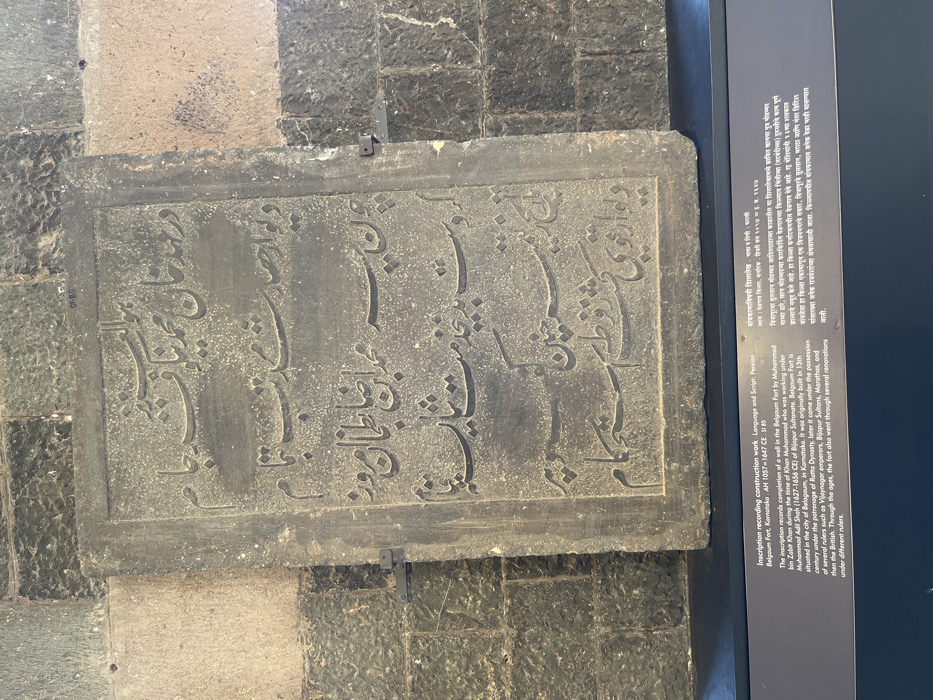
The image displays a rectangular stone inscription slab, likely presented in a museum setting, with a black information board adjacent to it. The dark gray stone slab features multiple lines of carved Persian script, indicative of a historical artifact. It is subtly held in place by small metal brackets and rests against a backdrop of textured, dark stone blocks, resembling a wall or floor.

The visible text on the information board, presented in both English and Marathi/Hindi, describes the stone as an "Inscription recording construction work." It identifies the language and script as Persian, from Belgaum Fort, Karnataka, dated AH 1057 (1647 CE). The inscription details the completion of a wall in Belgaum Fort by Muhammad bin Zabir Khan, under Muhammad Adil Shah (1627-1656 CE) of the Bijapur Sultanate. The board further explains that Belgaum Fort, situated in Belagavi, Karnataka, was originally built in the 13th century by the Ratta Dynasty and later came under the possession of various rulers, including Vijaynagar emperors, Bijapur Sultans, Marathas, and the British, undergoing multiple renovations. The artifact is presumably exhibited in Mumbai, India.
FM-OhtiC3

Dec 10, 2024

Mumbai, India

Stake attention in this memory

The image displays a rectangular stone inscription slab, likely presented in a museum setting, with a black information board adjacent to it. The dark gray stone slab features multiple lines of carved Persian script, indicative of a historical artifact. It is subtly held in place by small metal brackets and rests against a backdrop of textured, dark stone blocks, resembling a wall or floor. The visible text on the information board, presented in both English and Marathi/Hindi, describes the stone as an "Inscription recording construction work." It identifies the language and script as Persian, from Belgaum Fort, Karnataka, dated AH 1057 (1647 CE). The inscription details the completion of a wall in Belgaum Fort by Muhammad bin Zabir Khan, under Muhammad Adil Shah (1627-1656 CE) of the Bijapur Sultanate. The board further explains that Belgaum Fort, situated in Belagavi, Karnataka, was originally built in the 13th century by the Ratta Dynasty and later came under the possession of various rulers, including Vijaynagar emperors, Bijapur Sultans, Marathas, and the British, undergoing multiple renovations. The artifact is presumably exhibited in Mumbai, India.

transactions
revenues
stakers
Earliest
Latest
Highest stake

No transactions found

More from this user

More from Mumbai

FM-OhtiC3

Dec 10, 2024

Mumbai, India

Licensed under Creative Commons Attribution 4.0 International License. You are free to share and adapt this content with proper attribution.