
Sign in
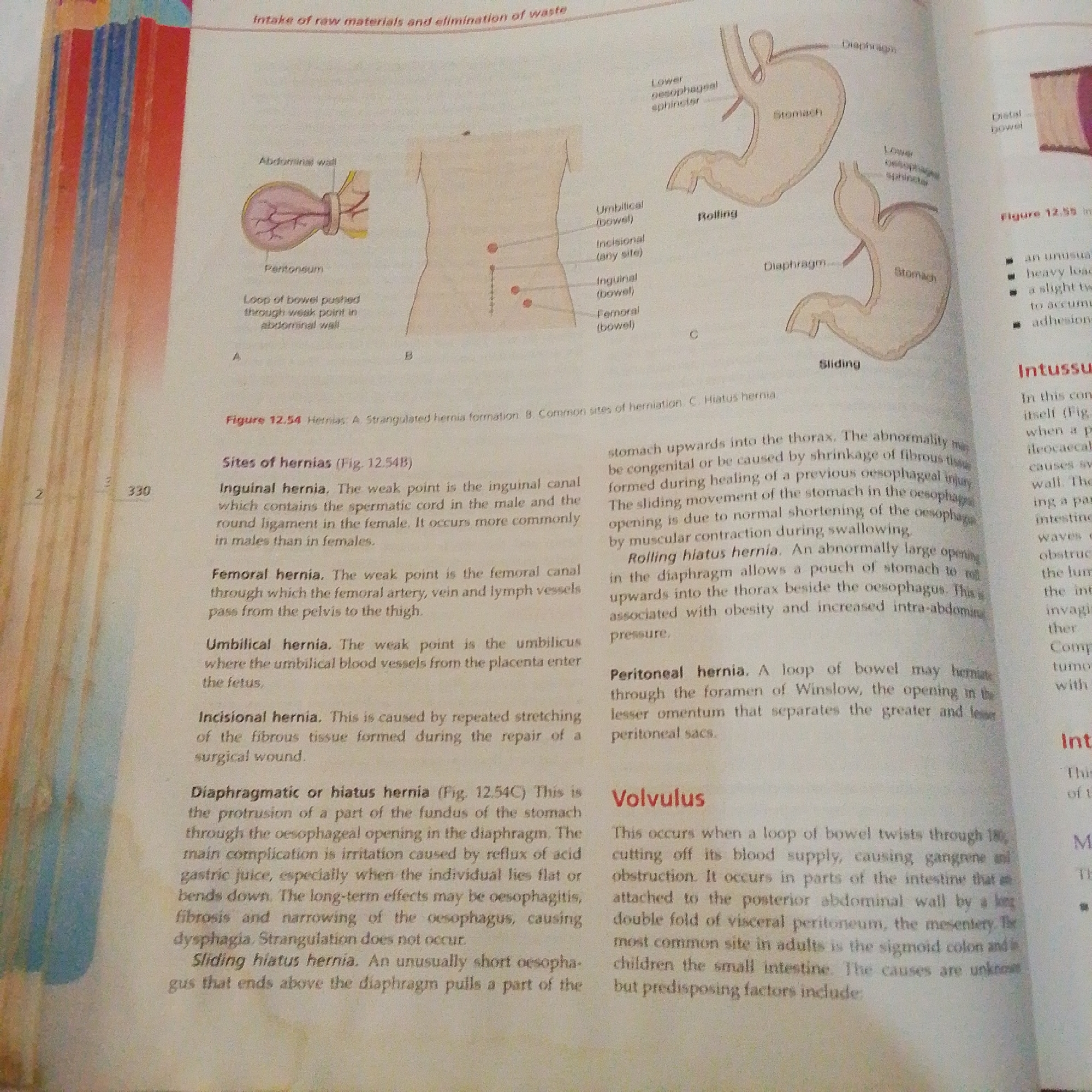
The image is a photograph of an open textbook, likely a medical or biology textbook, showing diagrams and text related to hernias and other gastrointestinal conditions. The subjects are illustrations of the human anatomy, specifically the abdominal region and the stomach, as well as textual descriptions of medical terms.

The scene is a close-up of an open book lying on a flat surface, likely a table or desk. The background is out of focus, but appears to be a typical indoor setting, possibly a classroom or study area. There are no people directly visible, but the content of the book implies a context of human anatomy and health.

The primary activity taking place is educational, with the textbook serving as the medium for conveying information. The diagrams illustrate different types of hernias, including inguinal, femoral, umbilical, incisional, and hiatal hernias, with labeled parts of the anatomy such as the abdominal wall, peritoneum, and diaphragm. The text explains the formation, causes, and effects of these conditions. There is also a section on "Volvulus" and "Intussusception."

Notable details include the specific diagrams: one shows a loop of bowel pushed through a weak point in the abdominal wall (strangulated hernia formation), another displays common sites of herniation on the torso, and two diagrams illustrate "rolling" and "sliding" hiatal hernias. The text also provides definitions and explanations of these medical conditions.

The visible text includes titles such as "Intake of raw materials and elimination of waste," "Figure 12.54 Hernias," "Sites of hernias," "Inguinal hernia," "Femoral hernia," "Umbilical hernia," "Incisional hernia," "Diaphragmatic or hiatus hernia," "Sliding hiatus hernia," "Peritoneal hernia," "Volvulus," and "Intussusception." There are also page numbers visible, such as "330." The context "Jalingo, Nigeria" suggests the book might be used in an educational institution in that location, but there are no direct visual cues in the image to confirm this. The lighting is bright, suggesting it is daytime or under artificial lights. There are no obvious emotional cues as the image focuses on illustrative and textual content.
FM-66btC3

Jun 30, 2026, 1:44 PM

Jalingo, Nigeria

Stake attention in this memory

analytical
clinical
concerned
serious
curious

The image is a photograph of an open textbook, likely a medical or biology textbook, showing diagrams and text related to hernias and other gastrointestinal conditions. The subjects are illustrations of the human anatomy, specifically the abdominal region and the stomach, as well as textual descriptions of medical terms. The scene is a close-up of an open book lying on a flat surface, likely a table or desk. The background is out of focus, but appears to be a typical indoor setting, possibly a classroom or study area. There are no people directly visible, but the content of the book implies a context of human anatomy and health. The primary activity taking place is educational, with the textbook serving as the medium for conveying information. The diagrams illustrate different types of hernias, including inguinal, femoral, umbilical, incisional, and hiatal hernias, with labeled parts of the anatomy such as the abdominal wall, peritoneum, and diaphragm. The text explains the formation, causes, and effects of these conditions. There is also a section on "Volvulus" and "Intussusception." Notable details include the specific diagrams: one shows a loop of bowel pushed through a weak point in the abdominal wall (strangulated hernia formation), another displays common sites of herniation on the torso, and two diagrams illustrate "rolling" and "sliding" hiatal hernias. The text also provides definitions and explanations of these medical conditions. The visible text includes titles such as "Intake of raw materials and elimination of waste," "Figure 12.54 Hernias," "Sites of hernias," "Inguinal hernia," "Femoral hernia," "Umbilical hernia," "Incisional hernia," "Diaphragmatic or hiatus hernia," "Sliding hiatus hernia," "Peritoneal hernia," "Volvulus," and "Intussusception." There are also page numbers visible, such as "330." The context "Jalingo, Nigeria" suggests the book might be used in an educational institution in that location, but there are no direct visual cues in the image to confirm this. The lighting is bright, suggesting it is daytime or under artificial lights. There are no obvious emotional cues as the image focuses on illustrative and textual content.

Loading AttnAds…

transactions
revenues
stakers
Earliest
Latest
Highest stake

No transactions found

More from this user

More from Jalingo

FM-66btC3

Jun 30, 2026, 1:44 PM

Jalingo, Nigeria

Licensed under Creative Commons Attribution 4.0 International License. You are free to share and adapt this content with proper attribution.