
Stake attention in this memory
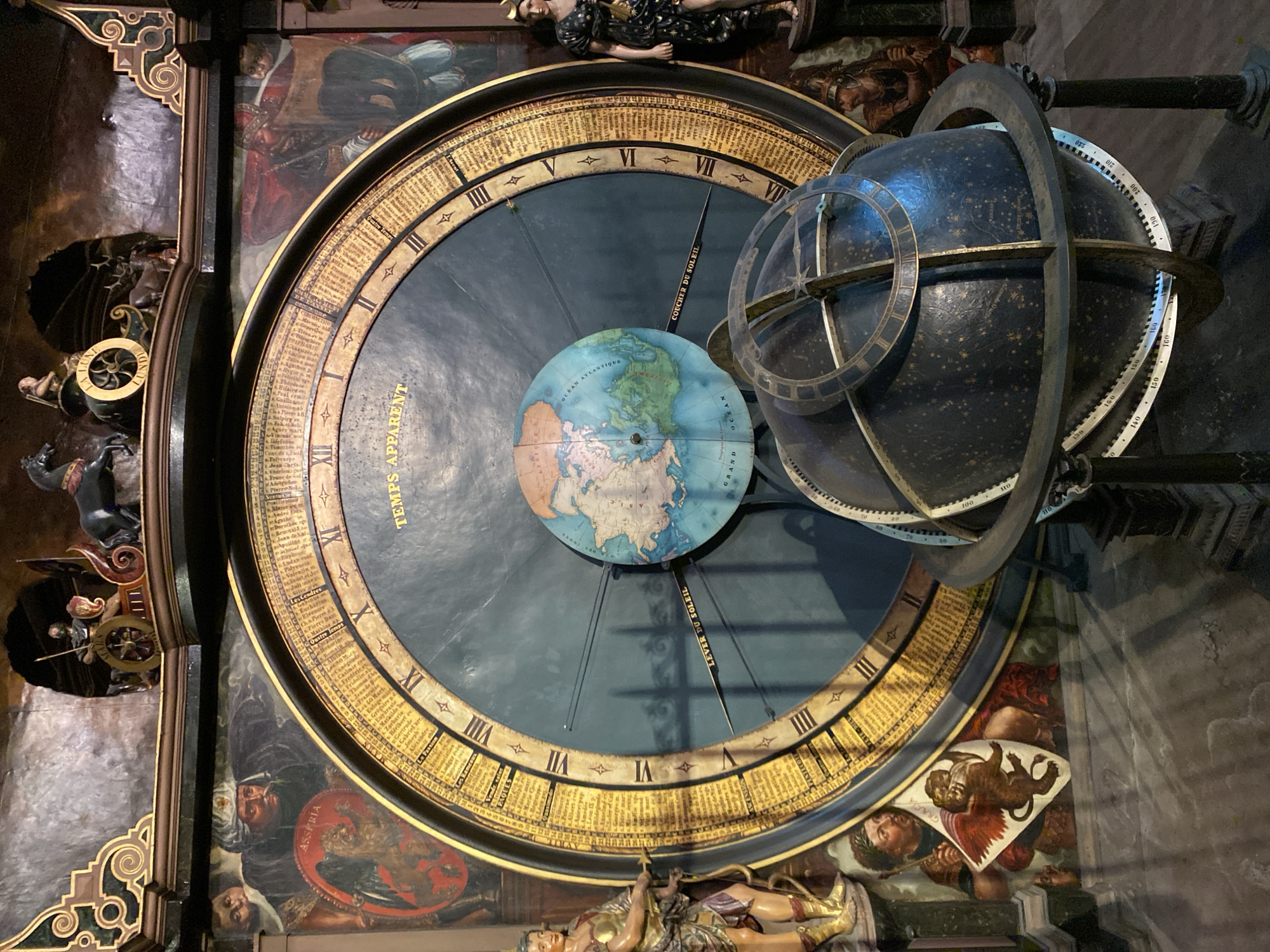
This media file captures an elaborate, historical astronomical clock or astrolabe, likely situated within the Strasbourg Cathedral in France. The image is taken from a slightly elevated perspective, looking down upon the complex mechanism. The central feature is a large, dark blue circular dial. Its gilded outer ring serves as a calendar or zodiac, inscribed with Roman numerals I through XII, and numerous small French text entries denoting dates and names, including "ASCENSION" and "PENTECOTE." The phrase "TEMPS APPARENT" (Apparent Time) is prominently displayed on this ring. At the center of the dial is an Earth globe, depicting continents such as North America, South America, Europe, Africa, and Asia, with "OCEAN ATLANTIQUE" (Atlantic Ocean) and "GRAND OCEAN" (Great Ocean) clearly labeled. Pointers extending from the globe indicate celestial events, marked "LEVER DU SOLEIL" (Sunrise) and "COUCHER DU SOLEIL" (Sunset). To the right of the central dial is a large, dark blue celestial globe or armillary sphere, adorned with golden stars and constellations. This sphere is encircled by multiple metal rings, some bearing numerical markings like 100, 110, 130, 140, 150, 160, 190, and 200. The entire clock mechanism is framed by rich, painted murals featuring reclining and allegorical figures. Intricate gilded patterns and dark carved woodwork add to the ornate decoration. Small, sculptural figurines, including a golden figure at the bottom and a reclining figure with stars at the top, further embellish the piece. Text within the surrounding murals includes "ASSPRIA" and "GRACIA." The French language on the clock face, combined with its historical and astronomical complexity, firmly places this artifact within its Strasbourg, France context.
Loading AttnAds…
No transactions found