
Sign in
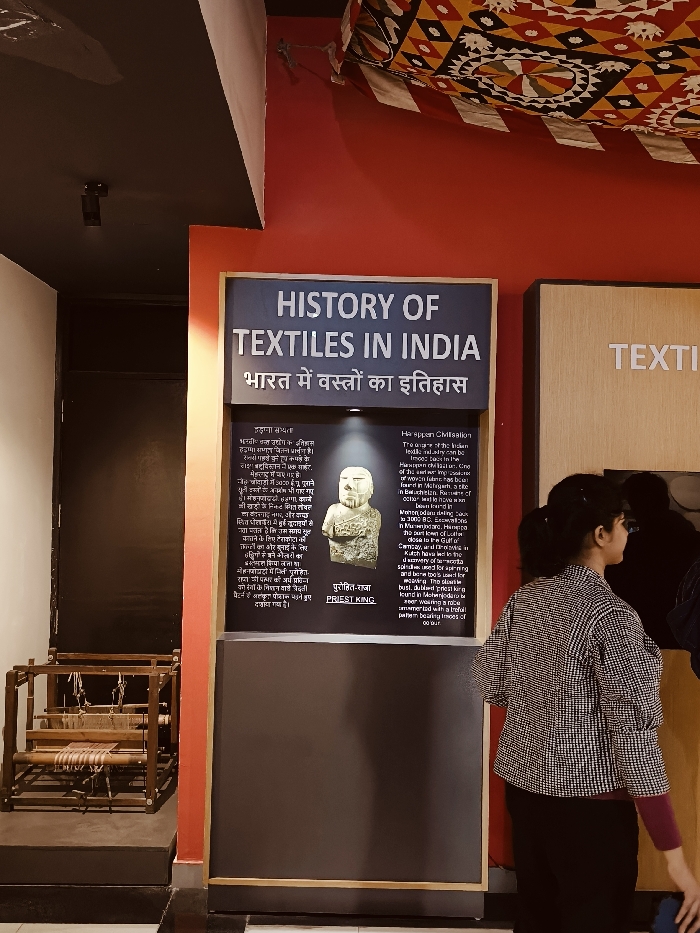
The image depicts an indoor scene within a museum or exhibition, likely focused on the history of textiles in India. The central feature is a large display panel, titled "HISTORY OF TEXTILES IN INDIA" in prominent white English lettering, with the Hindi translation "भारत में वस्त्रों का इतिहास" below it.

The panel's dark background is illuminated by spotlights, highlighting informational text in both English and Hindi. The text discusses the Harappan Civilization and the origins of the Indian textile industry, referencing discoveries in Mohenjo-Daro, Balochistan, and Lothal, Kutch, dating back to 2000-3000 BC. It mentions terracotta spindles and bone tools used for spinning and weaving. Integrated into the display is a stone bust labeled "PRIEST KING" (पुरोहित-राजा), which is described as wearing an ornamented robe with a trefoil pattern.

To the right of this main exhibit, a young woman with dark hair tied back, wearing a black and white checkered jacket over a maroon shirt and dark pants, is observing another display panel, of which only the partial text "TEXTI" (presumably "TEXTILES") is visible.

On the far left, a traditional wooden handloom with fabric being woven is on display, complementing the textile theme. The museum walls are painted a striking red, contrasting with a dark ceiling. Above the main display, a colorful fabric with intricate geometric patterns, possibly a traditional Indian textile, hangs decoratively. The scene captures an informative and culturally rich environment dedicated to India's textile heritage. The presence of both English and Hindi text, along with the given location context, confirms the setting as New Delhi, India.
FM-v457R2

Jan 21, 2025, 10:41 AM

New Delhi, India

Stake attention in this memory

The image depicts an indoor scene within a museum or exhibition, likely focused on the history of textiles in India. The central feature is a large display panel, titled "HISTORY OF TEXTILES IN INDIA" in prominent white English lettering, with the Hindi translation "भारत में वस्त्रों का इतिहास" below it. The panel's dark background is illuminated by spotlights, highlighting informational text in both English and Hindi. The text discusses the Harappan Civilization and the origins of the Indian textile industry, referencing discoveries in Mohenjo-Daro, Balochistan, and Lothal, Kutch, dating back to 2000-3000 BC. It mentions terracotta spindles and bone tools used for spinning and weaving. Integrated into the display is a stone bust labeled "PRIEST KING" (पुरोहित-राजा), which is described as wearing an ornamented robe with a trefoil pattern. To the right of this main exhibit, a young woman with dark hair tied back, wearing a black and white checkered jacket over a maroon shirt and dark pants, is observing another display panel, of which only the partial text "TEXTI" (presumably "TEXTILES") is visible. On the far left, a traditional wooden handloom with fabric being woven is on display, complementing the textile theme. The museum walls are painted a striking red, contrasting with a dark ceiling. Above the main display, a colorful fabric with intricate geometric patterns, possibly a traditional Indian textile, hangs decoratively. The scene captures an informative and culturally rich environment dedicated to India's textile heritage. The presence of both English and Hindi text, along with the given location context, confirms the setting as New Delhi, India.

transactions
revenues
stakers
Earliest
Latest
Highest stake

No transactions found

More from this user

More from New Delhi

FM-v457R2

Jan 21, 2025, 10:41 AM

New Delhi, India

Licensed under Creative Commons Attribution 4.0 International License. You are free to share and adapt this content with proper attribution.