
Sign in
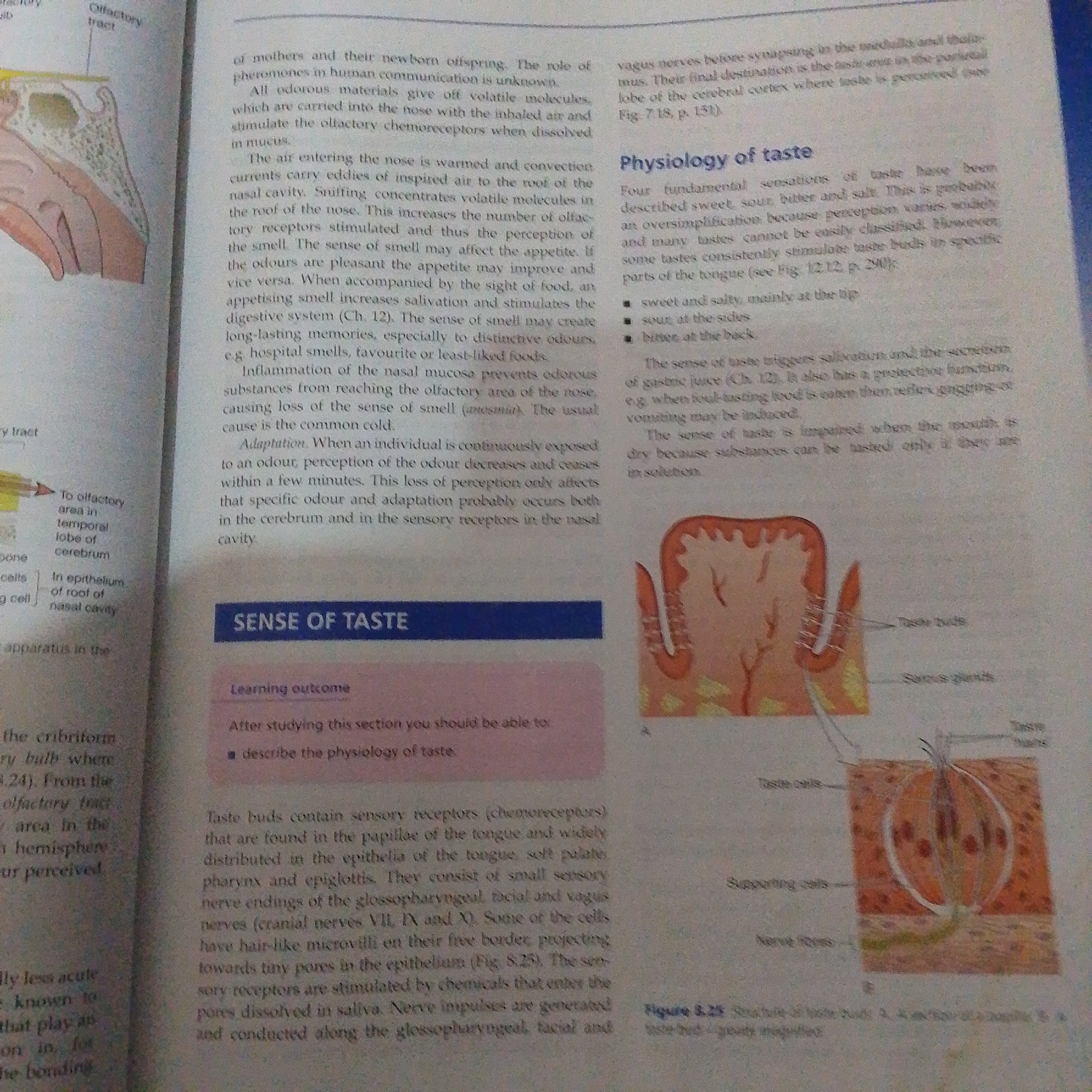
This media file is a scanned image of an open textbook page. The page is divided into two columns, with text and illustrations. The left column features a diagram of the human nasal cavity, illustrating the olfactory tract and its connection to the temporal lobe of the cerebrum. Accompanying text discusses the sense of smell, including olfactory receptors, adaptation, and common causes of smell loss like the common cold.

The right column focuses on the "Physiology of taste." It begins by introducing the four fundamental taste sensations: sweet, sour, bitter, and salt, acknowledging that this classification is an oversimplification. Bullet points highlight the areas of the tongue where these tastes are primarily perceived. The text further explains how taste triggers salivation and gastric juice secretion, and how a dry mouth can impair taste perception. An illustration depicts a cross-section of a taste bud, labeling its components such as taste cells, supporting cells, and nerve fibers. A caption beneath this illustration reads "Figure 8.25 Structure of a taste bud. A. Longitudinal section of a taste bud; B, Taste bud, greatly magnified."

Visible text includes headings like "Olfactory tract," "SENSE OF TASTE," and "Physiology of taste," as well as descriptive labels on the diagrams and body text detailing biological processes related to smell and taste. There are no people, specific time of day, or weather conditions depicted. The setting is clearly an academic or educational context, with the content pertaining to human biology, specifically the sensory systems of smell and taste.
FM-66btC3

Jun 30, 2026

Jalingo, Nigeria

Stake attention in this memory

informative
educational
scientific
focused
explanatory

This media file is a scanned image of an open textbook page. The page is divided into two columns, with text and illustrations. The left column features a diagram of the human nasal cavity, illustrating the olfactory tract and its connection to the temporal lobe of the cerebrum. Accompanying text discusses the sense of smell, including olfactory receptors, adaptation, and common causes of smell loss like the common cold. The right column focuses on the "Physiology of taste." It begins by introducing the four fundamental taste sensations: sweet, sour, bitter, and salt, acknowledging that this classification is an oversimplification. Bullet points highlight the areas of the tongue where these tastes are primarily perceived. The text further explains how taste triggers salivation and gastric juice secretion, and how a dry mouth can impair taste perception. An illustration depicts a cross-section of a taste bud, labeling its components such as taste cells, supporting cells, and nerve fibers. A caption beneath this illustration reads "Figure 8.25 Structure of a taste bud. A. Longitudinal section of a taste bud; B, Taste bud, greatly magnified." Visible text includes headings like "Olfactory tract," "SENSE OF TASTE," and "Physiology of taste," as well as descriptive labels on the diagrams and body text detailing biological processes related to smell and taste. There are no people, specific time of day, or weather conditions depicted. The setting is clearly an academic or educational context, with the content pertaining to human biology, specifically the sensory systems of smell and taste.

transactions
revenues
stakers
Earliest
Latest
Highest stake

No transactions found

More from this user

More from Jalingo

FM-66btC3

Jun 30, 2026

Jalingo, Nigeria

Licensed under Creative Commons Attribution 4.0 International License. You are free to share and adapt this content with proper attribution.