
Sign in
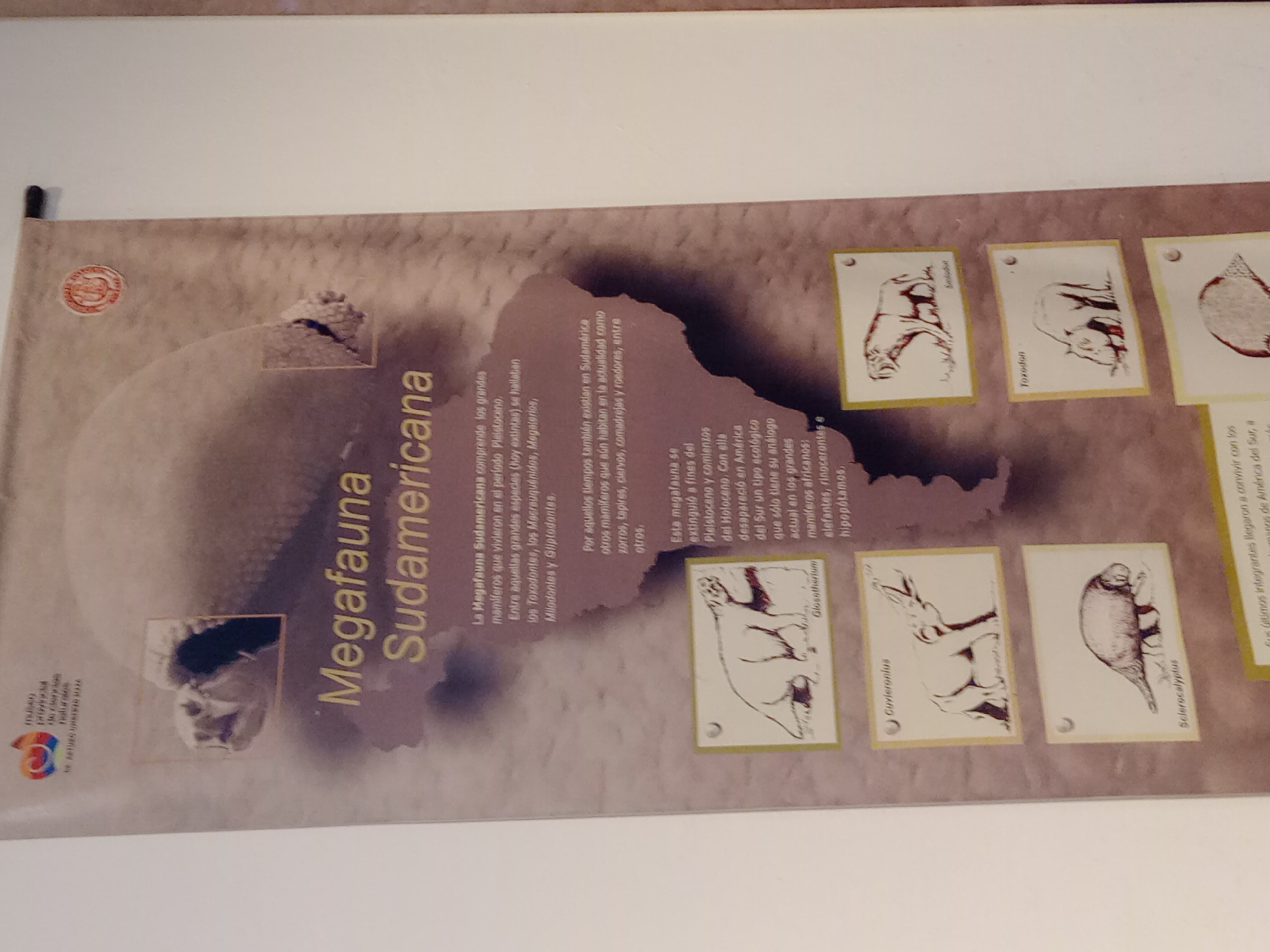
This image captures a vertical banner displayed indoors, likely in a museum or educational exhibition in Villa Carlos Paz, Argentina. The banner's central theme is "Megafauna Sudamericana" (South American Megafauna).

The main subject is a large, brown-toned banner featuring a silhouette of South America as its background. Overlaid on this map are various illustrations of extinct megafauna from the region, depicted in a sketch-like style with red outlines. Prominently displayed animal names include "Toxodon," "Seladon" (likely Smilodon given the illustration), "Glosetherium," "Cuvieronlus," and "Sclerocalyptus."

The banner contains Spanish text providing information about these ancient creatures. It explains that the South American megafauna comprises large mammals from the Pleistocene period, including Toxodonts, Macraucheniids, Megatheriums, Mylodonts, and Glyptodonts. The text also notes that some mammals, such as foxes, tapirs, deer, weasels, and rodents, still exist today. It details the extinction of this megafauna at the end of the Pleistocene and beginning of the Holocene, highlighting that its ecological niche in South America is now only comparable to large African mammals like elephants, rhinoceroses, and hippopotamuses. A partial sentence mentions the last members coexisting with humans in South America.

The banner is well-lit, suggesting an intentional display setup. A small, circular logo is visible in the top-left corner, though its details are not legible. The overall impression is an informative and visually engaging display dedicated to prehistoric life on the South American continent.
FM-DpvwB2

Apr 24, 2026

Villa Carlos Paz, Argentina

Moment

Stake attention in this memory

curiosity
wonder
nostalgia
educational
historical

This image captures a vertical banner displayed indoors, likely in a museum or educational exhibition in Villa Carlos Paz, Argentina. The banner's central theme is "Megafauna Sudamericana" (South American Megafauna). The main subject is a large, brown-toned banner featuring a silhouette of South America as its background. Overlaid on this map are various illustrations of extinct megafauna from the region, depicted in a sketch-like style with red outlines. Prominently displayed animal names include "Toxodon," "Seladon" (likely Smilodon given the illustration), "Glosetherium," "Cuvieronlus," and "Sclerocalyptus." The banner contains Spanish text providing information about these ancient creatures. It explains that the South American megafauna comprises large mammals from the Pleistocene period, including Toxodonts, Macraucheniids, Megatheriums, Mylodonts, and Glyptodonts. The text also notes that some mammals, such as foxes, tapirs, deer, weasels, and rodents, still exist today. It details the extinction of this megafauna at the end of the Pleistocene and beginning of the Holocene, highlighting that its ecological niche in South America is now only comparable to large African mammals like elephants, rhinoceroses, and hippopotamuses. A partial sentence mentions the last members coexisting with humans in South America. The banner is well-lit, suggesting an intentional display setup. A small, circular logo is visible in the top-left corner, though its details are not legible. The overall impression is an informative and visually engaging display dedicated to prehistoric life on the South American continent.

transactions
revenues
stakers
Earliest
Latest
Highest stake

No transactions found

More from this user

More from Villa Carlos Paz

FM-DpvwB2

Apr 24, 2026

Villa Carlos Paz, Argentina

Licensed under Creative Commons Attribution 4.0 International License. You are free to share and adapt this content with proper attribution.