
Sign in
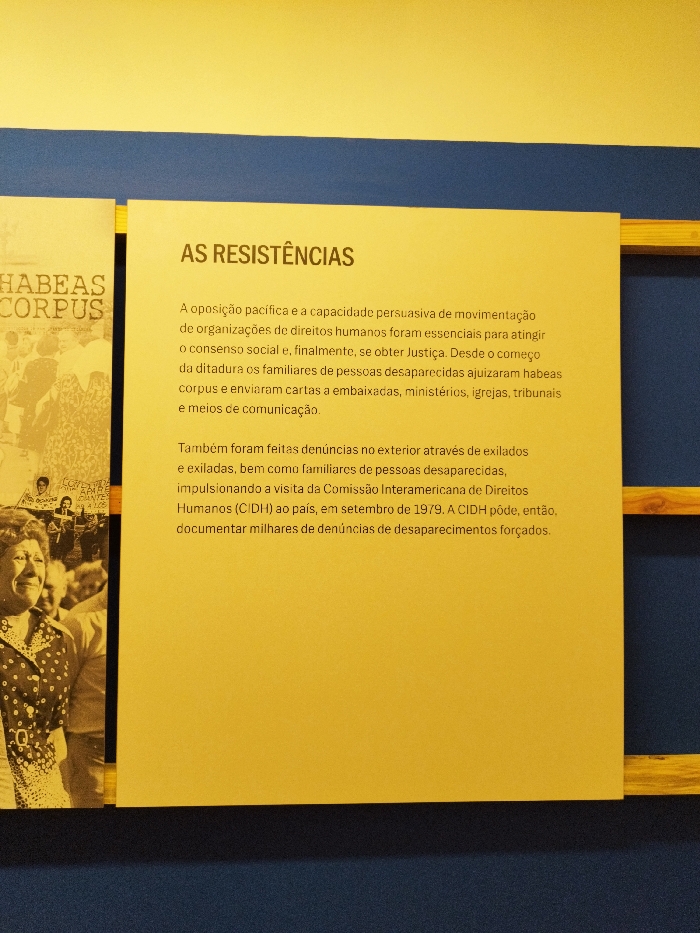
The image shows a wall display in a museum in São Paulo, Brazil at the coordinates -23.627 latitude, -46.674 longitude. The display features a yellow panel with black text, titled "AS RESISTÊNCIAS," which translates to "The Resistances." The text describes the peaceful opposition and persuasive mobilization of human rights organizations in Brazil. It mentions that these organizations were crucial in achieving social consensus and, ultimately, obtaining justice. The text also highlights the role of families of disappeared persons during the dictatorship, noting that they sought to obtain habeas corpus and sent letters to embassies, ministries, churches, courts, and other communication channels. The text concludes by describing how denunciations were made from outside the country by exiles and families of the disappeared, culminating in the Inter-American Commission on Human Rights visiting Brazil in September 1979. The Commission was then able to document thousands of forced disappearances. To the left of the panel, there is a black and white photograph showing a woman wearing a patterned dress, standing next to a group of people. The woman's face is visible, and she appears to be smiling. The display is mounted on a dark blue wall with wooden trim around the edges.
Mrv

May 14, 2025, 6:13 PM

São Paulo, Brazil

Stake attention in this memory

historical
political
informative
serious
resistant

The image shows a wall display in a museum in São Paulo, Brazil at the coordinates -23.627 latitude, -46.674 longitude. The display features a yellow panel with black text, titled "AS RESISTÊNCIAS," which translates to "The Resistances." The text describes the peaceful opposition and persuasive mobilization of human rights organizations in Brazil. It mentions that these organizations were crucial in achieving social consensus and, ultimately, obtaining justice. The text also highlights the role of families of disappeared persons during the dictatorship, noting that they sought to obtain habeas corpus and sent letters to embassies, ministries, churches, courts, and other communication channels. The text concludes by describing how denunciations were made from outside the country by exiles and families of the disappeared, culminating in the Inter-American Commission on Human Rights visiting Brazil in September 1979. The Commission was then able to document thousands of forced disappearances. To the left of the panel, there is a black and white photograph showing a woman wearing a patterned dress, standing next to a group of people. The woman's face is visible, and she appears to be smiling. The display is mounted on a dark blue wall with wooden trim around the edges.

Loading AttnAds…

transactions
revenues
stakers
Earliest
Latest
Highest stake

No transactions found

More from this user

More from São Paulo

Mrv

May 14, 2025, 6:13 PM

São Paulo, Brazil

Licensed under Creative Commons Attribution 4.0 International License. You are free to share and adapt this content with proper attribution.