
Sign in
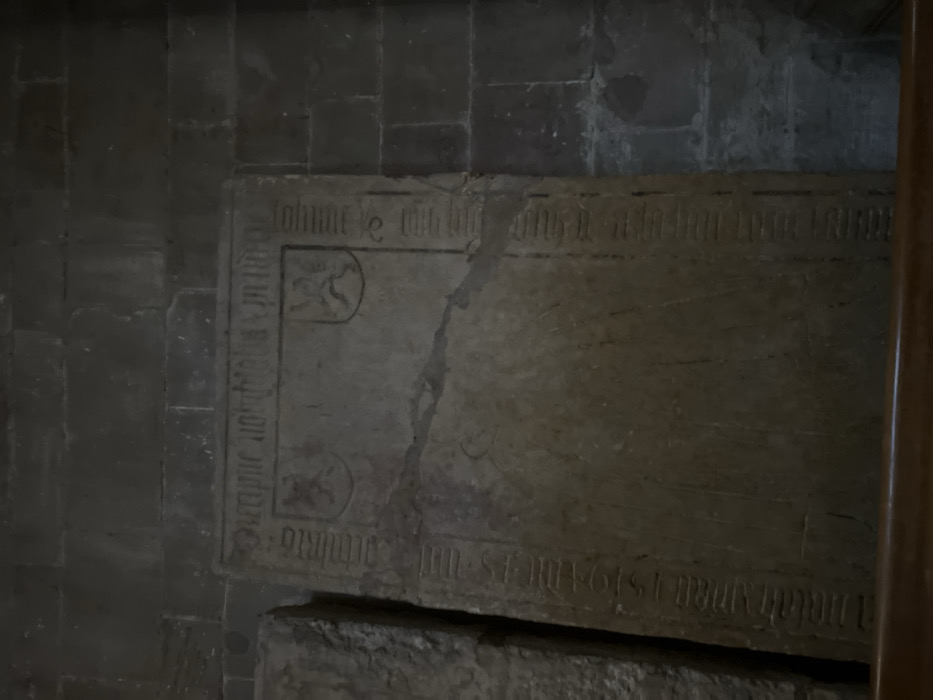
This media file presents a close-up view of an ancient, rectangular stone funerary slab, likely a tombstone, resting on a darker stone floor or platform. The slab, appearing to be made of light-colored stone such as limestone, is significantly aged and marked by a prominent diagonal crack that traverses its surface. The overall setting is indoors, suggested by the dim, consistent lighting and the surrounding floor, which consists of large, irregular dark stone tiles. The location is presumed to be in Geneva, Switzerland, possibly within a historical church or cathedral.

The slab features carved inscriptions along its outer edges and stylized motifs within circular frames at its corners, two of which are visible in the top-left and bottom-left. These motifs appear to be heraldic or cross-like designs. The central area of the slab is largely worn smooth and blank. No human activity is depicted in the static scene.

Visible text, carved in an old script (likely a form of Latin, possibly Gothic), can be partially deciphered from the slab's edges:
*   Along the top edge, the inscription begins with "Iohannes de Dublio armiger quondam..." (John of Dublin, esquire, formerly...).
*   The left edge includes "...obijt die iouis..." (died on Thursday...).
*   The bottom edge reveals part of the death year as "...anno domini MCCC sexagesimo..." (in the year of our Lord 1360...).

The worn condition of the stone and the style of the script indicate a medieval or early modern origin, underscoring the artifact's historical significance.
FM-nv0sw2

Dec 28, 2024

Genève, Switzerland

Stake attention in this memory

This media file presents a close-up view of an ancient, rectangular stone funerary slab, likely a tombstone, resting on a darker stone floor or platform. The slab, appearing to be made of light-colored stone such as limestone, is significantly aged and marked by a prominent diagonal crack that traverses its surface. The overall setting is indoors, suggested by the dim, consistent lighting and the surrounding floor, which consists of large, irregular dark stone tiles. The location is presumed to be in Geneva, Switzerland, possibly within a historical church or cathedral. The slab features carved inscriptions along its outer edges and stylized motifs within circular frames at its corners, two of which are visible in the top-left and bottom-left. These motifs appear to be heraldic or cross-like designs. The central area of the slab is largely worn smooth and blank. No human activity is depicted in the static scene. Visible text, carved in an old script (likely a form of Latin, possibly Gothic), can be partially deciphered from the slab's edges: * Along the top edge, the inscription begins with "Iohannes de Dublio armiger quondam..." (John of Dublin, esquire, formerly...). * The left edge includes "...obijt die iouis..." (died on Thursday...). * The bottom edge reveals part of the death year as "...anno domini MCCC sexagesimo..." (in the year of our Lord 1360...). The worn condition of the stone and the style of the script indicate a medieval or early modern origin, underscoring the artifact's historical significance.

transactions
revenues
stakers
Earliest
Latest
Highest stake

No transactions found

More from this user

More from Genève

FM-nv0sw2

Dec 28, 2024

Genève, Switzerland

Licensed under Creative Commons Attribution 4.0 International License. You are free to share and adapt this content with proper attribution.