
Stake attention in this memory
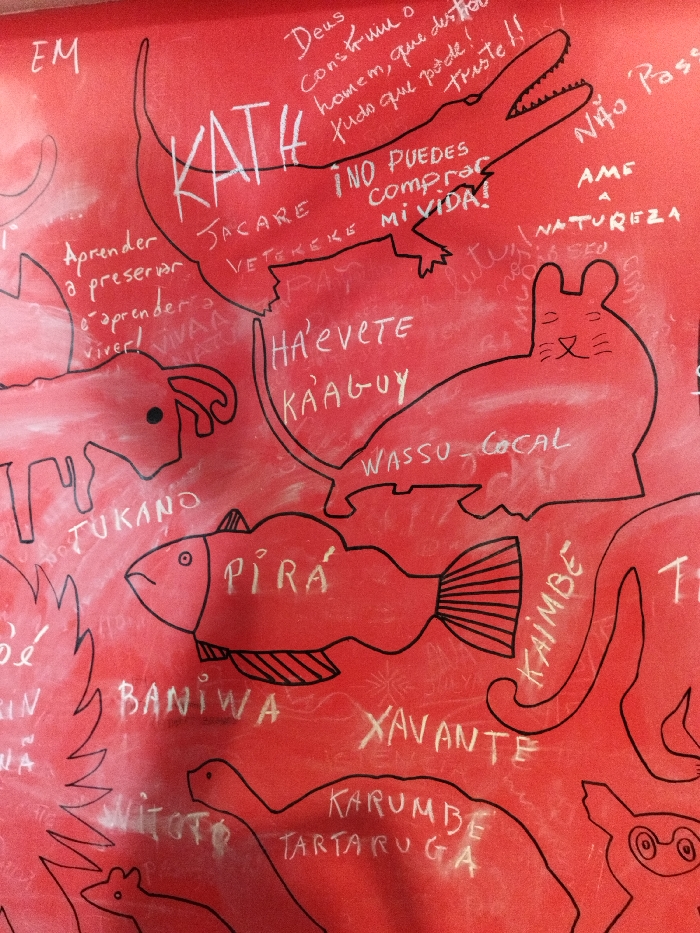
An interactive red wall display, marked with minor scuffs from public interaction, features numerous black outline animal drawings and white chalk or marker texts. Prominent animal subjects include an alligator or caiman labeled "JACARE" (Portuguese), with "KATH" and "VETEREKE" nearby; a four-legged animal, possibly a capybara or tapir, near the tribal name "TUKANO"; a feline creature with distinct facial markings, next to "HA'EVETE KA'AGUY" and "WASSU - COCAL"; a fish labeled "PIRÁ" (Portuguese); and a turtle-like creature labeled "TARTARUGA" (Portuguese), with "KARUMBE" and "XAVANTE" (an indigenous group) also visible. A primate-like figure and abstract animal shapes appear in other sections, often alongside indigenous tribal names like "WITOTO," "BANIWA," and "KAIMBE." The display is covered with messages in Portuguese, Spanish, and various indigenous languages. Notable Portuguese texts include: "Deus Construiu o homem, que destrói tudo que pode! Triste!!" (God created man, who destroys everything he can! Sad!!), "Aprender a preservar é aprender a viver!" (To learn to preserve is to learn to live!), "VIVA A NATUREZA" (Long Live Nature), and "AME A NATUREZA" (Love Nature). A Spanish phrase reads: "¡NO PUEDES comprar mi VIDA!" (You cannot buy my LIFE!). The handwritten drawings and texts indicate an interactive exhibit where visitors contribute, collectively commenting on environmental preservation, the impact of human actions, and the importance of indigenous cultures and languages. The setting is likely a cultural or educational institution in São Paulo, Brazil, focusing on socio-environmental issues and indigenous heritage.
Loading AttnAds…
No transactions found