
Sign in
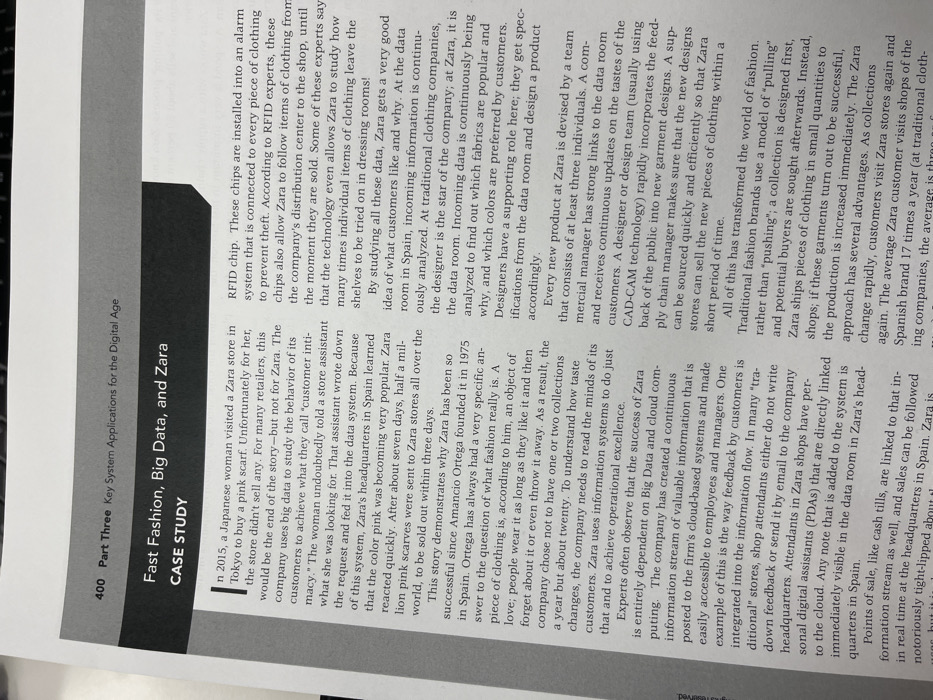
The image displays a printed page, likely from a textbook or business case study document, laid flat. The page is predominantly white with black text. A prominent dark grey vertical bar on the left side contains white text.

The visible text indicates that the document is titled "Fast Fashion, Big Data, and Zara" and is a "CASE STUDY." It is labeled "400 Part Three Key System Applications for the Digital Age."

The body of the text discusses Zara's business practices. It begins with an anecdote about a Japanese woman seeking a pink scarf in Tokyo and Zara's rapid response based on customer feedback and data. The text elaborates on Zara's use of big data, continuous information streams, cloud computing, and RFID technology to track clothing items and understand customer preferences. It describes how designers and supply chain managers work with data to quickly produce new garments. The case study also contrasts Zara's "pulling" model with traditional fashion's "pushing" model, highlighting the advantages of Zara's approach, such as frequent customer visits.

The page appears to be slightly curved, suggesting it's from a bound book or magazine. The lighting is even, implying an indoor setting. No people or specific outdoor scenes are depicted in the photograph.
FM-kkr2I2

Jan 13, 2025

Reims, France

Stake attention in this memory

The image displays a printed page, likely from a textbook or business case study document, laid flat. The page is predominantly white with black text. A prominent dark grey vertical bar on the left side contains white text. The visible text indicates that the document is titled "Fast Fashion, Big Data, and Zara" and is a "CASE STUDY." It is labeled "400 Part Three Key System Applications for the Digital Age." The body of the text discusses Zara's business practices. It begins with an anecdote about a Japanese woman seeking a pink scarf in Tokyo and Zara's rapid response based on customer feedback and data. The text elaborates on Zara's use of big data, continuous information streams, cloud computing, and RFID technology to track clothing items and understand customer preferences. It describes how designers and supply chain managers work with data to quickly produce new garments. The case study also contrasts Zara's "pulling" model with traditional fashion's "pushing" model, highlighting the advantages of Zara's approach, such as frequent customer visits. The page appears to be slightly curved, suggesting it's from a bound book or magazine. The lighting is even, implying an indoor setting. No people or specific outdoor scenes are depicted in the photograph.

transactions
revenues
stakers
Earliest
Latest
Highest stake

No transactions found

More from this user

More from Reims

FM-kkr2I2

Jan 13, 2025

Reims, France

Licensed under Creative Commons Attribution 4.0 International License. You are free to share and adapt this content with proper attribution.