Sign in
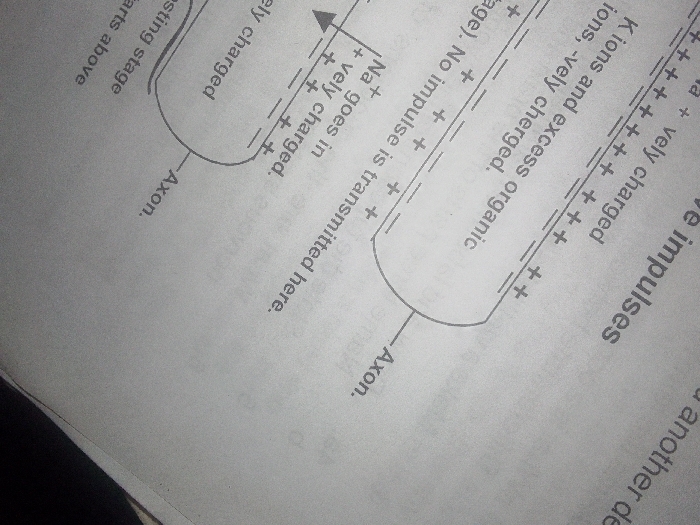
The image displays a page from a textbook or educational material, featuring a biological diagram illustrating concepts related to nerve impulses and an axon. The page is light in color, possibly white or off-white, and appears slightly crumpled or creased. The diagram is drawn with simple lines and various labels and symbols.

The central part of the diagram consists of two segmented structures, each labeled as "Axon." These segments represent parts of a nerve cell's axon.

**On the right side of the diagram, in the upper region:**
One segment of the axon is shown with numerous positive charges ("+") outside its membrane and negative charges ("-") inside. Text surrounding this segment provides further details:
- "ve impulses" (likely "nerve impulses" with part cut off)
- "+++++++++++"
- "Na+ vely charged" (likely "Na+ positively charged") is visible near the exterior positive charges.
- "K ions and excess organic ions, -vely charged." is written inside the axon segment, explaining the negative internal charge.
- Below this segment, "another de" is visible, possibly part of "another depolarization" or a similar phrase, indicating continuity or progression.

**On the left side of the diagram, in the lower region:**
Another segment of the axon is depicted. It also shows positive charges ("+") outside and negative charges ("-") inside. An arrow points from outside to inside the axon, alongside the text "Na+ goes in" and "vely charged" (likely "positively charged"). This segment is explicitly labeled as the "resting stage" with the text "sting stage" clearly visible and "arts above" (possibly "starts above" or "parts above") near the top edge. An arrow points away from this resting stage segment towards the right, where the text "+age). No impulse is transmitted here." is written, implying that in this depicted state, the axon is not actively conducting an electrical impulse. This text fragment suggests the full phrase might have been something like "resting stage). No impulse is transmitted here." or "This stage). No impulse is transmitted here."

The overall diagram explains the distribution of ions and charges across an axon membrane in different states, particularly emphasizing the "resting stage" and a state where no impulse is being transmitted, contrasting it with the general concept of "nerve impulses" shown on the right. The presence of Na+ and K+ ions, and organic ions, indicates the electrochemical basis of nerve signal transmission.
G
Georgie

Jan 31, 2026, 4:16 PM

Oba-Aboji, Nigeria

Stake attention in this memory

Intellectual
Curiosity
Focus
Boredom
Concentration

The image displays a page from a textbook or educational material, featuring a biological diagram illustrating concepts related to nerve impulses and an axon. The page is light in color, possibly white or off-white, and appears slightly crumpled or creased. The diagram is drawn with simple lines and various labels and symbols. The central part of the diagram consists of two segmented structures, each labeled as "Axon." These segments represent parts of a nerve cell's axon. **On the right side of the diagram, in the upper region:** One segment of the axon is shown with numerous positive charges ("+") outside its membrane and negative charges ("-") inside. Text surrounding this segment provides further details: - "ve impulses" (likely "nerve impulses" with part cut off) - "+++++++++++" - "Na+ vely charged" (likely "Na+ positively charged") is visible near the exterior positive charges. - "K ions and excess organic ions, -vely charged." is written inside the axon segment, explaining the negative internal charge. - Below this segment, "another de" is visible, possibly part of "another depolarization" or a similar phrase, indicating continuity or progression. **On the left side of the diagram, in the lower region:** Another segment of the axon is depicted. It also shows positive charges ("+") outside and negative charges ("-") inside. An arrow points from outside to inside the axon, alongside the text "Na+ goes in" and "vely charged" (likely "positively charged"). This segment is explicitly labeled as the "resting stage" with the text "sting stage" clearly visible and "arts above" (possibly "starts above" or "parts above") near the top edge. An arrow points away from this resting stage segment towards the right, where the text "+age). No impulse is transmitted here." is written, implying that in this depicted state, the axon is not actively conducting an electrical impulse. This text fragment suggests the full phrase might have been something like "resting stage). No impulse is transmitted here." or "This stage). No impulse is transmitted here." The overall diagram explains the distribution of ions and charges across an axon membrane in different states, particularly emphasizing the "resting stage" and a state where no impulse is being transmitted, contrasting it with the general concept of "nerve impulses" shown on the right. The presence of Na+ and K+ ions, and organic ions, indicates the electrochemical basis of nerve signal transmission.

Loading AttnAds…

transactions
revenues
stakers
Earliest
Latest
Highest stake

No transactions found

More from this user

More from Oba-Aboji

GGeorgie

Jan 31, 2026, 4:16 PM

Oba-Aboji, Nigeria

Licensed under Creative Commons Attribution 4.0 International License. You are free to share and adapt this content with proper attribution.