
Sign in
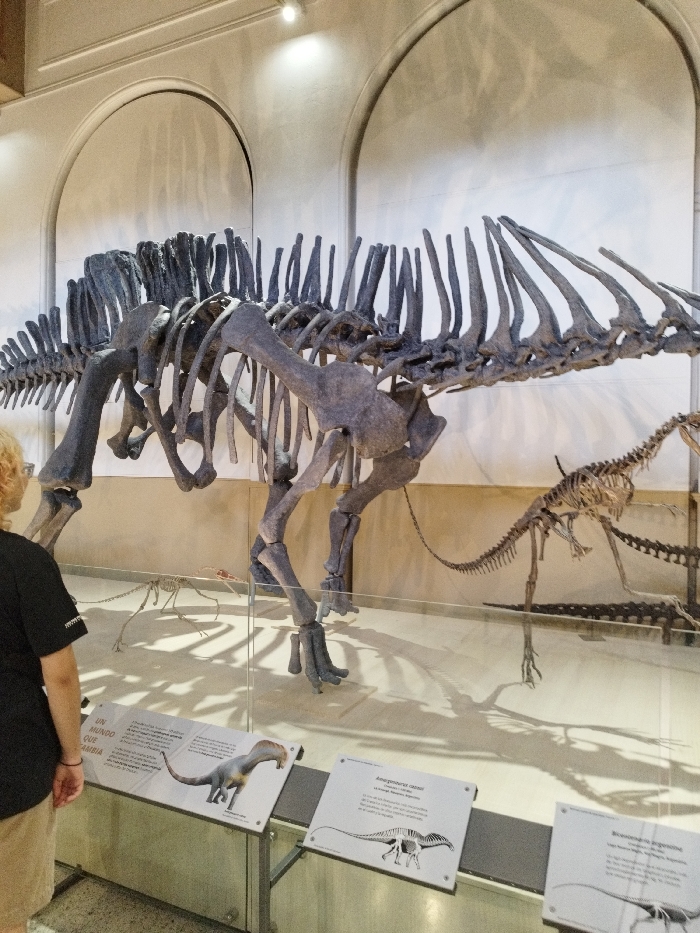
This media file captures an indoor scene within a natural history museum, likely located in Santiago, Chile, as suggested by the Spanish text on the information panels and the provided location context. The central subject is a large fossil skeleton of a dinosaur, prominently displayed as an exhibit. This skeleton, characterized by its distinctive tall, spiky neural spines running along its back, strongly resembles an *Amargasaurus*.

In the foreground, a person is visible from the back, wearing a black t-shirt and light-colored shorts, observing the exhibit. They are standing behind a clear glass barrier that separates the viewing area from the dinosaur displays. Below the large skeleton, two smaller, bipedal dinosaur skeletons are also exhibited, one very small and delicate, the other slightly larger, possibly illustrating scale or different species.

Several white information panels are placed on stands in front of the glass barrier. One panel clearly displays the name "Amargasaurus cazaui" along with an illustration and descriptive text in Spanish. Another partially visible panel to its right mentions "Brachiosaurus argentinas" and details about its discovery in "Neuquén, Argentina," underscoring the South American paleontological theme of the exhibit. The text "UN MUNDO QUE CAMBIA" (A CHANGING WORLD) is also visible on one of the panels. A word starting with "HYPER" or "MYPER" is faintly visible on the viewer's t-shirt.

The museum hall features light-colored walls with elegant arched alcoves and subtle overhead spotlights, creating a bright and spacious atmosphere. The floor is reflective, casting clear shadows of the dinosaur skeletons, adding depth to the display. The overall scene depicts a contemplative, educational moment of appreciation for prehistoric life. The time of day is not discernible, but the indoor setting is well-lit.
Mrv

Jan 7, 2025

Santiago, Chile

Stake attention in this memory

This media file captures an indoor scene within a natural history museum, likely located in Santiago, Chile, as suggested by the Spanish text on the information panels and the provided location context. The central subject is a large fossil skeleton of a dinosaur, prominently displayed as an exhibit. This skeleton, characterized by its distinctive tall, spiky neural spines running along its back, strongly resembles an *Amargasaurus*. In the foreground, a person is visible from the back, wearing a black t-shirt and light-colored shorts, observing the exhibit. They are standing behind a clear glass barrier that separates the viewing area from the dinosaur displays. Below the large skeleton, two smaller, bipedal dinosaur skeletons are also exhibited, one very small and delicate, the other slightly larger, possibly illustrating scale or different species. Several white information panels are placed on stands in front of the glass barrier. One panel clearly displays the name "Amargasaurus cazaui" along with an illustration and descriptive text in Spanish. Another partially visible panel to its right mentions "Brachiosaurus argentinas" and details about its discovery in "Neuquén, Argentina," underscoring the South American paleontological theme of the exhibit. The text "UN MUNDO QUE CAMBIA" (A CHANGING WORLD) is also visible on one of the panels. A word starting with "HYPER" or "MYPER" is faintly visible on the viewer's t-shirt. The museum hall features light-colored walls with elegant arched alcoves and subtle overhead spotlights, creating a bright and spacious atmosphere. The floor is reflective, casting clear shadows of the dinosaur skeletons, adding depth to the display. The overall scene depicts a contemplative, educational moment of appreciation for prehistoric life. The time of day is not discernible, but the indoor setting is well-lit.

transactions
revenues
stakers
Earliest
Latest
Highest stake

No transactions found

More from this user

More from Santiago

Mrv

Jan 7, 2025

Santiago, Chile

Licensed under Creative Commons Attribution 4.0 International License. You are free to share and adapt this content with proper attribution.