
Sign in
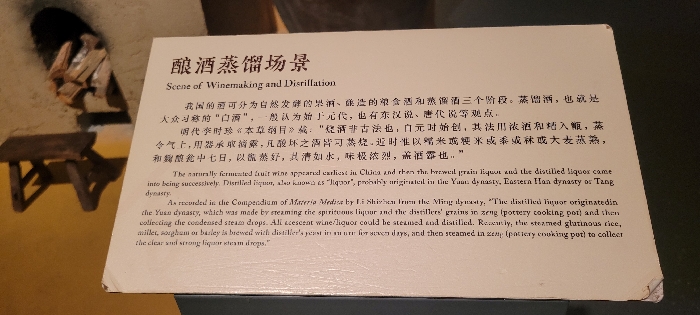
The image shows a museum exhibit panel titled "Scene of Winemaking and Distillation" in the National Museum of China, located at 39.904° N, 116.396° E in Beijing, China. The panel displays a text in both Chinese and English, describing the history and methods of winemaking and distillation in China. The panel is mounted on a wall, with a wooden bench in the foreground. The panel's text describes how naturally fermented fruit wine first appeared in China, and how the process was subsequently developed into distilled liquor, known as "liquor," which originated in the Yuan dynasty, Eastern Han dynasty, or Tang dynasty. The text details how during the Yuan dynasty, a method of steaming the spirituous liquor and distiller's grains in "xeng" (pottery cooking pot) was developed. The process involved collecting the condensed steam drops, which were then distilled. The text concludes by explaining how sticky rice, millet, sorghum, or barley were brewed with distiller's yeast in an urn for seven days and then steamed. The steamed steam drops were then collected in the "zen" (pottery cooking pot). The text uses multiple examples of specific Chinese terms and methods.
FM-EJXaw1

Mar 23, 2025, 8:01 AM

Beijing, China

Stake attention in this memory

Historical
Informative
Educational
Curious
Intriguing

The image shows a museum exhibit panel titled "Scene of Winemaking and Distillation" in the National Museum of China, located at 39.904° N, 116.396° E in Beijing, China. The panel displays a text in both Chinese and English, describing the history and methods of winemaking and distillation in China. The panel is mounted on a wall, with a wooden bench in the foreground. The panel's text describes how naturally fermented fruit wine first appeared in China, and how the process was subsequently developed into distilled liquor, known as "liquor," which originated in the Yuan dynasty, Eastern Han dynasty, or Tang dynasty. The text details how during the Yuan dynasty, a method of steaming the spirituous liquor and distiller's grains in "xeng" (pottery cooking pot) was developed. The process involved collecting the condensed steam drops, which were then distilled. The text concludes by explaining how sticky rice, millet, sorghum, or barley were brewed with distiller's yeast in an urn for seven days and then steamed. The steamed steam drops were then collected in the "zen" (pottery cooking pot). The text uses multiple examples of specific Chinese terms and methods.

Loading AttnAds…

transactions
revenues
stakers
Earliest
Latest
Highest stake

No transactions found

More from this user

More from Beijing

FM-EJXaw1

Mar 23, 2025, 8:01 AM

Beijing, China

Licensed under Creative Commons Attribution 4.0 International License. You are free to share and adapt this content with proper attribution.