Sign in
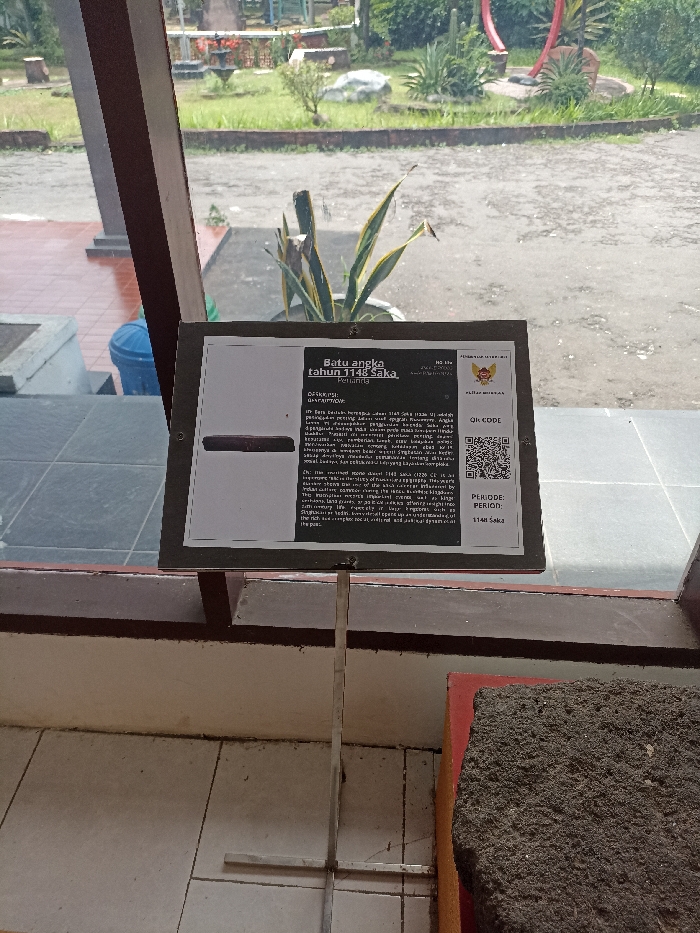
An indoor shot through a window displays an informational exhibit about a historical stone, set against an outdoor background. In the center, a metal stand supports a rectangular sign with a black border. The sign's title reads "Batu angka tahun 1148 Saka" (Stone with the year 1148 Saka), accompanied by "Pertanirla" (possibly a typo or specific term). Below, a detailed description in both Indonesian and English explains the significance of the stone, dated 1148 Saka (1226 CE), as an important artifact for understanding Nusantara's history, Indian cultural influence, land grants, judicial systems, and economic aspects. An image of the stone, appearing dark and elongated, is embedded on the left side of the text. A QR code and the period "1148 Saka" are also visible, along with a small Indonesian coat of arms.

To the right of the stand, a close-up section of a dark, porous rock or stone object is visible, possibly the artifact itself, contrasting with the smooth surface of the display.

Through the window in the background, a sunny outdoor scene is visible. A variety of green plants, including a potted snake plant directly behind the sign, are arranged in a garden setting with paved or concrete ground. Elements like a blue trash can on the left, and a red structure and more foliage further back, suggest a park or courtyard environment. The lighting indicates it is daytime. The overall setting is likely a museum or cultural center in Kediri, Indonesia, exhibiting local historical artifacts.
FM-DWNFF3

Jan 19, 2025

Kediri, Indonesia

Stake attention in this memory

An indoor shot through a window displays an informational exhibit about a historical stone, set against an outdoor background. In the center, a metal stand supports a rectangular sign with a black border. The sign's title reads "Batu angka tahun 1148 Saka" (Stone with the year 1148 Saka), accompanied by "Pertanirla" (possibly a typo or specific term). Below, a detailed description in both Indonesian and English explains the significance of the stone, dated 1148 Saka (1226 CE), as an important artifact for understanding Nusantara's history, Indian cultural influence, land grants, judicial systems, and economic aspects. An image of the stone, appearing dark and elongated, is embedded on the left side of the text. A QR code and the period "1148 Saka" are also visible, along with a small Indonesian coat of arms. To the right of the stand, a close-up section of a dark, porous rock or stone object is visible, possibly the artifact itself, contrasting with the smooth surface of the display. Through the window in the background, a sunny outdoor scene is visible. A variety of green plants, including a potted snake plant directly behind the sign, are arranged in a garden setting with paved or concrete ground. Elements like a blue trash can on the left, and a red structure and more foliage further back, suggest a park or courtyard environment. The lighting indicates it is daytime. The overall setting is likely a museum or cultural center in Kediri, Indonesia, exhibiting local historical artifacts.

transactions
revenues
stakers
Earliest
Latest
Highest stake

No transactions found

More from this user

More from Kediri

FM-DWNFF3

Jan 19, 2025

Kediri, Indonesia

Licensed under Creative Commons Attribution 4.0 International License. You are free to share and adapt this content with proper attribution.