
Stake attention in this memory
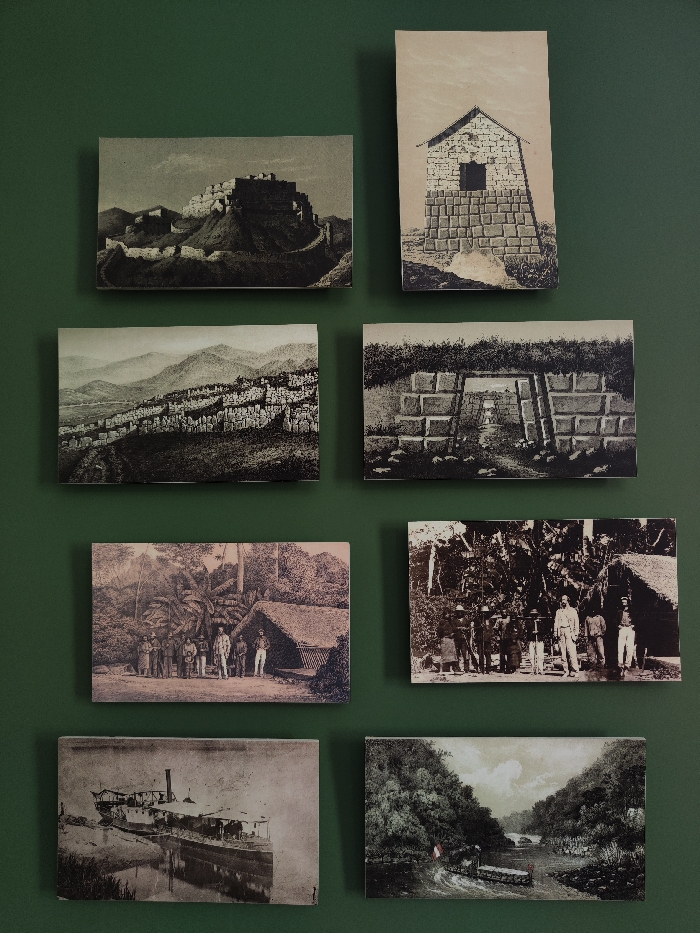
The image displays eight historical sepia-toned or monochrome prints mounted directly onto a plain, dark green wall. The arrangement is primarily in three rows, with two prints in the top row, two in the middle, two in the second-to-bottom row, and two in the bottom row. The prints are rectangular, with varying orientations (six horizontal, one vertical). The wall, which likely serves as a display in a building, is in the city of Tacna, Peru. The content of the prints themselves, however, depicts diverse scenes from various geographical regions within Peru, including the Andean highlands and tropical lowlands. Detailed description of each print: 1. **Top-Left (Horizontal):** Depicts a vast ancient fortified complex or citadel situated on a rocky hilltop. Numerous stone walls, structures, and terraces are visible, characteristic of pre-Columbian Andean architecture. Mountains form the background, suggesting an elevated, possibly arid, environment. 2. **Top-Right (Vertical):** Shows a singular, well-preserved stone building with a gabled roof and a distinct, dark rectangular opening, possibly a doorway or window, on its facade. The structure is built with large, precisely cut rectangular stone blocks, indicative of advanced ancient masonry. 3. **Middle-Left (Horizontal):** Features an expansive landscape dominated by extensive agricultural terraces built into a hillside. These terraces descend across the middle ground, framed by a valley and distant mountains under an overcast sky. This infrastructure suggests large-scale ancient farming practices. 4. **Middle-Right (Horizontal):** Displays a monumental stone gateway or archway. Two large, trapezoidal stone pillars support a horizontal lintel, forming an entrance. The surrounding wall is constructed from large, irregularly shaped but tightly fitted stones, leading into a dimly visible passageway or interior space. 5. **Second Row from Bottom, Left (Horizontal):** A group of approximately ten individuals, appearing to be a mix of indigenous people in traditional attire and men in early 20th-century European clothing (shirts, trousers, hats), stand in front of two rudimentary thatched-roof huts. The environment is lush and tropical, with dense jungle foliage and prominent palm trees. 6. **Second Row from Bottom, Right (Horizontal):** Another group of ten or more individuals, similarly composed of indigenous and European-dressed men, stands in a dense tropical environment. Large trees and thick vegetation form the backdrop, with a partial view of a thatched structure on the right side of the frame. 7. **Bottom-Left (Horizontal):** Features a large, multi-decked paddle-wheel steamboat or riverboat on a body of water, likely a river. The vessel has at least one smokestack and is positioned near a bank, with its reflection visible in the water. The design suggests a 19th or early 20th-century craft. 8. **Bottom-Right (Horizontal):** A scenic view of a river flowing through a densely forested valley. Hills or mountains covered in vegetation rise on both sides. In the foreground, a wooden structure, possibly a pier or a small bridge, extends into the river. A small boat, resembling a canoe, is visible near the structure. A flag, displaying vertical red, white, and red stripes (the national flag of Peru), is affixed to the wooden structure. The overall collection of prints presents a historical visual record of diverse landscapes, ancient architecture, and human activity across different regions of Peru, displayed within a contemporary setting in Tacna.
No transactions found