
Stake attention in this memory
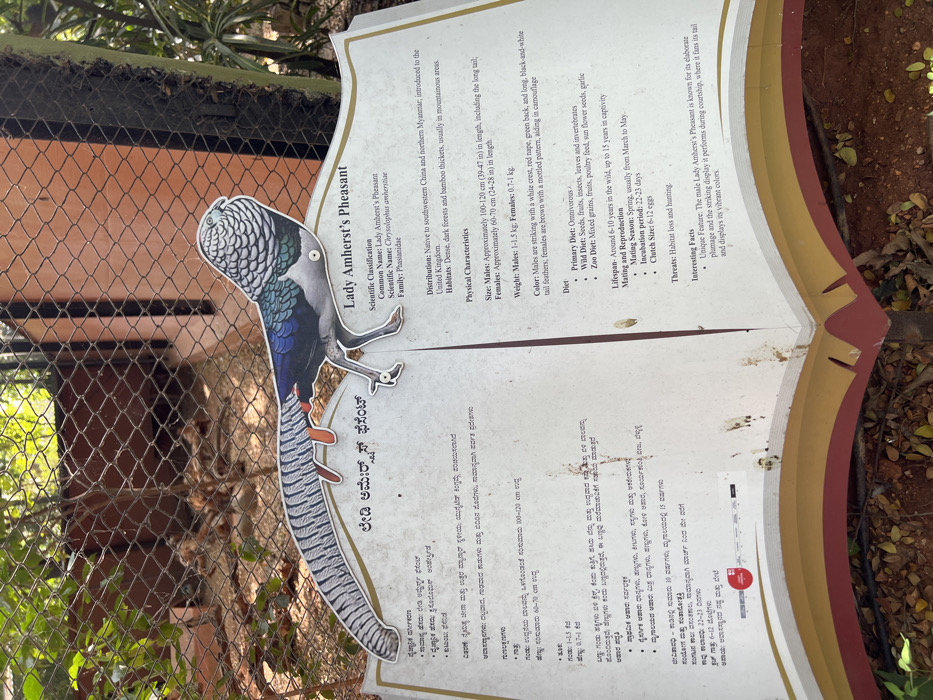
An informational sign about the Lady Amherst's Pheasant is prominently displayed outdoors, likely at a zoo or wildlife sanctuary in Mysuru, India. The sign is designed in the shape of an open book, with text presented in both English and Kannada. An illustration of a Lady Amherst's Pheasant, featuring its distinctive long tail and colorful plumage, is attached to the left "page" of the sign. The English text provides details about the bird, including its common and scientific names (Chrysolophus amherstiae), family (Phasianidae), and distribution (native to southwestern China and northern Myanmar, introduced to the UK). It describes its habitats as dense, dark forests and bamboo thickets in mountainous areas. Physical characteristics note males are 100-120 cm long (including the tail) and weigh 1-1.5 kg, while females are 60-70 cm and weigh 0.7-1 kg. Coloration for males includes a white crest, red nape, green back, and black-and-white tail feathers, with females being brown for camouflage. The bird's diet is omnivorous, consisting of seeds, fruits, insects, leaves, and invertebrates in the wild, and mixed grains, fruits, poultry feed, sunflower seeds, and garlic in zoos. Lifespan is 6-10 years in the wild and up to 15 in captivity. Mating season is spring (March-May), with an incubation period of 22-23 days and a clutch size of 6-12 eggs. Threats include habitat loss and hunting. An interesting fact highlights the male's elaborate plumage and striking courtship display. The Kannada text mirrors this information. In the background, a wire mesh fence or cage wall is visible, suggesting an animal enclosure. Some green foliage is also present, indicating an outdoor, natural setting. The lighting suggests it is daytime with bright sun.
No transactions found