
Sign in
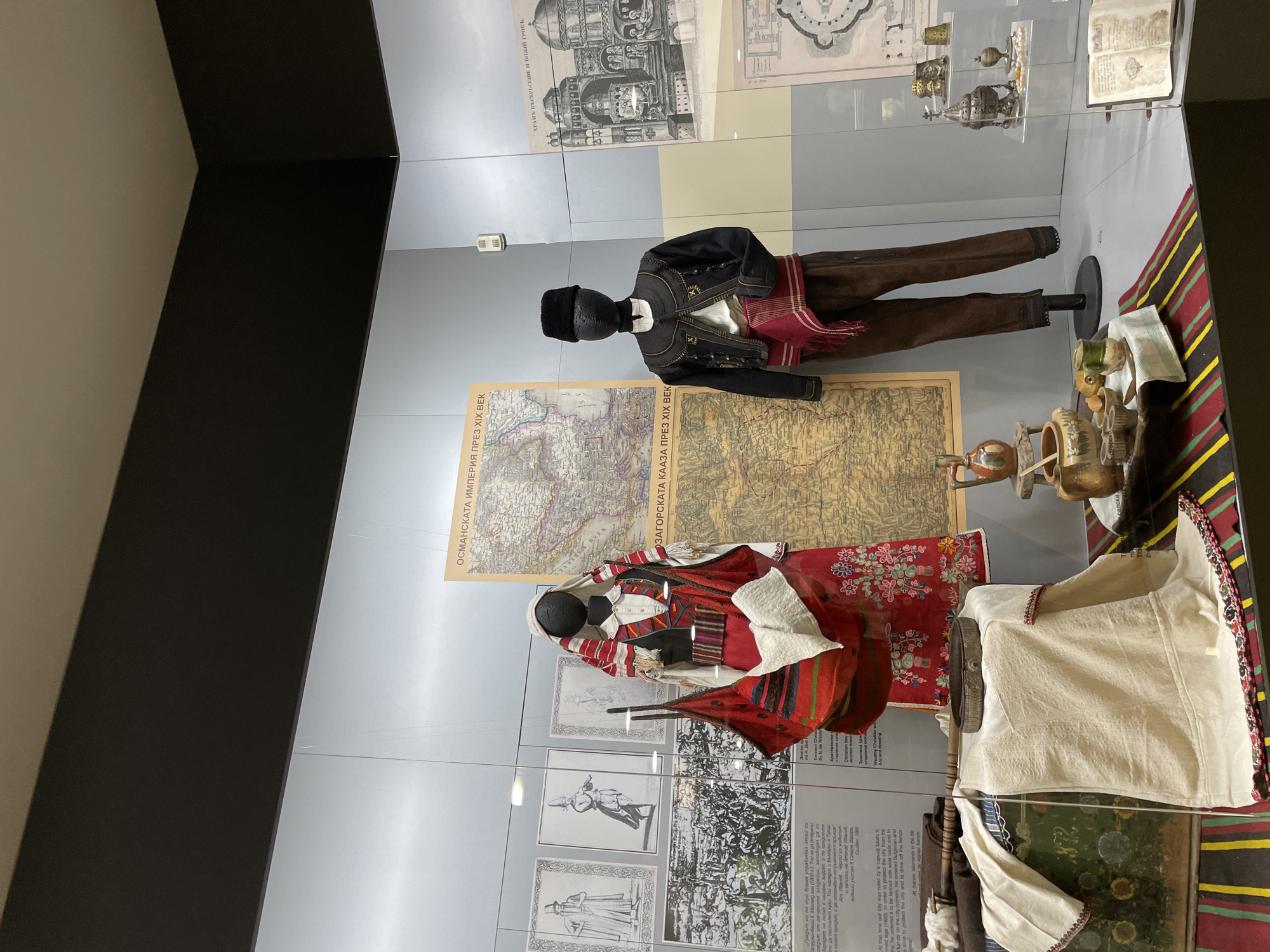
This media file captures a museum exhibit, likely in Stara Zagora, Bulgaria, showcasing historical and cultural artifacts, maps, and traditional costumes, all behind a reflective glass display.

The central subjects are two mannequins dressed in traditional attire. The male mannequin on the upper right wears a black jacket with intricate embroidery, a white shirt, a red sash, brown pants, and a black hat. The female mannequin on the lower left is adorned in a white head covering, a red dress with floral embroidery, a striped red and black apron, and a white, textured garment over her shoulders.

Surrounding the mannequins and within the display are various objects and informational panels. To the right of the male mannequin, a display case holds several antique metal items, possibly incense burners or ornate vessels, and an open, aged book. On a striped woven cloth beneath, there are several pieces of pottery, including jugs and bowls, and a wooden staff or spindle.

Two large historical maps are prominently displayed on the back wall. The upper map is titled "ОСМАНСКАТА ИМПЕРИЯ ПРЕЗ ХІХ ВЕК" (The Ottoman Empire in the 19th Century), and the lower one "ЗАГОРСКАТА КААЗА ПРЕЗ ХІХ ВЕК" (The Zagora Kaza in the 19th Century).

Below the female mannequin are several smaller black and white illustrations depicting historical figures and scenes. Above the male mannequin, another illustration shows a complex architectural structure, labeled in Cyrillic as "ХРАМЪ ИТ И БОЖІЙ ГРОТЪ". A text panel in both Bulgarian and English provides historical context, describing an event in 1800 in a city ruled by a "capudji-bashi X. Mehmed aga," who ordered walls and towers for protection. The text attributes this information to "At. Ivanov, Moments in the life and notes by Atanas Ivanov, former teacher in Stara Zagora, Sliven, 1885."

The setting is an indoor museum, with a dark partition on the left creating a corner effect, and visible reflections on the glass display case. The overall scene is educational, presenting aspects of 19th-century history and culture from the Stara Zagora region under the Ottoman Empire.
MK

Jun 5, 2026, 9:21 AM

Stara Zagora, Bulgaria

Moment

Stake attention in this memory

nostalgic
historical
cultural
educational
curious

This media file captures a museum exhibit, likely in Stara Zagora, Bulgaria, showcasing historical and cultural artifacts, maps, and traditional costumes, all behind a reflective glass display. The central subjects are two mannequins dressed in traditional attire. The male mannequin on the upper right wears a black jacket with intricate embroidery, a white shirt, a red sash, brown pants, and a black hat. The female mannequin on the lower left is adorned in a white head covering, a red dress with floral embroidery, a striped red and black apron, and a white, textured garment over her shoulders. Surrounding the mannequins and within the display are various objects and informational panels. To the right of the male mannequin, a display case holds several antique metal items, possibly incense burners or ornate vessels, and an open, aged book. On a striped woven cloth beneath, there are several pieces of pottery, including jugs and bowls, and a wooden staff or spindle. Two large historical maps are prominently displayed on the back wall. The upper map is titled "ОСМАНСКАТА ИМПЕРИЯ ПРЕЗ ХІХ ВЕК" (The Ottoman Empire in the 19th Century), and the lower one "ЗАГОРСКАТА КААЗА ПРЕЗ ХІХ ВЕК" (The Zagora Kaza in the 19th Century). Below the female mannequin are several smaller black and white illustrations depicting historical figures and scenes. Above the male mannequin, another illustration shows a complex architectural structure, labeled in Cyrillic as "ХРАМЪ ИТ И БОЖІЙ ГРОТЪ". A text panel in both Bulgarian and English provides historical context, describing an event in 1800 in a city ruled by a "capudji-bashi X. Mehmed aga," who ordered walls and towers for protection. The text attributes this information to "At. Ivanov, Moments in the life and notes by Atanas Ivanov, former teacher in Stara Zagora, Sliven, 1885." The setting is an indoor museum, with a dark partition on the left creating a corner effect, and visible reflections on the glass display case. The overall scene is educational, presenting aspects of 19th-century history and culture from the Stara Zagora region under the Ottoman Empire.

Symbol

C441A

Volume

0

Creator

+$0.04

Revenue

+$0.00

TVL

$0.00

1D
1W
1M
All

Loading AttnAds…

transactions
revenues
stakers
Earliest
Latest
Highest stake

1

?
??

Staked 1mo ago
Redeemed 1mo ago

$2.90 USD

+$0.02 USD

Fee: $0.01 (0.25%)

+0.7%

2

Rev Bot 🤖💰

Injected revenue 1mo ago

Revenue bonus for the last stake.

+$0.06 USD

More from this user

More from Stara Zagora

MK

Jun 5, 2026, 9:21 AM

Stara Zagora, Bulgaria

Licensed under Creative Commons Attribution 4.0 International License. You are free to share and adapt this content with proper attribution.