Stake attention in this memory
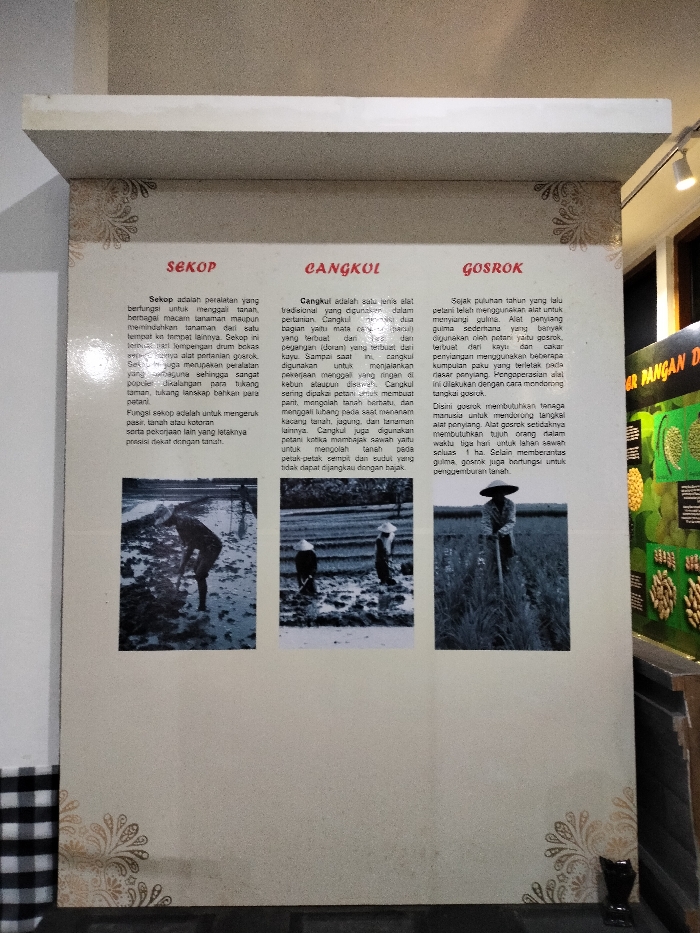
An informational display board, likely in a museum or exhibition, is the central subject of the image. The board is light-colored with decorative patterns in its top and bottom corners. It is divided into three vertical sections, each dedicated to a traditional Indonesian farming tool: "SEKOP" (shovel), "CANGKOL" (hoe), and "GOSROK" (weeder/rake). Each section features a block of Indonesian text describing the tool's function and composition, accompanied by a black and white photograph depicting its use. Under the "SEKOP" heading, the text describes a shovel as a digging tool for soil, for moving various plants, and popular among gardeners and farmers. It's used for scooping sand, soil, or dirt. The accompanying photo shows a person, wearing a hat, stooped over in what appears to be a muddy field, using a shovel-like implement. The "CANGKOL" section details a hoe as a traditional farming tool with an iron blade and a wooden handle, used for light digging, making furrows, cultivating rocky soil, planting crops like peanuts and corn, and tilling small or corner sections of rice paddies inaccessible to plows. The photo shows two people, wearing conical hats, standing in a muddy rice field, each holding a hoe. The "GOSROK" section explains this tool as a simple weeder used by farmers for decades, made of wood and "weeding claws," operated by pushing. The text notes that weeding 1 hectare requires about seven people over three days and that the tool also helps loosen the soil. The corresponding image shows a person, wearing a conical hat, standing in a field of young plants, holding a long-handled gosrok. The setting appears to be indoors, possibly an exhibition hall or museum, with artificial lighting visible in the top right. A portion of another display board, with text "PANGAN D...", is visible on the far right. The overall tone of the display is educational and informative about traditional agricultural practices, consistent with the provided context of Bogor, Indonesia.
No transactions found