Sign in
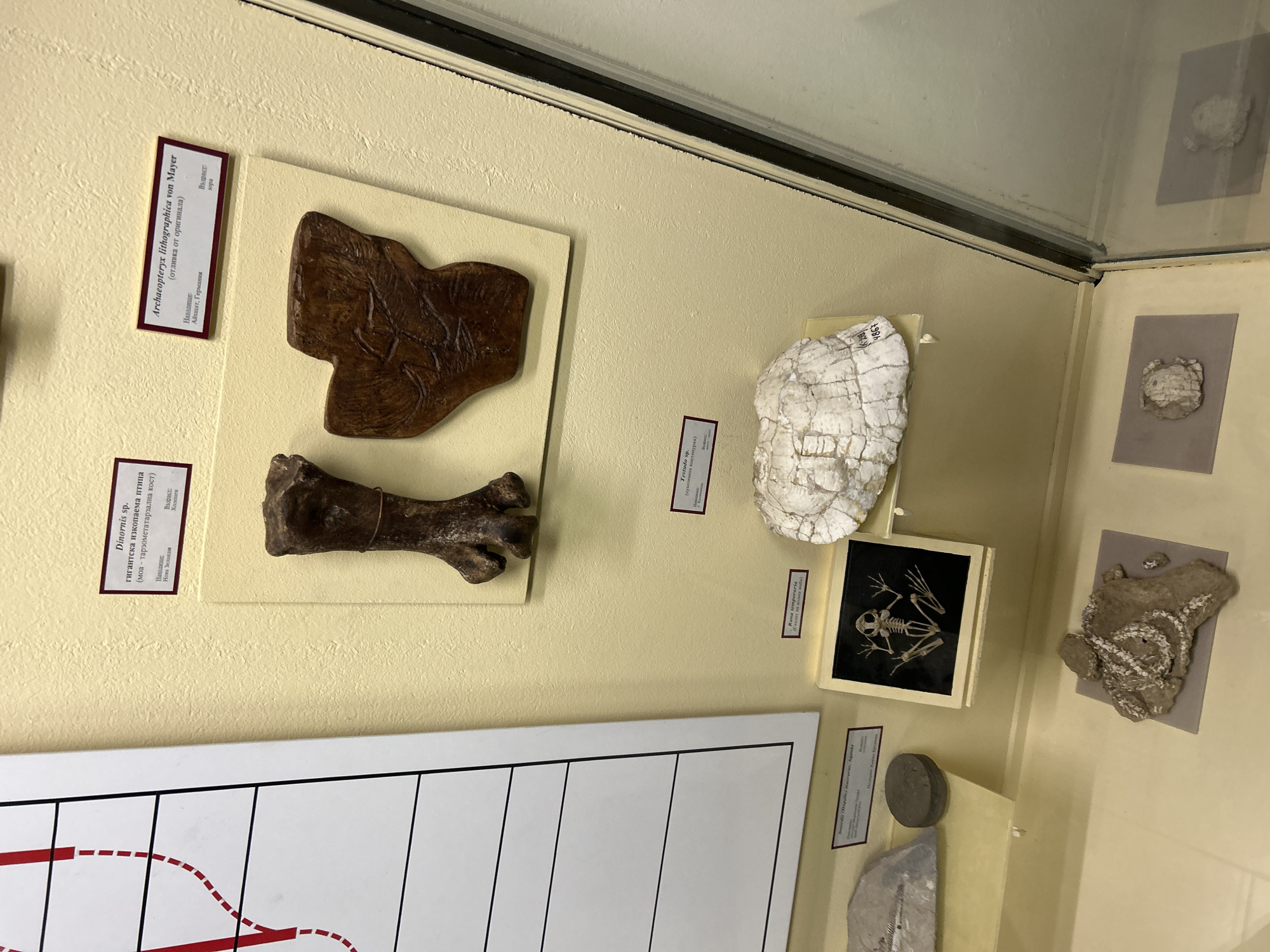
This image captures a section of an indoor paleontological or natural history exhibit, located in the city of Asenovgrad, Bulgaria. The scene presents a multi-level display against a light yellow wall and within a glass-fronted case.

On the upper wall, to the left, a portion of a large white panel with a red dashed branching diagram is visible. To its right, two scientific exhibits are mounted:
1.  **Left Exhibit:** A dark brown, robust fossilized bone, identified by an adjacent label as a tarsometatarsus bone from *Dinornis sp.* (Moa), originating from New Zealand and dated to the Holocene. A thin wire secures the bone to the display.
2.  **Right Exhibit:** A dark brown, irregularly shaped cast of an *Archaeopteryx lithographica* fossil, showing feather impressions. Its accompanying label specifies it is a cast from the original specimen found in Eichstätt, Germany, from the Jurassic period.

Below these wall-mounted displays, a light-colored shelf or platform holds several specimens:
1.  **Left Group:** A flat, light gray stone slab with a faint fossil impression, identified by a label as *Smerdis (Bupalis) macrurus* from Kameno Bryag village, dated to the Miocene. Next to it is a small, dark gray cylindrical object.
2.  **Center:** A square, wooden-framed shadow box containing a preserved skeleton of *Rana temporaria* (common frog), displayed anatomically.
3.  **Right:** A large, white, fractured fossil, identified as *Testudo sp.* (fossil turtle), originating from the Eocene period. A handwritten "4861" is visible on its surface.

The lower portion of the image shows the interior of a display case with a light-colored bottom surface. Two objects are visible here:
1.  **Left:** A dark gray, irregularly shaped fossil or rock specimen with a wavy, possibly concentric, pattern, resting on a light gray rectangular pad.
2.  **Right:** A smaller, light-colored, circular fossil or specimen, also on a light gray rectangular pad.

The rightmost edge of the image reveals a vertical glass panel, reflecting the objects on the lower shelf, indicating a protective barrier for the exhibit. The overall environment suggests a well-lit museum or educational institution.
c++ king

Mar 27, 2026, 9:57 AM

Asenovgrad, Bulgaria

Stake attention in this memory

Curiosity
Wonder
Educational
Fascination
History

This image captures a section of an indoor paleontological or natural history exhibit, located in the city of Asenovgrad, Bulgaria. The scene presents a multi-level display against a light yellow wall and within a glass-fronted case. On the upper wall, to the left, a portion of a large white panel with a red dashed branching diagram is visible. To its right, two scientific exhibits are mounted: 1. **Left Exhibit:** A dark brown, robust fossilized bone, identified by an adjacent label as a tarsometatarsus bone from *Dinornis sp.* (Moa), originating from New Zealand and dated to the Holocene. A thin wire secures the bone to the display. 2. **Right Exhibit:** A dark brown, irregularly shaped cast of an *Archaeopteryx lithographica* fossil, showing feather impressions. Its accompanying label specifies it is a cast from the original specimen found in Eichstätt, Germany, from the Jurassic period. Below these wall-mounted displays, a light-colored shelf or platform holds several specimens: 1. **Left Group:** A flat, light gray stone slab with a faint fossil impression, identified by a label as *Smerdis (Bupalis) macrurus* from Kameno Bryag village, dated to the Miocene. Next to it is a small, dark gray cylindrical object. 2. **Center:** A square, wooden-framed shadow box containing a preserved skeleton of *Rana temporaria* (common frog), displayed anatomically. 3. **Right:** A large, white, fractured fossil, identified as *Testudo sp.* (fossil turtle), originating from the Eocene period. A handwritten "4861" is visible on its surface. The lower portion of the image shows the interior of a display case with a light-colored bottom surface. Two objects are visible here: 1. **Left:** A dark gray, irregularly shaped fossil or rock specimen with a wavy, possibly concentric, pattern, resting on a light gray rectangular pad. 2. **Right:** A smaller, light-colored, circular fossil or specimen, also on a light gray rectangular pad. The rightmost edge of the image reveals a vertical glass panel, reflecting the objects on the lower shelf, indicating a protective barrier for the exhibit. The overall environment suggests a well-lit museum or educational institution.

Loading AttnAds…

transactions
revenues
stakers
Earliest
Latest
Highest stake

No transactions found

More from this user

More from Asenovgrad

c++ king

Mar 27, 2026, 9:57 AM

Asenovgrad, Bulgaria

Licensed under Creative Commons Attribution 4.0 International License. You are free to share and adapt this content with proper attribution.