
Sign in
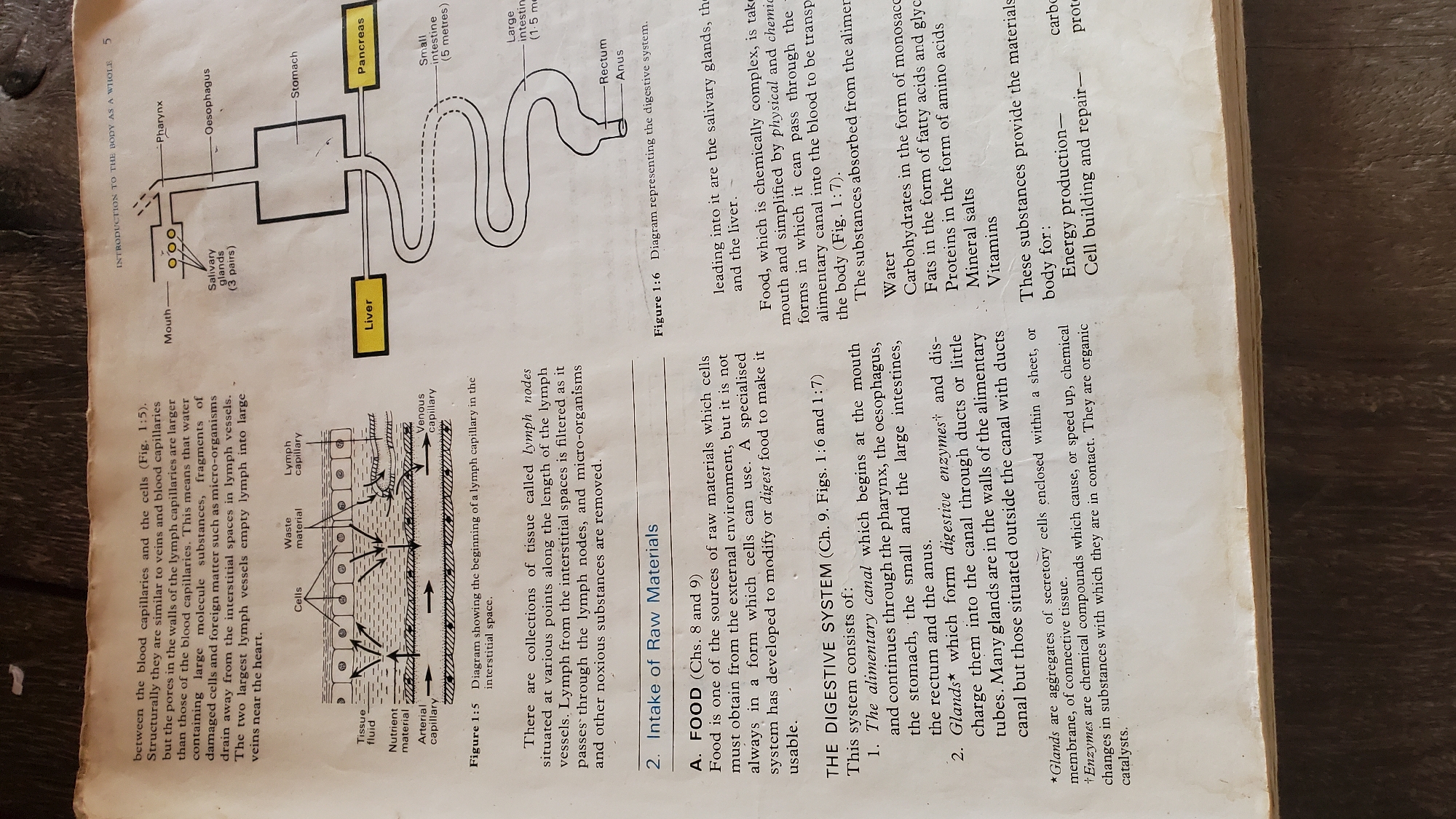
This media file contains an image of two diagrams from a textbook. The first diagram, labeled Figure 1:5, illustrates the beginning of a lymph capillary, showing tissue fluid, nutrient material, waste material, cells, lymph capillary, arterial capillary, and venous capillary. It explains how lymph capillaries absorb substances from interstitial spaces. The second diagram, Figure 1:6, is a schematic representation of the human digestive system, outlining the path of food from the mouth through the pharynx, oesophagus, stomach, small intestine, large intestine, rectum, and anus. It also indicates the locations of the liver, pancreas, and salivary glands, which are associated with the digestive process.

The text accompanying the diagrams discusses the intake of raw materials by cells, focusing on food as a source of nutrients. It describes the function of the digestive system in breaking down complex food into simpler forms that can be absorbed into the bloodstream and transported to the body's cells. The text also lists the substances absorbed from the alimentary canal – water, carbohydrates, fats, proteins, mineral salts, and vitamins – and their roles in energy production, cell building, and repair. A definition of glands and enzymes is also provided.

No people, specific time of day, weather, or emotions are depicted in this media file. The setting is clearly an academic or educational context, likely a biology or physiology textbook. The visible text is primarily explanatory and diagrammatic, relating to the biological processes of the lymphatic and digestive systems.
FM-Ssetp2

Jun 29, 2026, 12:05 PM

Jalingo, Nigeria

Stake attention in this memory

educational
informative
scientific
diagrammatic
biological

This media file contains an image of two diagrams from a textbook. The first diagram, labeled Figure 1:5, illustrates the beginning of a lymph capillary, showing tissue fluid, nutrient material, waste material, cells, lymph capillary, arterial capillary, and venous capillary. It explains how lymph capillaries absorb substances from interstitial spaces. The second diagram, Figure 1:6, is a schematic representation of the human digestive system, outlining the path of food from the mouth through the pharynx, oesophagus, stomach, small intestine, large intestine, rectum, and anus. It also indicates the locations of the liver, pancreas, and salivary glands, which are associated with the digestive process. The text accompanying the diagrams discusses the intake of raw materials by cells, focusing on food as a source of nutrients. It describes the function of the digestive system in breaking down complex food into simpler forms that can be absorbed into the bloodstream and transported to the body's cells. The text also lists the substances absorbed from the alimentary canal – water, carbohydrates, fats, proteins, mineral salts, and vitamins – and their roles in energy production, cell building, and repair. A definition of glands and enzymes is also provided. No people, specific time of day, weather, or emotions are depicted in this media file. The setting is clearly an academic or educational context, likely a biology or physiology textbook. The visible text is primarily explanatory and diagrammatic, relating to the biological processes of the lymphatic and digestive systems.

Loading AttnAds…

transactions
revenues
stakers
Earliest
Latest
Highest stake

No transactions found

More from this user

More from Jalingo

FM-Ssetp2

Jun 29, 2026, 12:05 PM

Jalingo, Nigeria

Licensed under Creative Commons Attribution 4.0 International License. You are free to share and adapt this content with proper attribution.