
Sign in
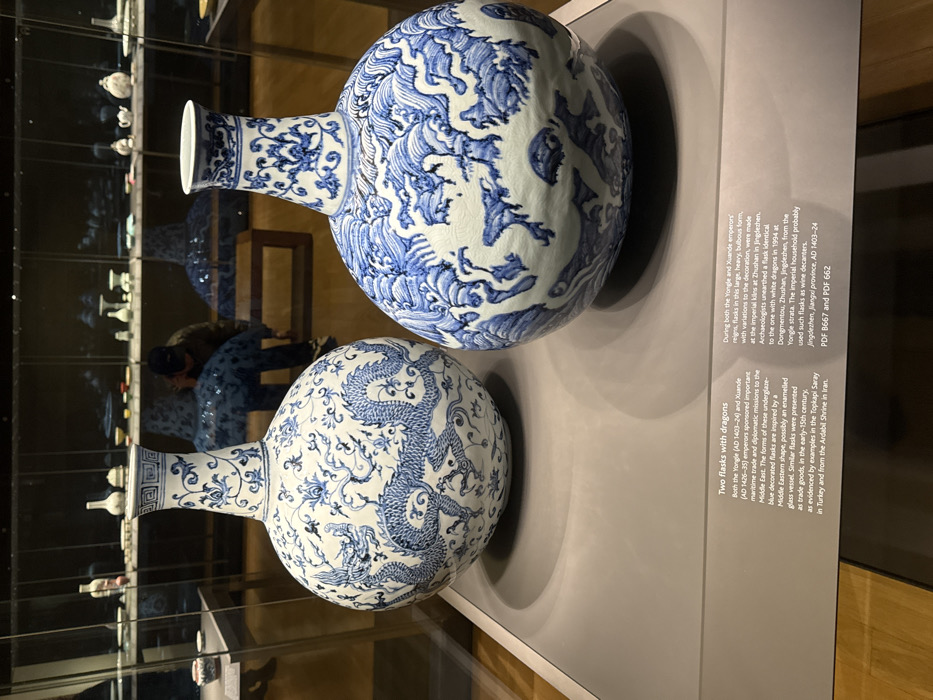
The image displays two large, blue and white porcelain "moon flasks" or "pilgrim flasks" exhibited within a museum display case. Both flasks are intricately decorated with mythical dragon motifs. The upper flask showcases dragons dynamically emerging from crashing waves, while the lower flask features dragons intertwined with delicate scrolling floral patterns. Both have flattened, globular bodies and tall, slender necks adorned with decorative bands.

The setting is an indoor museum or gallery, indicated by the professional display and an informational text panel to the right. Reflections in the glass case show other ceramic artifacts on shelves in the background, as well as a partially visible person (likely a museum visitor or the photographer) and a wooden stool.

The visible text panel, titled "Two flasks with dragons," provides extensive details. It states that these flasks date from the Yongle (AD 1403-24) and Xuande (AD 1426-35) imperial reigns, produced at the imperial kilns in Zhushan, Jingdezhen, Jiangxi province. The text explains their inspiration from Middle Eastern shapes, possibly enameled glass vessels, and their use in maritime trade and diplomatic missions as trade goods, with similar examples found in the Topkapi Saray in Turkey and the Ardabil Shrine in Iran. It also notes the archaeological discovery of an identical flask in 1994, suggesting their function as wine decanters for the imperial household. Reference numbers PDF 8667 and PDF 662 are also present.
punit03

Dec 13, 2024, 3:41 PM

London, UK

Stake attention in this memory

The image displays two large, blue and white porcelain "moon flasks" or "pilgrim flasks" exhibited within a museum display case. Both flasks are intricately decorated with mythical dragon motifs. The upper flask showcases dragons dynamically emerging from crashing waves, while the lower flask features dragons intertwined with delicate scrolling floral patterns. Both have flattened, globular bodies and tall, slender necks adorned with decorative bands. The setting is an indoor museum or gallery, indicated by the professional display and an informational text panel to the right. Reflections in the glass case show other ceramic artifacts on shelves in the background, as well as a partially visible person (likely a museum visitor or the photographer) and a wooden stool. The visible text panel, titled "Two flasks with dragons," provides extensive details. It states that these flasks date from the Yongle (AD 1403-24) and Xuande (AD 1426-35) imperial reigns, produced at the imperial kilns in Zhushan, Jingdezhen, Jiangxi province. The text explains their inspiration from Middle Eastern shapes, possibly enameled glass vessels, and their use in maritime trade and diplomatic missions as trade goods, with similar examples found in the Topkapi Saray in Turkey and the Ardabil Shrine in Iran. It also notes the archaeological discovery of an identical flask in 1994, suggesting their function as wine decanters for the imperial household. Reference numbers PDF 8667 and PDF 662 are also present.

Loading AttnAds…

transactions
revenues
stakers
Earliest
Latest
Highest stake

No transactions found

More from this user

More from London

punit03

Dec 13, 2024, 3:41 PM

London, UK

Licensed under Creative Commons Attribution 4.0 International License. You are free to share and adapt this content with proper attribution.