
Sign in
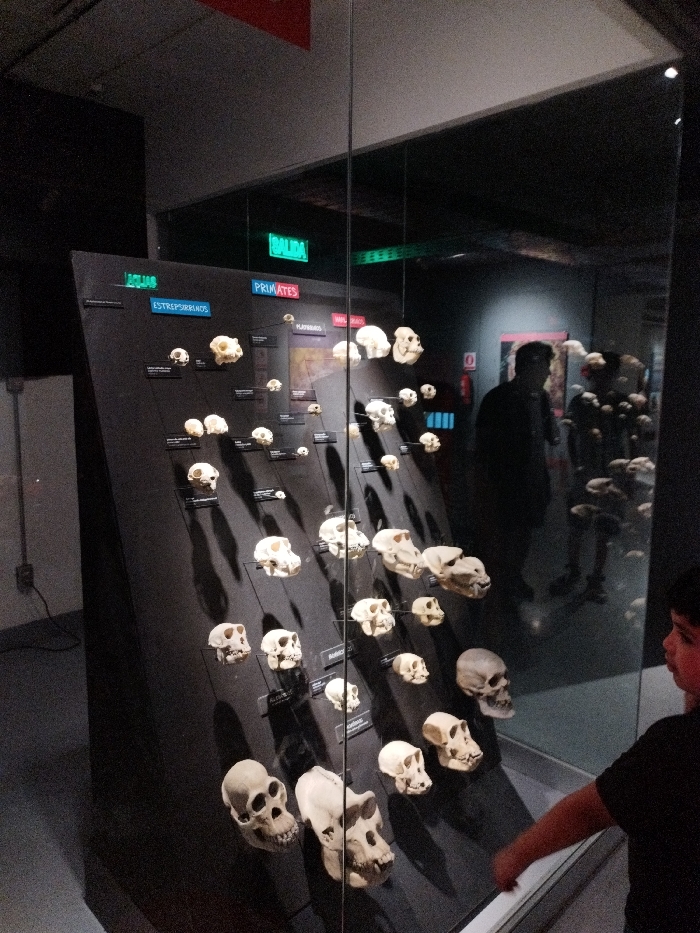
The image captures a dimly lit museum exhibit featuring a collection of primate and hominid skull replicas, displayed behind a transparent glass barrier. The exhibit consists of a dark, angled display board on which numerous light-colored skulls of varying sizes and shapes are mounted. These skulls appear to be arranged in a chronological or evolutionary sequence, connected by thin lines, suggesting a phylogenetic tree or lineage of primate evolution.

On the upper left side of the display, a blue sign reads "PRIMATES" (Primates). Below it, another blue sign reads "ESTREPSIRRINOS" (Strepsirrhines), and further to the right, a red sign shows "PLATIRRINOS" (Platyrrhines). Smaller, unreadable labels accompany many of the individual skull mounts. The skulls range from very small, possibly representing early primates, to larger, more human-like skulls towards the bottom right of the display. The lighting from above casts distinct shadows of each skull onto the dark board.

The transparent glass barrier in front of the exhibit reflects the surrounding museum environment. Most notably, a green illuminated "SALIDA" (Exit in Spanish) sign is reflected prominently in the upper right quadrant of the glass. The reflection of an adult male figure, seen from the chest up, is visible behind the exhibit in the center-right, looking towards another part of the museum. Fainter reflections of other objects and possibly people are also visible in the background.

In the foreground on the right, a young child, wearing a dark shirt, is partially visible. The child's face and right arm are turned towards the exhibit, suggesting engagement and observation of the skulls. The child's presence adds a human element to the scene, emphasizing the educational context of the display. The overall atmosphere is dark and contemplative, typical of a natural history or anthropology museum.
Mrv

Jan 7, 2025

Santiago, Chile

Stake attention in this memory

The image captures a dimly lit museum exhibit featuring a collection of primate and hominid skull replicas, displayed behind a transparent glass barrier. The exhibit consists of a dark, angled display board on which numerous light-colored skulls of varying sizes and shapes are mounted. These skulls appear to be arranged in a chronological or evolutionary sequence, connected by thin lines, suggesting a phylogenetic tree or lineage of primate evolution. On the upper left side of the display, a blue sign reads "PRIMATES" (Primates). Below it, another blue sign reads "ESTREPSIRRINOS" (Strepsirrhines), and further to the right, a red sign shows "PLATIRRINOS" (Platyrrhines). Smaller, unreadable labels accompany many of the individual skull mounts. The skulls range from very small, possibly representing early primates, to larger, more human-like skulls towards the bottom right of the display. The lighting from above casts distinct shadows of each skull onto the dark board. The transparent glass barrier in front of the exhibit reflects the surrounding museum environment. Most notably, a green illuminated "SALIDA" (Exit in Spanish) sign is reflected prominently in the upper right quadrant of the glass. The reflection of an adult male figure, seen from the chest up, is visible behind the exhibit in the center-right, looking towards another part of the museum. Fainter reflections of other objects and possibly people are also visible in the background. In the foreground on the right, a young child, wearing a dark shirt, is partially visible. The child's face and right arm are turned towards the exhibit, suggesting engagement and observation of the skulls. The child's presence adds a human element to the scene, emphasizing the educational context of the display. The overall atmosphere is dark and contemplative, typical of a natural history or anthropology museum.

transactions
revenues
stakers
Earliest
Latest
Highest stake

No transactions found

More from this user

More from Santiago

Mrv

Jan 7, 2025

Santiago, Chile

Licensed under Creative Commons Attribution 4.0 International License. You are free to share and adapt this content with proper attribution.