Stake attention in this memory
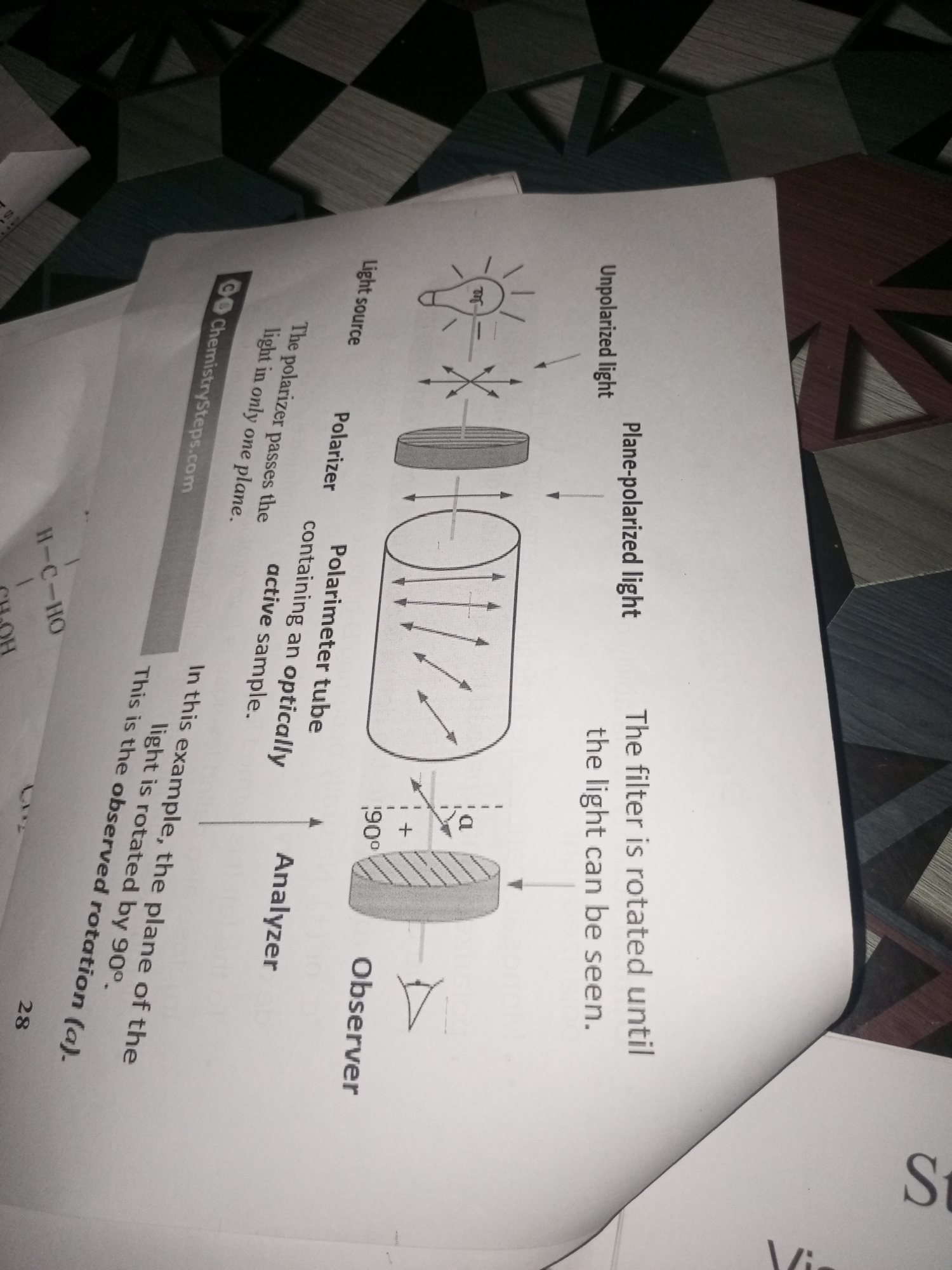
This image depicts a diagram illustrating the principle of a polarimeter, a device used to measure the optical rotation of chiral substances. The diagram shows a light source, a polarizer, a polarimeter tube containing an optically active sample, an analyzer, and an observer. Unpolarized light from the source passes through the polarizer, becoming plane-polarized. This plane-polarized light then enters the polarimeter tube, where its plane of polarization is rotated by the optically active sample. Finally, the analyzer, which is a second polarizer, is rotated until the light is completely blocked or maximally transmitted, allowing the angle of rotation to be measured. The accompanying text explains that the polarizer passes light in only one plane, and in the example shown, the light is rotated by 90 degrees, resulting in the observed rotation. The image is a page from a textbook or educational material, as evidenced by the diagram, labels, and text. The physical environment is that of an indoor setting, possibly a table or desk, with a patterned surface visible in the background, suggesting a domestic or academic environment. The question asks for the location in the city of Jalingo, Nigeria, which is not depicted in the image. The image itself is devoid of any geographical or environmental clues that would connect it to Jalingo, Nigeria, or any specific city. Therefore, it is impossible to provide a description of the scene in Jalingo, Nigeria based on the provided image.
Symbol
C8D74
Volume
1,566
Creator
+$0.00
Revenue
+$0.00
TVL
$0.07
Loading AttnAds…

2

Rev Bot 🤖💰
Injected revenue 2mo ago
“Revenue bonus for the last stake.”
+$0.00 USD