Stake attention in this memory
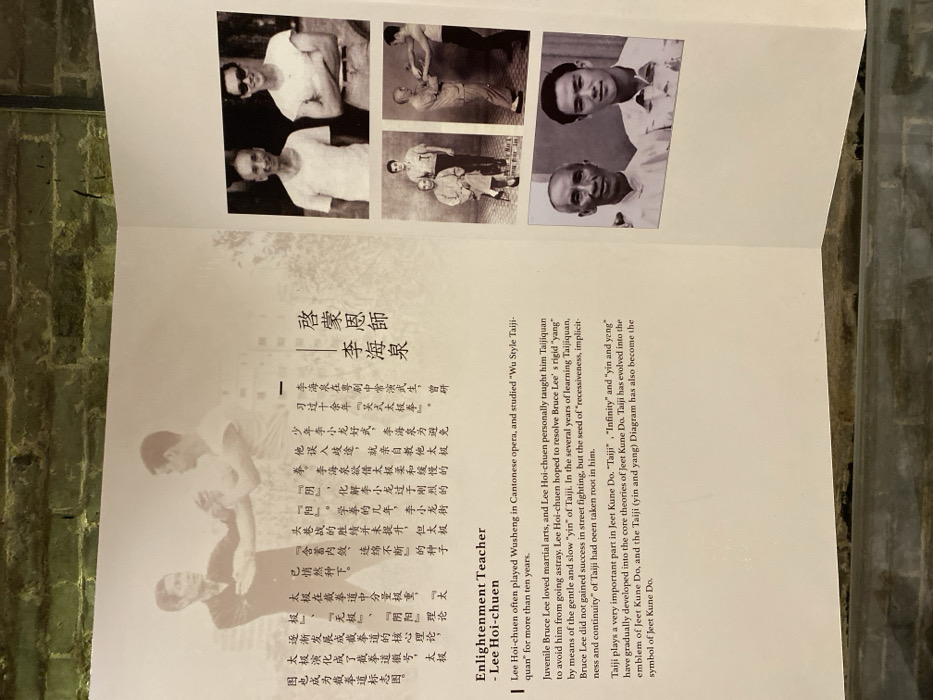
This image displays an open printed document, likely a book or pamphlet, featuring black and white photographs and text in both Chinese and English. On the left page, a large black and white photograph shows two men, one older and one younger, in a martial arts stance, with their hands in a blocking or guiding position. Below this image, extensive Chinese text is visible. The right page features a grid of smaller black and white photographs. The top row includes a photo of two men, one older with sunglasses and a younger man, and another showing two men engaged in a martial arts interaction. The bottom row includes a portrait of a younger man (resembling Bruce Lee) and an older man (resembling Lee Hoi-chuen), along with another image of two men in a martial arts pose. Below these photographs, there is text in both Chinese and English. The English text is titled "Enlightenment Teacher - Lee Hoi-chuen" and describes Lee Hoi-chuen as a Wusheng in Cantonese opera who studied "Wu Style Taijiquan." It details how he personally taught Taijiquan to a young Bruce Lee to instill principles of "gentle and slow 'yin'" to balance Lee's "rigid 'yang.'" The text further explains that Taijiquan played a crucial role in Jeet Kune Do, with concepts like "Taiji," "Infinity," and "yin and yang" becoming core theories and the Taiji (yin and yang) Diagram evolving into the emblem and symbol of Jeet Kune Do. The corresponding Chinese text conveys similar biographical and philosophical information. The document is set against a textured, brick-like surface, suggesting it is laid open on a wall or floor. The lighting is even, and the overall tone is historical and educational, focusing on the martial arts lineage and philosophical development of Jeet Kune Do.
Loading AttnAds…
No transactions found