
Sign in
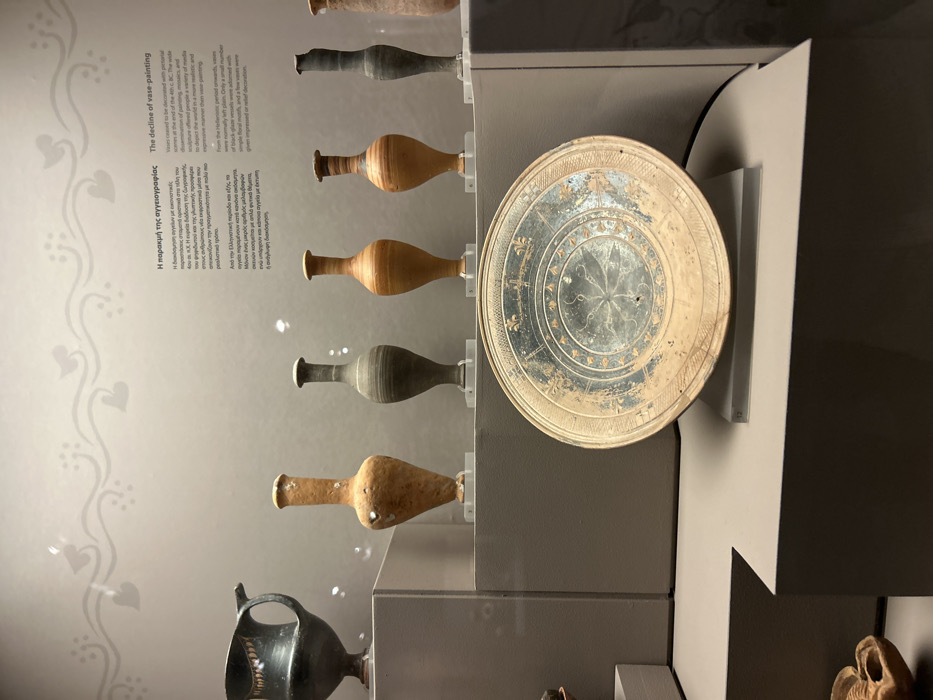
This image captures a museum exhibit, likely in Athina, Greece, focusing on ancient pottery. The scene is an interior shot of a display case, featuring several artifacts and an informational panel.

On the left side of the display is a large, vertical informational panel with text in both Greek and English. The English heading reads "The decline of vase-painting." The accompanying text explains that pictorial decoration on vases ceased by the end of the 4th century BC, as other art forms like painting, mosaics, and sculpture offered more realistic representation. It notes that from the Hellenistic period onwards, vases were generally undecorated, with only a few black-glazed vessels featuring simple floral motifs or embossed decorations.

To the right of the panel, arranged vertically on shelves, are five ancient Greek vases of varying shapes and colors. Most are elongated with narrow necks and flaring mouths. Two of the vases are light brown or terracotta-colored, while three are dark grey or black, showing signs of age and wear. Below these, a darker, handled jug or amphora is partially visible at the bottom left.

A prominent feature of the exhibit is a large, round, flat plate, displayed on a stand to the right. The plate has an intricate design, including a star-like motif at its center, surrounded by concentric bands of decorative patterns, possibly floral or geometric. The plate's surface appears aged and somewhat discolored.

The background of the display case includes a light grey wall with a subtle, reflective vine-like pattern on the left, behind the text panel. The artifacts are well-lit, suggesting internal lighting within the display.
FM-zLJPr2

Jan 11, 2025

Athina, Greece

Stake attention in this memory

This image captures a museum exhibit, likely in Athina, Greece, focusing on ancient pottery. The scene is an interior shot of a display case, featuring several artifacts and an informational panel. On the left side of the display is a large, vertical informational panel with text in both Greek and English. The English heading reads "The decline of vase-painting." The accompanying text explains that pictorial decoration on vases ceased by the end of the 4th century BC, as other art forms like painting, mosaics, and sculpture offered more realistic representation. It notes that from the Hellenistic period onwards, vases were generally undecorated, with only a few black-glazed vessels featuring simple floral motifs or embossed decorations. To the right of the panel, arranged vertically on shelves, are five ancient Greek vases of varying shapes and colors. Most are elongated with narrow necks and flaring mouths. Two of the vases are light brown or terracotta-colored, while three are dark grey or black, showing signs of age and wear. Below these, a darker, handled jug or amphora is partially visible at the bottom left. A prominent feature of the exhibit is a large, round, flat plate, displayed on a stand to the right. The plate has an intricate design, including a star-like motif at its center, surrounded by concentric bands of decorative patterns, possibly floral or geometric. The plate's surface appears aged and somewhat discolored. The background of the display case includes a light grey wall with a subtle, reflective vine-like pattern on the left, behind the text panel. The artifacts are well-lit, suggesting internal lighting within the display.

transactions
revenues
stakers
Earliest
Latest
Highest stake

No transactions found

More from this user

More from Athina

FM-zLJPr2

Jan 11, 2025

Athina, Greece

Licensed under Creative Commons Attribution 4.0 International License. You are free to share and adapt this content with proper attribution.