
Sign in
The image captures a close-up of a museum exhibit showcasing a vintage Peugeot car, likely in Athina, Greece. In the foreground, a black, multi-spoke car wheel and tire are prominently displayed. Behind it, a sepia-toned informational panel is visible through glass, causing reflections and a slight blur.

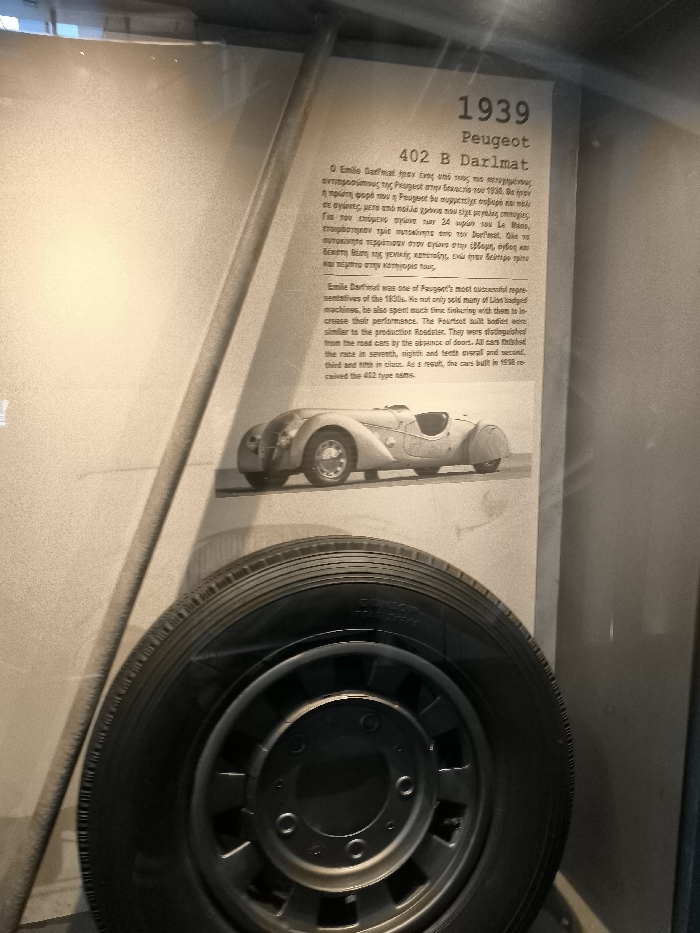
The panel features a black and white photograph of a sleek, aerodynamic, open-top vintage racing car. Above the photograph, text in both Greek and English provides details about the vehicle. The English text reads: "1939 Peugeot 402 B Darlmat. Emile Darlmat was one of Peugeot's most successful representatives of the 1930s. He not only sold many of Lion-badged machines, he also spent much time tinkering with them to increase their performance. The Pourtout built bodies were similar to the production Roadsters. They were distinguished from the road cars by the absence of doors. All cars finished the race in seventh, eighth and tenth overall and second, third and fifth in class. As a result, the cars built in 1938 received the 402 type name."

A metallic support pole runs vertically on the left side of the display, partially obscured by reflections. The overall scene conveys an educational and historical presentation of automotive heritage.
FM-DtDaN2

Jan 12, 2025

Athina, Greece

Stake attention in this memory

The image captures a close-up of a museum exhibit showcasing a vintage Peugeot car, likely in Athina, Greece. In the foreground, a black, multi-spoke car wheel and tire are prominently displayed. Behind it, a sepia-toned informational panel is visible through glass, causing reflections and a slight blur. The panel features a black and white photograph of a sleek, aerodynamic, open-top vintage racing car. Above the photograph, text in both Greek and English provides details about the vehicle. The English text reads: "1939 Peugeot 402 B Darlmat. Emile Darlmat was one of Peugeot's most successful representatives of the 1930s. He not only sold many of Lion-badged machines, he also spent much time tinkering with them to increase their performance. The Pourtout built bodies were similar to the production Roadsters. They were distinguished from the road cars by the absence of doors. All cars finished the race in seventh, eighth and tenth overall and second, third and fifth in class. As a result, the cars built in 1938 received the 402 type name." A metallic support pole runs vertically on the left side of the display, partially obscured by reflections. The overall scene conveys an educational and historical presentation of automotive heritage.

transactions
revenues
stakers
Earliest
Latest
Highest stake

No transactions found

More from this user

More from Athina

FM-DtDaN2

Jan 12, 2025

Athina, Greece

Licensed under Creative Commons Attribution 4.0 International License. You are free to share and adapt this content with proper attribution.