
Stake attention in this memory
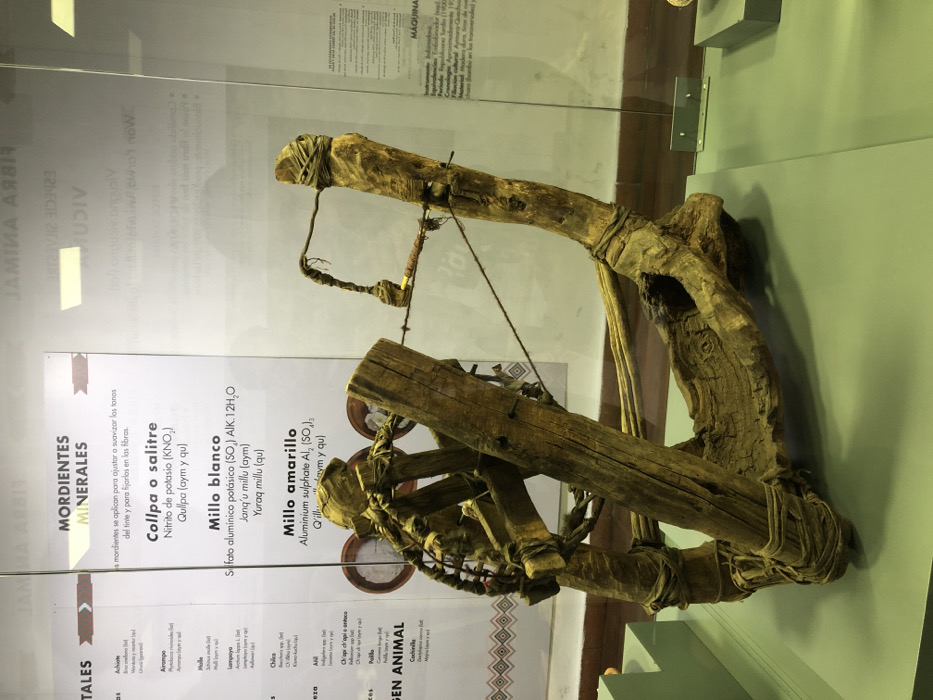
This image captures a static display within a museum setting in La Paz, Bolivia. The central subject is a large, weathered wooden structure, likely an antique or traditional tool, exhibited behind a glass barrier. The object itself is composed of thick, gnarled pieces of dark, aged wood, possibly branches or logs, which are lashed together with natural fibers or strips of cloth. Its construction suggests a functional, possibly handmade, piece of equipment, perhaps related to textile production like a loom or a fiber-processing device, or an agricultural implement. Smaller, finer cords and a spindle-like element are also visible, intricately woven into the main wooden framework. The overall appearance conveys a sense of history and traditional craftsmanship. No people or direct activity are visible, emphasizing the object's presentation as an artifact. The setting is clearly an indoor exhibit, characterized by the protective glass case and informational signage in the background. The wall behind the exhibit is a light green color. Notable details include the rustic texture and dark hue of the wood, indicating its age and the natural materials used in its construction. The lighting is typical of a museum, with reflections visible on the glass. The image is oriented sideways, with the object appearing vertically. Visible text on the informational panels, predominantly in Spanish, provides context. A prominent heading reads "MORDIENTES MINERALES" (Mineral Mordants). Below this, various substances are listed, including "Collpa o salitre" (Potassium nitrate, KNO3), "Millo blanco" (Potassium aluminum sulfate, (SO4) AlK. 12H2O), and "Millo amarillo" (Aluminum sulphate, Al2(SO4)3), along with their Quechua/Aymara equivalents. A description states that "mordants are applied to adjust and soften the dye tones and to fix them in the fibers," indicating the exhibit's theme is traditional dyeing processes. Other visible fragments include "FIBRA ANIMAL" (Animal Fiber), "MAQUINA" (Machine), and "Quechua," further linking the object to local cultural practices and material science.
Loading AttnAds…
No transactions found