Stake attention in this memory
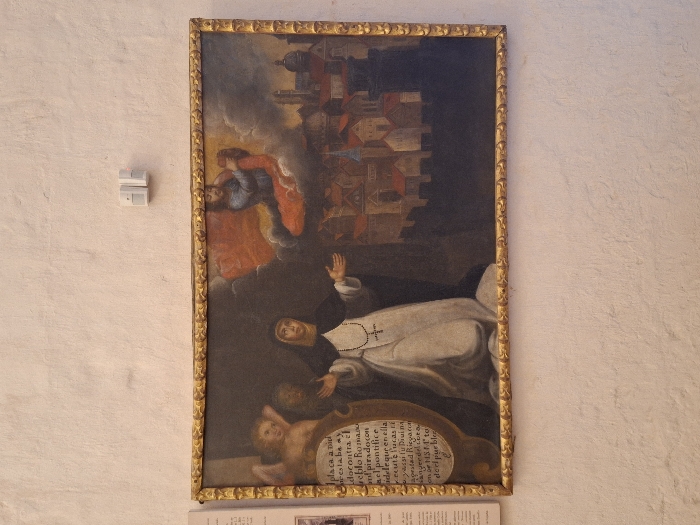
The image presents a vertical painting with an ornate gold frame, mounted on a textured, light-colored wall. The painting itself depicts a dramatic religious scene, likely an oil on canvas, characterized by a dark and muted color palette. In the foreground of the painting, a figure, likely a monk or nun, is shown kneeling or lying down, dressed in a white habit with a black scapular or cowl, and wearing a rosary with a crucifix around their neck. Their right arm is raised in a gesture of supplication or prayer, and their face conveys an expression of devotion or distress. To the lower left of this figure, a winged putto or cherub is depicted near a scroll or tablet. This scroll bears an inscription in what appears to be Old Spanish or Latin. Partially legible phrases from the OCR include "placa a vid," "cestaba ay," "docontra ef," "eblo Romano," "fpiradocon," "el pontifice," "delequr en ella," "route lucas LE," "yassi l'iu Diuina," and "doel puebles," suggesting an explanatory text or a prayer related to the scene. The middle and background of the painting portray a city or fortified town engulfed in turmoil. Dark, billowing smoke or clouds rise dramatically from the buildings. Within these smoky clouds, two figures are visible: one cloaked in red and blue garments, possibly a saint or an angel, interacting with or assisting another figure, suggesting a moment of divine intervention amidst a disaster. The city itself features numerous buildings, roofs, and towers, indicative of an older European or colonial architectural style, appearing to be under siege or experiencing a catastrophic event like a fire. The wall on which the painting hangs has a rough, stucco-like texture. To the left of the painting, a small, light-colored rectangular object, possibly an electrical outlet or sensor, is visible on the wall. Below the painting, a small portion of a printed document or label is present, though its text is mostly unreadable. The overall setting suggests the painting is displayed in a historical or institutional context, possibly a museum, church, or monastery. The image itself is slightly tilted to the right.
No transactions found