Sign in
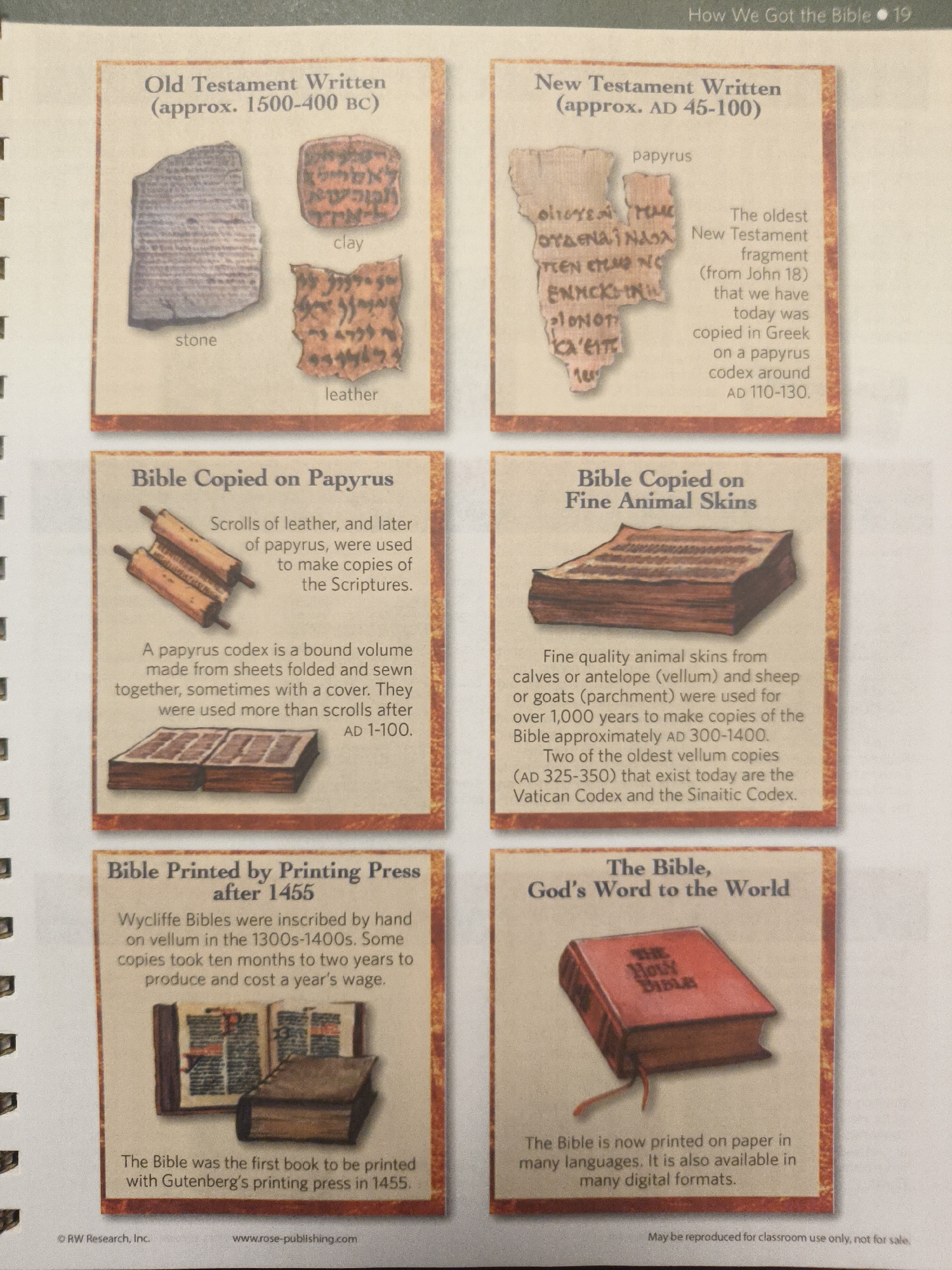
The image is a page from a book or educational material that discusses the history of the Bible. It is divided into six sections, each with a heading, an illustration, and accompanying text.

The top left section, "Old Testament Written (approx. 1500-400 BC)," shows images of stone, clay, and leather with ancient writing.
The top right section, "New Testament Written (approx. AD 45-100)," displays a fragment of papyrus with writing and text explaining it as the oldest New Testament fragment.
The middle left section, "Bible Copied on Papyrus," features an illustration of two scrolls and a codex, with text describing the use of papyrus for copying scriptures and the development of the codex format.
The middle right section, "Bible Copied on Fine Animal Skins," shows an illustration of a vellum codex and text discussing the use of animal skins for making Bible copies and mentioning the Vatican Codex and Sinaitic Codex.
The bottom left section, "Bible Printed by Printing Press after 1455," includes an image of an open book and a closed book, with text about Wycliffe Bibles and the first Bible printed by Gutenberg.
The bottom right section, "The Bible, God's Word to the World," presents an image of a red Bible and text stating that the Bible is now printed on paper in many languages and available in digital formats.

The page has a numbered header "How We Got the Bible • 19" at the top. At the bottom, there are copyright and website information: "© RW Research, Inc." and "www.rose-publishing.com". There is also a disclaimer at the very bottom: "May be reproduced for classroom use only, not for sale."

There is no information in this image that relates to the city of Kuta Selatan, Indonesia.
Richard

Jun 16, 2026, 8:16 PM

Kuta Selatan, Indonesia

Stake attention in this memory

historical
educational
informative
religious
ancient

The image is a page from a book or educational material that discusses the history of the Bible. It is divided into six sections, each with a heading, an illustration, and accompanying text. The top left section, "Old Testament Written (approx. 1500-400 BC)," shows images of stone, clay, and leather with ancient writing. The top right section, "New Testament Written (approx. AD 45-100)," displays a fragment of papyrus with writing and text explaining it as the oldest New Testament fragment. The middle left section, "Bible Copied on Papyrus," features an illustration of two scrolls and a codex, with text describing the use of papyrus for copying scriptures and the development of the codex format. The middle right section, "Bible Copied on Fine Animal Skins," shows an illustration of a vellum codex and text discussing the use of animal skins for making Bible copies and mentioning the Vatican Codex and Sinaitic Codex. The bottom left section, "Bible Printed by Printing Press after 1455," includes an image of an open book and a closed book, with text about Wycliffe Bibles and the first Bible printed by Gutenberg. The bottom right section, "The Bible, God's Word to the World," presents an image of a red Bible and text stating that the Bible is now printed on paper in many languages and available in digital formats. The page has a numbered header "How We Got the Bible • 19" at the top. At the bottom, there are copyright and website information: "© RW Research, Inc." and "www.rose-publishing.com". There is also a disclaimer at the very bottom: "May be reproduced for classroom use only, not for sale." There is no information in this image that relates to the city of Kuta Selatan, Indonesia.

Loading AttnAds…

transactions
revenues
stakers
Earliest
Latest
Highest stake

No transactions found

More from this user

More from Kuta Selatan

Richard

Jun 16, 2026, 8:16 PM

Kuta Selatan, Indonesia

Licensed under Creative Commons Attribution 4.0 International License. You are free to share and adapt this content with proper attribution.