Sign in
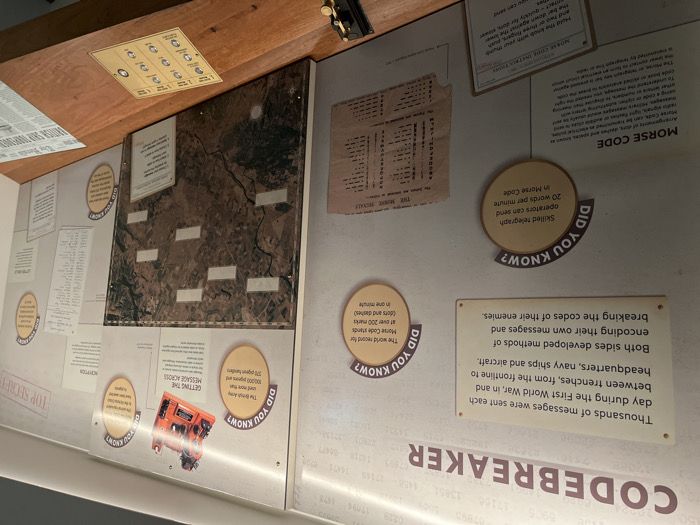
This image captures an indoor exhibition display, likely in a museum in South Brisbane, Australia, focusing on historical communication and code-breaking. The scene features various panels, text placards, and interactive elements.

Key objects include a large aerial map with rectangular overlays, possibly indicating strategic locations or message routes. Several circular "Did You Know?" signs are interspersed, along with larger rectangular text panels. A device resembling an antique radio or telegraph key is visible near a "GETTING THE MESSAGE ACROSS" panel. The overall setting is a well-lit museum wall, with some elements appearing on a wooden surface.

The activity depicted is an informative exhibit, presenting historical facts and mechanisms related to communication during wartime. No people are visible, but the display is designed for visitor engagement.

Notable details include text that is oriented at various angles, including sideways and upside down, due to the photograph's perspective. The display features a "CODEBREAKER" section with a numerical sequence background, and detailed explanations of "MORSE CODE," including "MORSE CODE INSTRUCTIONS."

Visible text includes:
*   "CODEBREAKER" as a large heading.
*   "Thousands of messages were sent each day during the First World War, in and between trenches, from the frontline to headquarters, navy ships and aircraft. Both sides developed methods of encoding their own messages and breaking the codes of their enemies."
*   "DID YOU KNOW?" circles stating: "The world record for Morse Code stands at over 200 marks (dots and dashes) in one minute" and "Skilled telegraph operators can send 20 words per minute in Morse Code." Another partially visible one mentions "The British Army used more than 100,000 pigeons and 50,000 pigeon handlers."
*   Sections on "MORSE CODE" explaining arrangements of dots and dashes, and "MORSE CODE INSTRUCTIONS" on how to operate a telegraph key.
*   A "TOP SECRET" folder graphic.
*   Numerical sequences like "67893 5004" and "13851 4458 17149 14471," possibly examples of coded messages.
FM-VfnHd2

Jan 2, 2025

South Brisbane, Australia

Stake attention in this memory

This image captures an indoor exhibition display, likely in a museum in South Brisbane, Australia, focusing on historical communication and code-breaking. The scene features various panels, text placards, and interactive elements. Key objects include a large aerial map with rectangular overlays, possibly indicating strategic locations or message routes. Several circular "Did You Know?" signs are interspersed, along with larger rectangular text panels. A device resembling an antique radio or telegraph key is visible near a "GETTING THE MESSAGE ACROSS" panel. The overall setting is a well-lit museum wall, with some elements appearing on a wooden surface. The activity depicted is an informative exhibit, presenting historical facts and mechanisms related to communication during wartime. No people are visible, but the display is designed for visitor engagement. Notable details include text that is oriented at various angles, including sideways and upside down, due to the photograph's perspective. The display features a "CODEBREAKER" section with a numerical sequence background, and detailed explanations of "MORSE CODE," including "MORSE CODE INSTRUCTIONS." Visible text includes: * "CODEBREAKER" as a large heading. * "Thousands of messages were sent each day during the First World War, in and between trenches, from the frontline to headquarters, navy ships and aircraft. Both sides developed methods of encoding their own messages and breaking the codes of their enemies." * "DID YOU KNOW?" circles stating: "The world record for Morse Code stands at over 200 marks (dots and dashes) in one minute" and "Skilled telegraph operators can send 20 words per minute in Morse Code." Another partially visible one mentions "The British Army used more than 100,000 pigeons and 50,000 pigeon handlers." * Sections on "MORSE CODE" explaining arrangements of dots and dashes, and "MORSE CODE INSTRUCTIONS" on how to operate a telegraph key. * A "TOP SECRET" folder graphic. * Numerical sequences like "67893 5004" and "13851 4458 17149 14471," possibly examples of coded messages.

transactions
revenues
stakers
Earliest
Latest
Highest stake

No transactions found

More from this user

More from South Brisbane

FM-VfnHd2

Jan 2, 2025

South Brisbane, Australia

Licensed under Creative Commons Attribution 4.0 International License. You are free to share and adapt this content with proper attribution.